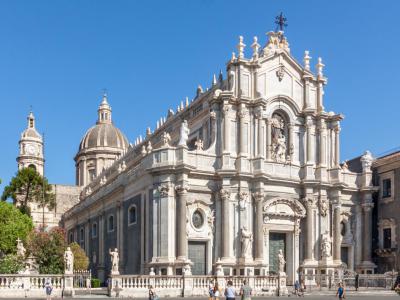


Cathedral of Catania, Catania (must see)
Catania Cathedral, officially the Cathedral of Saint Agatha, stands as both the city’s main religious landmark and a witness to centuries of upheaval. The site has been sacred since the Norman period, when the first cathedral was completed in the 11th century. Repeated earthquakes and eruptions from Mount Etna caused extensive damage, most dramatically in 1169 and in the catastrophic earthquake of 1693. Rather than erasing its past, each reconstruction added another layer.
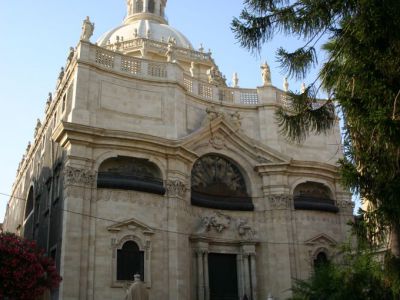
The present building is a refined example of Sicilian Baroque, shaped largely in the early 18th century. The façade, designed by Giovanni Battista Vaccarini after 1693, rises in three tiers articulated by columns and niches, with pale limestone set against darker volcanic stone. The broad parvis is edged by a white stone balustrade and lined with Carrara marble statues of saints. The central wooden door is carved with panels illustrating episodes from the life of Saint Agatha. The dome was completed in the early 19th century and the bell tower rebuilt following earlier collapses.
Inside, the cathedral follows a Latin cross plan with three naves. The austere rhythm of columns leads toward an apse that dates back to the 12th century, preserving traces of the medieval structure. Several chapels punctuate the interior, including the Chapel of the Holy Crucifix in the north transept. The cathedral also houses, close to the right transept, the tomb of Vincenzo Bellini, Catania’s most celebrated composer, as well as the burial places of King Frederick III of Sicily, John of Randazzo, and Constance of Aragon.
Saint Agatha herself remains central to the cathedral’s meaning. According to tradition, she was a young noblewoman who refused the advances of the Roman prefect Quintianus and was martyred in the 3rd century. Local belief holds that she continues to protect Catania from enemies, injustice, and even Mount Etna. This faith is captured in the letters carved into the façade: N.O.P.A.Q.V.I.E., an acronym of a Latin phrase affirming that Agatha avenges wrongs committed against her land.
The present building is a refined example of Sicilian Baroque, shaped largely in the early 18th century. The façade, designed by Giovanni Battista Vaccarini after 1693, rises in three tiers articulated by columns and niches, with pale limestone set against darker volcanic stone. The broad parvis is edged by a white stone balustrade and lined with Carrara marble statues of saints. The central wooden door is carved with panels illustrating episodes from the life of Saint Agatha. The dome was completed in the early 19th century and the bell tower rebuilt following earlier collapses.
Inside, the cathedral follows a Latin cross plan with three naves. The austere rhythm of columns leads toward an apse that dates back to the 12th century, preserving traces of the medieval structure. Several chapels punctuate the interior, including the Chapel of the Holy Crucifix in the north transept. The cathedral also houses, close to the right transept, the tomb of Vincenzo Bellini, Catania’s most celebrated composer, as well as the burial places of King Frederick III of Sicily, John of Randazzo, and Constance of Aragon.
Saint Agatha herself remains central to the cathedral’s meaning. According to tradition, she was a young noblewoman who refused the advances of the Roman prefect Quintianus and was martyred in the 3rd century. Local belief holds that she continues to protect Catania from enemies, injustice, and even Mount Etna. This faith is captured in the letters carved into the façade: N.O.P.A.Q.V.I.E., an acronym of a Latin phrase affirming that Agatha avenges wrongs committed against her land.
Want to visit this sight? Check out these Self-Guided Walking Tours in Catania. Alternatively, you can download the mobile app "GPSmyCity: Walks in 1K+ Cities" from Apple App Store or Google Play Store. The app turns your mobile device to a personal tour guide and it works offline, so no data plan is needed when traveling abroad.
Download The GPSmyCity App



Cathedral of Catania on Map
Sight Name: Cathedral of Catania
Sight Location: Catania, Italy (See walking tours in Catania)
Sight Type: Religious
Guide(s) Containing This Sight:
Sight Location: Catania, Italy (See walking tours in Catania)
Sight Type: Religious
Guide(s) Containing This Sight:
Nearby Sights
Walking Tours in Catania, Italy

Create Your Own Walk in Catania
Creating your own self-guided walk in Catania is easy and fun. Choose the city attractions that you want to see and a walk route map will be created just for you. You can even set your hotel as the start point of the walk.
A Walk Through Catania’s Baroque Old Town
Most cities avoid danger. But here, the danger is part of the experience. Catania settled beside a volcano and stayed. Lava flows, earthquakes, and ash are a living memory here, shaping everything from building materials to local legends.
Catania is one of Sicily’s oldest cities, with a history shaped by colonization, conquest, natural disaster, and repeated renewal. It was founded in 729 BC... view more
Tour Duration: 2 Hours
Travel Distance: 3.8 Km or 2.4 Miles
Catania is one of Sicily’s oldest cities, with a history shaped by colonization, conquest, natural disaster, and repeated renewal. It was founded in 729 BC... view more
Tour Duration: 2 Hours
Travel Distance: 3.8 Km or 2.4 Miles
Discover Catania's Historical Churches on Foot
Just as many other Italian destinations, the Sicilian city of Catania is full of churches, especially in the historic center, where the presence of religious sites is particularly high! A good number of local churches date back centuries, and as such represent marvelous pieces of architecture, adding much character to the area. It is also commonplace to find inside most of them, be it a duomo,... view more
Tour Duration: 1 Hour
Travel Distance: 1.6 Km or 1 Miles
Tour Duration: 1 Hour
Travel Distance: 1.6 Km or 1 Miles