

Historical Churches Walking Tour, Catania

Historical Churches Walking Tour (Self Guided), Catania

Just as many other Italian destinations, the Sicilian city of Catania is full of churches, especially in the historic center, where the presence of religious sites is particularly high! A good number of local churches date back centuries, and as such represent marvelous pieces of architecture, adding much character to the area. It is also commonplace to find inside most of them, be it a duomo, basilica, chiesa or cattedrale, at least one spectacular piece of art amid the rich decorations of gold, bronze and marble.

All the “older” churches of Catania – styled Baroque – emerged in the 18th century. The reason for that is simple, as the history of the city is split between “before” and “after” the earthquake of January 9, 1693 which saw Catania largely destroyed. Here are some of the most impressive local churches built since:

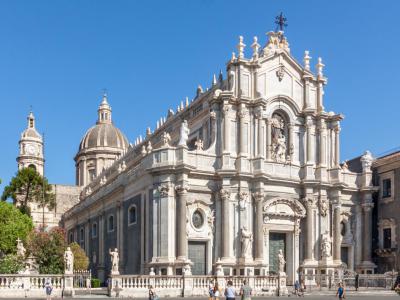
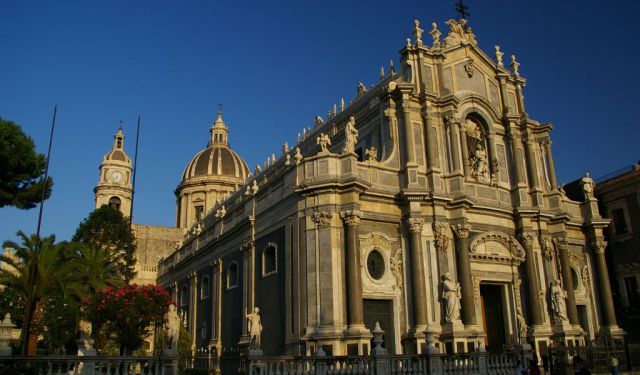
The Cathedral of Catania – aka Saint Agatha’s Cathedral, named after the “Santuzza” protector of the city; the massive structure shows a characteristic contrast between the gray and white marble used for decorations.

The Abbey of Saint Agata – right next to the Cathedral, completed in 1735 and regarded as a jewel of Sicilian Baroque; the masterpiece of the architect Giovanni Battista Vaccarini, designer of the post-earthquake Catania.

The San Giuliano Church – seen by many as the “pearl” of the city’s 18th-century reconstruction.

The Monastery of St. Nicholas Arena – one of the largest churches in Sicily, with a long and troubled history, predating the 1693 earthquake.

To explore these and other historic places of worship in Catania in more detail, take this self-guided walking tour.
How it works: Download the app "GPSmyCity: Walks in 1K+ Cities" from Apple App Store or Google Play Store to your mobile phone or tablet. The app turns your mobile device into a personal tour guide and its built-in GPS navigation functions guide you from one tour stop to next. The app works offline, so no data plan is needed when traveling abroad.

Download The GPSmyCity App

Historical Churches Walking Tour Map

Guide Name: Historical Churches Walking Tour
Guide Location: Italy » Catania (See other walking tours in Catania)
Guide Type: Self-guided Walking Tour (Sightseeing)
# of Attractions: 7
Tour Duration: 1 Hour(s)
Travel Distance: 1.6 Km or 1 Miles
Author: vickyc
Sight(s) Featured in This Guide:
  • Cathedral of Catania
  • Badia di Sant'Agata (Church of the Abbey of Saint Agata)
  • Chiesa San Benedetto (Church of St. Benedict)
  • San Francesco Borgia (Church of Saint Francis Borgia)
  • Chiesa di San Giuliano (Church of San Giuliano)
  • Monastery of St. Nicholas Arena
  • Santuario di Santa Maria dell'Aiuto (Church of Santa Maria dell'Aiuto)
1
Cathedral of Catania

1) Cathedral of Catania (must see)

Catania Cathedral, officially the Cathedral of Saint Agatha, stands as both the city’s main religious landmark and a witness to centuries of upheaval. The site has been sacred since the Norman period, when the first cathedral was completed in the 11th century. Repeated earthquakes and eruptions from Mount Etna caused extensive damage, most dramatically in 1169 and in the catastrophic earthquake of 1693. Rather than erasing its past, each reconstruction added another layer.

The present building is a refined example of Sicilian Baroque, shaped largely in the early 18th century. The façade, designed by Giovanni Battista Vaccarini after 1693, rises in three tiers articulated by columns and niches, with pale limestone set against darker volcanic stone. The broad parvis is edged by a white stone balustrade and lined with Carrara marble statues of saints. The central wooden door is carved with panels illustrating episodes from the life of Saint Agatha. The dome was completed in the early 19th century and the bell tower rebuilt following earlier collapses.

Inside, the cathedral follows a Latin cross plan with three naves. The austere rhythm of columns leads toward an apse that dates back to the 12th century, preserving traces of the medieval structure. Several chapels punctuate the interior, including the Chapel of the Holy Crucifix in the north transept. The cathedral also houses, close to the right transept, the tomb of Vincenzo Bellini, Catania’s most celebrated composer, as well as the burial places of King Frederick III of Sicily, John of Randazzo, and Constance of Aragon.

Saint Agatha herself remains central to the cathedral’s meaning. According to tradition, she was a young noblewoman who refused the advances of the Roman prefect Quintianus and was martyred in the 3rd century. Local belief holds that she continues to protect Catania from enemies, injustice, and even Mount Etna. This faith is captured in the letters carved into the façade: N.O.P.A.Q.V.I.E., an acronym of a Latin phrase affirming that Agatha avenges wrongs committed against her land.
2
Badia di Sant'Agata (Church of the Abbey of Saint Agata)

2) Badia di Sant'Agata (Church of the Abbey of Saint Agata)

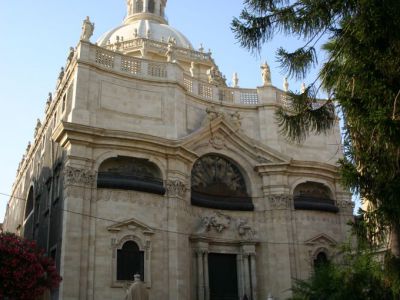
The Church of the Abbey of Saint Agatha (Badia di Sant'Agata), a masterpiece of 18th-century Baroque architecture, stands prominently in Catania, Italy, across the street from the left transept of the city’s cathedral. This Roman Catholic church, part of a female Benedictine convent, is dedicated to Saint Agatha, the patron saint of Catania, and embodies a rich history intertwined with resilience and devotion.

The nunnery was originally founded in 1620 under the Benedictine rule. However, the devastating 1693 earthquake destroyed the convent, claiming the lives of 15 of its 28 nuns. Reconstruction efforts began modestly with cloisters and a perimeter fence, but the ambitious rebuilding of the church itself only commenced in 1736 under the architect Giovanni Battista Vaccarini. His design incorporated a surviving 17th-century portal by Giovanni Maria Amato, preserving a tangible link to the pre-earthquake structure.

The church’s façade, completed by 1742, exudes Baroque elegance, while the octagonal dome, finished in 1768, offers panoramic views of Catania and the imposing Mount Etna. The elongated octagonal interior features a harmonious blend of white marble flooring and yellow Castronovo marble, handpicked by the architect Nicolò Daniele. A metal grill behind the main altar enables the cloistered nuns to observe mass discreetly, while a glass chandelier hangs beneath the dome, adding a touch of grandeur.

The side altars house stucco statues crafted in 1782 by Giovanni Battista Marino, Mario Biondo, and Giovanni Battista Amato, depicting Saint Benedict, the Immaculate Conception, Saint Joseph, and Saint Euplio. The centerpiece of the main altar is a striking statue of Saint Agatha, a fitting tribute to the saint to whom the church is dedicated.

The church was consecrated in 1796, marking its completion as a spiritual and architectural triumph. Over the centuries, the structure endured additional challenges, including earthquake damage in 1990. A comprehensive restoration completed in 2012 ensured its preservation for future generations.
3
Chiesa San Benedetto (Church of St. Benedict)

3) Chiesa San Benedetto (Church of St. Benedict)

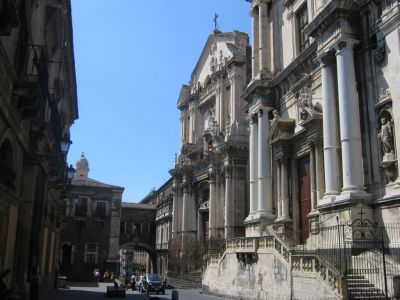
In 1334 the Church of Saint Benedict of Nursia was completed. In 1693, like most of Catania, the church was destroyed by the great earthquake. Only five nuns lived to tell the tale. In 1714 the church was rebuilt but the monastery was not finished until 1763. Rebuilding was mainly the the work of architect Giovanni Battista Vaccarini.

The facade has pilasters and several statues. The pediment of the tympanum has two feminine figures representing Fortitude and Temperence. Above the entrance is a statue of the Virgin Mary. The wooden main door has panels showing scenes from the life of Saint Benedict. The marble Angel Staircase has angels and railings of wrought iron.

The interior has one nave. It is lushly adorned with stucco and frescoes on the walls, vault and semi-dome. Artists include Matteo Desiderato and Giovanni Tuccari. Pictures of the life of Saint Benedict are everywhere in scenes both lively and cheerful. The main altar is of polychrome marble with panels of bronze.
4
San Francesco Borgia (Church of Saint Francis Borgia)

4) San Francesco Borgia (Church of Saint Francis Borgia)

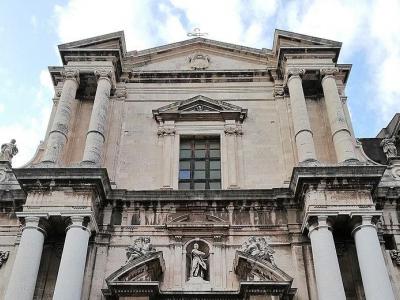
The Church of Saint Francis Borgia in Catania is a former Jesuit church now repurposed as a cultural venue under the administration of the Regional Superintendence of Cultural Heritage. Located adjacent to the Collegio Gesuita and parallel to the Church of San Benedetto, this deconsecrated church is notable for its Jesuit heritage and the preservation of much of its original artwork.

The church’s facade exemplifies classical design, adorned with five statues of Jesuit saints. Central to this arrangement is a statue of the titular Saint Francis Borgia positioned above the portal. Flanking him are Ignatius Loyola and Francis Xavier on the lower level, with Aloysius Gonzaga and Stanislaus Kostka depicted on the upper tier. This sculptural ensemble underscores the Jesuit influence on the church's identity.

The church's Latin cross layout features a central nave and two aisles lined with chapels. Completed in 1740, its interior boasts frescoes, altarpieces, and sculptures. Highlights include the first altar on the right, depicting the Vision of Madonna and Child to San Giovanni Francesco Regis; the second altar, showing Saints Stanislaus Kostka and Aloysius Gonzaga; and the main altar, adorned with polychrome marble and sculptures by Giovanni Battista Marino. At its center is a 1567 copy of the Madonna of the Snow (Madonna della Neve), gifted by Saint Francis Borgia.

The dome’s base is adorned with statues of the four Evangelists, complementing frescoes that celebrate the Triumph of Saint Ignatius and the Jesuits over heresy. The apse features trompe-l'œil painted curtains, adding to the grandeur of the space. On the left altars, notable artworks include depictions of Saint Agatha visited in jail and the Glory of Saint Joseph, further enriching the church's artistic legacy.

Although no longer serving as a place of worship, the Church of Saint Francis Borgia remains an important cultural and historical landmark in Catania, hosting exhibits and events that continue to draw attention to its artistic and architectural significance.
5
Chiesa di San Giuliano (Church of San Giuliano)

5) Chiesa di San Giuliano (Church of San Giuliano)

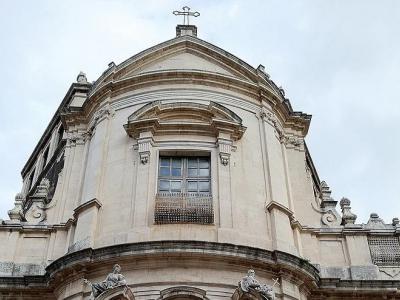
The Church of San Giuliano in Catania is a remarkable testament to the city’s architectural and spiritual heritage, earning its reputation as one of the most beautiful places of worship in the area. This late-Baroque masterpiece was built between 1739 and 1751 on the ruins of an older church destroyed by the devastating 1693 earthquake. The design was entrusted to Giuseppe Palazzotto and Vincenzo Caffarelli, who created a space dedicated to Saint Julian the Hospitaller.

The church’s convex façade is an elaborate and captivating feature. Its upper-story windows, shielded by a dense iron grate, allowed the Benedictine nuns from the adjacent convent to discreetly observe the vibrant Sant’Agata processions. Above the façade, a striking pediment features a reclining maiden sculpted by Gaspare Ciriaci, adding a touch of elegance and mystique. The entrance door is adorned with the cross of the Order of the Holy Sepulchre, a nod to the order’s restoration of the church after 1939.

The interior is no less impressive. Shaped as an elongated asymmetric octagon, the nave boasts a main altar and four minor altars, each rich in detail and devotion. The main altar, a polychrome marvel, was designed by Giovanni Battista Vaccarini and sculpted by Giovanni Battista Marino, featuring allegorical statuettes of Faith and Charity alongside a painted cross.

The crowning glory of the interior is the cupola fresco painted by Giuseppe Rapisardi in 1842, depicting God the Father and Saint Peter, a work that fills the space with divine radiance.

Visiting the Church of San Giuliano offers a glimpse into the profound artistry and religious devotion that shaped Catania’s post-earthquake resurgence. It’s a place where history, art, and faith converge in a symphony of Baroque splendor.
6
Monastery of St. Nicholas Arena

6) Monastery of St. Nicholas Arena (must see)

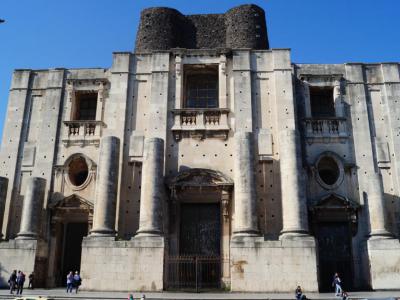
The Monastery of Saint Nicholas Arena is one of the largest Benedictine monasteries in Europe. Founded in 1558, it was established by Benedictine monks whose wealth and noble origins earned the monastery the reputation of being a true “palace for monks”. The name “Arena” does not refer to a Roman amphitheater, but to the red volcanic sand characteristic of the area on the slopes of Mount Etna where the order first settled before moving into the city.

The monastery’s survival through natural disaster is central to its story. During the 1669 eruption of Mount Etna, lava flows reached the complex but did not destroy it; the monks constructed a massive stone bulwark that successfully diverted the lava. The eruption instead raised the ground level around the monastery and reshaped the surrounding landscape. It was the catastrophic earthquake of 1693, not the lava, that flattened much of the structure. Reconstruction began in 1702, with the new monastery built directly over what remained of the earlier complex.

Much of the monastery’s distinctive late-Baroque character, especially the ornate window frames and exuberant southern façade, was shaped by Antonino Amato and Francesco Battaglia. The complex expanded with new cloisters, including the rebuilt Marble Cloister and the newly added Eastern Cloister, complemented by long corridors, staircases, and even a hanging garden. Subterranean spaces preserve visible traces of the 1669 lava flow pressed directly against the monastery walls.

Beside the monastery stands the vast Church of San Nicolò l’Arena, the largest church in Sicily, whose unfinished façade and columns reflect financial strain and political upheaval during the 19th century. Today, as part of the University of Catania and a UNESCO World Heritage Site, the monastery stands as a world-class example of adaptive reuse.
7
Santuario di Santa Maria dell'Aiuto (Church of Santa Maria dell'Aiuto)

7) Santuario di Santa Maria dell'Aiuto (Church of Santa Maria dell'Aiuto)

The Church of Santa Maria dell’Aiuto is a 17th-century religious landmark in Catania. This sanctuary is celebrated for housing a reproduction of the Holy House of Loreto, making it an important site for religious tourism.

The church originated as a medieval chapel dedicated to Saints Peter and Paul. In 1372, it gained prominence with the veneration of the miraculous Madonna dell’Aiuto icon. Transferred here in 1641 to accommodate growing crowds, the current church was rebuilt after the 1693 earthquake by architect Antonino Battaglia.

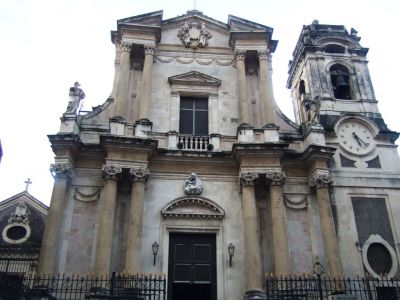
The Church of Santa Maria dell’Aiuto showcases Battaglia's style with a single nave leading to a deep presbytery framed by a triumphal arch. Its 19th-century façade features two orders of Corinthian columns, statues of Saints Peter and Paul, and a tympanum with Mary’s monogram surrounded by marble angels. A shield above the entrance depicts the Madonna dell’Aiuto, while a clock-equipped bell tower enhances the right side.

Inside, golden stucco, Marian symbols, and writings adorn the space, with four side altars dedicated to San Francesco de Sales, the Crucifix, Saints Peter and Paul, and a replica of Sant’Agata’s martyrdom by Filippo Paladini.

In the 1740s, a small-scale reproduction of the Holy House of Loreto was added by Canon Giuseppe Lauria, reflecting deep local devotion. The main altar enshrines the Madonna dell’Aiuto icon, which survived the 1693 earthquake. While it has been repainted over time, it remains the focal point of veneration. The altar itself is a masterpiece of colored marble and slender columns, crowned by a dynamic marble representation of the Eternal Father surrounded by angels.

Walking Tours in Catania, Italy

Create Your Own Walk in Catania

Create Your Own Walk in Catania

Creating your own self-guided walk in Catania is easy and fun. Choose the city attractions that you want to see and a walk route map will be created just for you. You can even set your hotel as the start point of the walk.
Catania Introduction Walking Tour

Catania Introduction Walking Tour

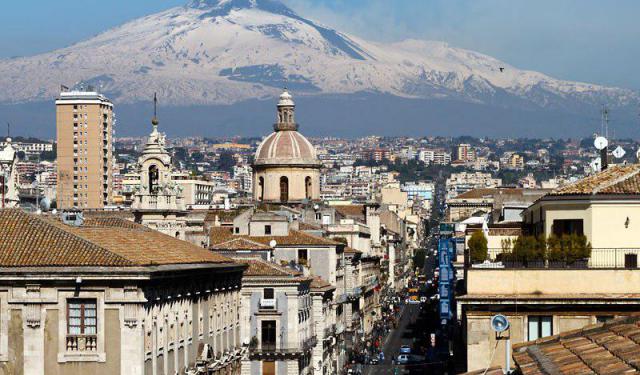
Most cities avoid danger. But here, the danger is part of the experience. Catania settled beside a volcano and stayed. Lava flows, earthquakes, and ash are a living memory here, shaping everything from building materials to local legends.

Catania is one of Sicily’s oldest cities, with a history shaped by colonization, conquest, natural disaster, and repeated renewal. It was founded in 729 BC...  view more

Tour Duration: 2 Hour(s)
Travel Distance: 3.8 Km or 2.4 Miles