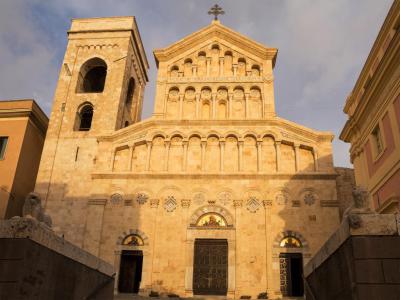


Cattedrale di Santa Maria Assunta e Santa Cecilia (Cathedral of Cagliari), Cagliari (must see)
The Cathedral of Saint Mary of the Assumption and Saint Cecilia is the main religious building in Cagliari, located in the elevated Castello district. Originally built in the 13th century during the Pisan period, the cathedral began as a Romanesque structure, later incorporating Gothic and Baroque elements as it was expanded and redesigned over time. Its current façade, reconstructed in the 20th century, reflects a return to its earlier Pisan-inspired appearance, giving the building a clean and balanced exterior.
As you approach the cathedral, you can notice its position within the Castello district, slightly elevated above the surrounding streets. The façade, with its pale stone and layered detailing, stands out against the surrounding buildings. This area also offers occasional views over parts of the city, reinforcing the cathedral’s role as both a religious and visual landmark within Cagliari.
Step inside and take a moment near the entrance, where you can find the cathedral’s main highlight: the ambo (also called a pulpit). This 12th-century work, originally created for the Cathedral of Pisa, was brought to Cagliari in 1312 and later divided into two separate pulpits in the 17th century. As you look at them, you can notice the detailed marble carvings depicting scenes from the New Testament. The original structure was supported by four marble lions, which you can now see placed at the base of the presbytery balustrade. As you continue along the central nave, the richly decorated Baroque interior opens up, with marble surfaces, side chapels, and sculptural details leading your attention toward the main altar, distinguished by its use of polychrome marble and layered design.
If you continue exploring, you can also find several notable artworks and monuments throughout the cathedral. Among them is a 15th-century Flemish triptych, often associated with the early Netherlandish painter Rogier van der Weyden, as well as the Baroque funerary monument of Archbishop Bernardo de La Cabra. In the left transept, there is a 14th-century chapel and the mausoleum of Martin I of Sicily.
Descending below the cathedral, you reach the Sanctuary of the Martyrs, part of the crypt, where 179 niches hold relics discovered in the 17th century near the Basilica of San Saturnino. The sanctuary is arranged into three chapels with rich Baroque decoration, offering a more enclosed and atmospheric contrast to the space above.
As you approach the cathedral, you can notice its position within the Castello district, slightly elevated above the surrounding streets. The façade, with its pale stone and layered detailing, stands out against the surrounding buildings. This area also offers occasional views over parts of the city, reinforcing the cathedral’s role as both a religious and visual landmark within Cagliari.
Step inside and take a moment near the entrance, where you can find the cathedral’s main highlight: the ambo (also called a pulpit). This 12th-century work, originally created for the Cathedral of Pisa, was brought to Cagliari in 1312 and later divided into two separate pulpits in the 17th century. As you look at them, you can notice the detailed marble carvings depicting scenes from the New Testament. The original structure was supported by four marble lions, which you can now see placed at the base of the presbytery balustrade. As you continue along the central nave, the richly decorated Baroque interior opens up, with marble surfaces, side chapels, and sculptural details leading your attention toward the main altar, distinguished by its use of polychrome marble and layered design.
If you continue exploring, you can also find several notable artworks and monuments throughout the cathedral. Among them is a 15th-century Flemish triptych, often associated with the early Netherlandish painter Rogier van der Weyden, as well as the Baroque funerary monument of Archbishop Bernardo de La Cabra. In the left transept, there is a 14th-century chapel and the mausoleum of Martin I of Sicily.
Descending below the cathedral, you reach the Sanctuary of the Martyrs, part of the crypt, where 179 niches hold relics discovered in the 17th century near the Basilica of San Saturnino. The sanctuary is arranged into three chapels with rich Baroque decoration, offering a more enclosed and atmospheric contrast to the space above.
Want to visit this sight? Check out these Self-Guided Walking Tours in Cagliari. Alternatively, you can download the mobile app "GPSmyCity: Walks in 1K+ Cities" from Apple App Store or Google Play Store. The app turns your mobile device to a personal tour guide and it works offline, so no data plan is needed when traveling abroad.
Download The GPSmyCity App



Cattedrale di Santa Maria Assunta e Santa Cecilia (Cathedral of Cagliari) on Map
Sight Name: Cattedrale di Santa Maria Assunta e Santa Cecilia (Cathedral of Cagliari)
Sight Location: Cagliari, Italy (See walking tours in Cagliari)
Sight Type: Religious
Guide(s) Containing This Sight:
Sight Location: Cagliari, Italy (See walking tours in Cagliari)
Sight Type: Religious
Guide(s) Containing This Sight:
Nearby Sights
Walking Tours in Cagliari, Italy

Create Your Own Walk in Cagliari
Creating your own self-guided walk in Cagliari is easy and fun. Choose the city attractions that you want to see and a walk route map will be created just for you. You can even set your hotel as the start point of the walk.
Cagliari Introduction Walking Tour
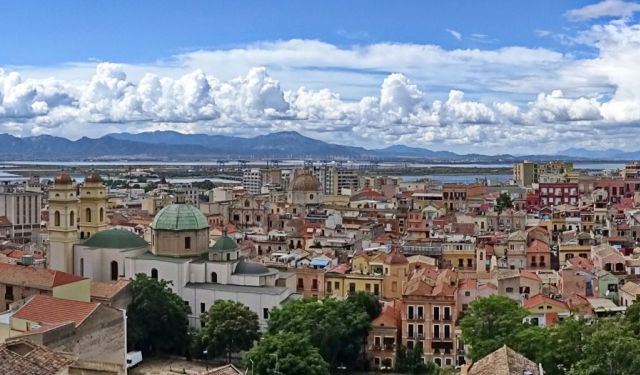
Welcome to Cagliari, Sardinia’s beating heart! Perched along the shimmering Mediterranean, this sun-soeaked city blends centuries-old history with modern charm. With stunning beaches, colorful lagoons, and lush greenery, it’s also a place where natural beauty meets cultural riches.
Cagliari’s story began long before our time. Around the 8th century BC, the Phoenicians founded Karaly as a... view more
Tour Duration: 2 Hour(s)
Travel Distance: 2.9 Km or 1.8 Miles
Cagliari’s story began long before our time. Around the 8th century BC, the Phoenicians founded Karaly as a... view more
Tour Duration: 2 Hour(s)
Travel Distance: 2.9 Km or 1.8 Miles