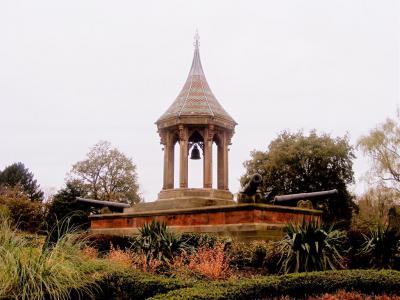


Chinese Pagoda, Nottingham
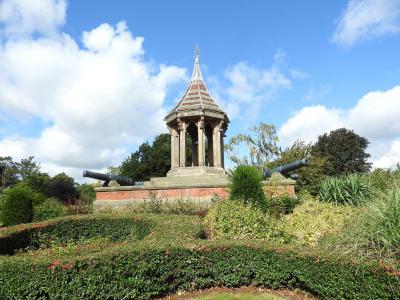
The Chinese Pagoda in Nottingham's Arboretum Park is a striking and historically layered monument built in 1862. Designed by civil engineer Marriott Ogle Tarbotton, it was conceived as a war memorial, blending Victorian commemoration with Eastern architectural influence. This octagonal cupola features traceried brackets, round columns, and a distinctive spire in the Chinese style, standing on a raised rectangular platform edged with inscriptions-some now weathered-and four cannons at each corner. Two of these are originals from the Crimean War, captured at Sebastopol in 1854-55, while the other two are replicas replacing those lost during wartime metal reclamation.
At the heart of the pagoda originally hung a large bronze bell taken from a Joss house (Chinese temple) in Canton-modern-day Guangzhou-during the Second Opium War. It was seized by the 59th Regiment of Foot (later known as the 2nd Nottinghamshire Regiment) when British forces stormed the city on December 20, 1859. The bell, inscribed in Chinese, was gifted to the city as a trophy of empire and suspended in the pagoda until 1955. It was then relocated to the regimental museum in Preston, and the pagoda was partly demolished in 1956.
The pagoda sits within Nottingham Arboretum, the city’s oldest public park, officially opened in 1852 as part of a broader civic movement to create green spaces following the 1845 Enclosure Act. The Arboretum was one of several public areas established for recreation in compensation for lost common lands. Today, the Chinese Pagoda stands not only as a symbol of 19th-century military legacy but also as a curious reminder of imperial histories, blending Eastern aesthetics with Victorian sentiment.
At the heart of the pagoda originally hung a large bronze bell taken from a Joss house (Chinese temple) in Canton-modern-day Guangzhou-during the Second Opium War. It was seized by the 59th Regiment of Foot (later known as the 2nd Nottinghamshire Regiment) when British forces stormed the city on December 20, 1859. The bell, inscribed in Chinese, was gifted to the city as a trophy of empire and suspended in the pagoda until 1955. It was then relocated to the regimental museum in Preston, and the pagoda was partly demolished in 1956.
The pagoda sits within Nottingham Arboretum, the city’s oldest public park, officially opened in 1852 as part of a broader civic movement to create green spaces following the 1845 Enclosure Act. The Arboretum was one of several public areas established for recreation in compensation for lost common lands. Today, the Chinese Pagoda stands not only as a symbol of 19th-century military legacy but also as a curious reminder of imperial histories, blending Eastern aesthetics with Victorian sentiment.
Want to visit this sight? Check out these Self-Guided Walking Tours in Nottingham. Alternatively, you can download the mobile app "GPSmyCity: Walks in 1K+ Cities" from Apple App Store or Google Play Store. The app turns your mobile device to a personal tour guide and it works offline, so no data plan is needed when traveling abroad.
Download The GPSmyCity App



Chinese Pagoda on Map
Sight Name: Chinese Pagoda
Sight Location: Nottingham, England (See walking tours in Nottingham)
Sight Type: Attraction/Landmark
Sight Location: Nottingham, England (See walking tours in Nottingham)
Sight Type: Attraction/Landmark
Nearby Sights



Walking Tours in Nottingham, England

Create Your Own Walk in Nottingham
Creating your own self-guided walk in Nottingham is easy and fun. Choose the city attractions that you want to see and a walk route map will be created just for you. You can even set your hotel as the start point of the walk.

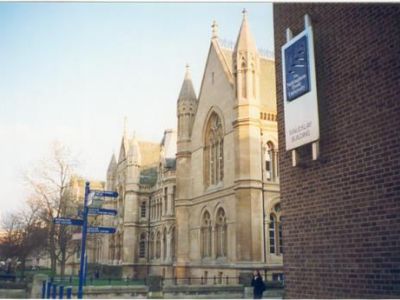
Nottingham's Historical Buildings Tour
Given the variety of architectural styles and designs in Nottingham, England, it is safe to call it the city of contrasts. The tapestry of historical buildings found here, each weaving a unique story of the city's past, is quite rich and worthy of attention.
Among these architectural treasures is the Bell Inn, a charming establishment steeped in history and character. Its traditional... view more
Tour Duration: 2 Hours
Travel Distance: 3.9 Km or 2.4 Miles
Among these architectural treasures is the Bell Inn, a charming establishment steeped in history and character. Its traditional... view more
Tour Duration: 2 Hours
Travel Distance: 3.9 Km or 2.4 Miles

Nottingham's Historic City Center Walking Tour
Nottingham was known only as "The Place of Caves" in 600 AD. A Saxon chief named Snot ruled "Snotingaham", or, "the home of Snot's people." It was part of Danelaw in the 7th century, administered from a stone Hall on High Pavement, the first street of Nottingham.
In 1068 Norman invaders built a wooden motte-and-bailey fortress on a high sandstone promontory.... view more
Tour Duration: 2 Hours
Travel Distance: 2.5 Km or 1.6 Miles
In 1068 Norman invaders built a wooden motte-and-bailey fortress on a high sandstone promontory.... view more
Tour Duration: 2 Hours
Travel Distance: 2.5 Km or 1.6 Miles
Robin Hood Trail
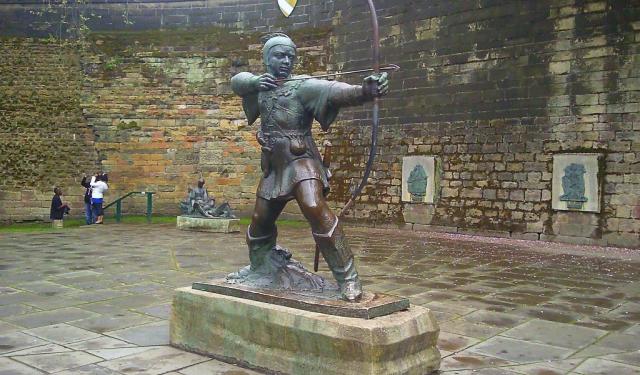
There's hardly anyone on this planet who hasn't heard of Robin Hood. Apparently, a Saxon nobleman born in 1160 in Loxley, this hero of numerous ballads, some dating back as far as the 14th century, earned fame by robbing from the rich and giving it back to the poor. A skilled archer and sword fighter as he was, Robin Hood famously defended villagers from attacks by corrupt noblemen,... view more
Tour Duration: 1 Hour
Travel Distance: 1.5 Km or 0.9 Miles
Tour Duration: 1 Hour
Travel Distance: 1.5 Km or 0.9 Miles