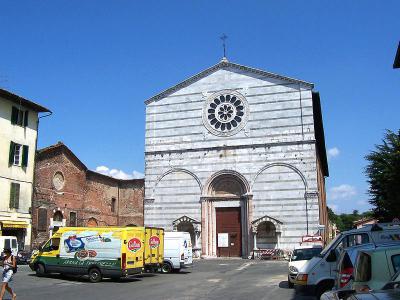


Church of San Francesco, Lucca
The Church of San Francesco in Lucca is a former Gothic-style Roman Catholic church and monastery located in San Francesco Square (Piazza San Francesco). Today, after an extensive restoration, it serves as the home of the IMT School for Advanced Studies Lucca, a prestigious graduate institution.
The Franciscan order had a presence in Lucca since 1228, but the current structure of the church dates back to the 14th century. Built primarily out of gravel, the church features a single nave with a trussed roof and was completed in the early 15th century with the addition of three apsidal chapels. Its façade, adorned with white limestone, remained unfinished until the 20th century. The completion of the façade, including a rose window and four coats of arms representing the Franciscan Order, the city of Lucca, a rampant lion, and a fascio littorio, took place in 1930.
The interior of the church is characterized by frescoed walls and elegant marble altars decorated with painted altarpieces. It houses several tomb monuments, including those of notable historical figures such as Bishop Giovanni Guidiccioni, the condottiero Castruccio Castracani, and Ugolino Visconti, a governor of Pisa who was mentioned by Dante in Purgatory. The church is also the final resting place of composers Francesco Geminiani and Luigi Boccherini.
Among its artistic treasures, the church once held important paintings such as Noli me Tangere by Domenico Passignano and Nativity by Federico Zuccari. A panel by Francesco di Andrea Anguilla, originally commissioned for the church, is now housed in the Birmingham Museum of Art. Inside, remnants of a fresco cycle attributed to Baldassarre di Biagio of Florence can still be seen in one of the chapels.
Open to the public on weekends, the church remains one of Lucca’s most evocative architectural landmarks, blending the city's medieval past with its modern intellectual pursuits.
The Franciscan order had a presence in Lucca since 1228, but the current structure of the church dates back to the 14th century. Built primarily out of gravel, the church features a single nave with a trussed roof and was completed in the early 15th century with the addition of three apsidal chapels. Its façade, adorned with white limestone, remained unfinished until the 20th century. The completion of the façade, including a rose window and four coats of arms representing the Franciscan Order, the city of Lucca, a rampant lion, and a fascio littorio, took place in 1930.
The interior of the church is characterized by frescoed walls and elegant marble altars decorated with painted altarpieces. It houses several tomb monuments, including those of notable historical figures such as Bishop Giovanni Guidiccioni, the condottiero Castruccio Castracani, and Ugolino Visconti, a governor of Pisa who was mentioned by Dante in Purgatory. The church is also the final resting place of composers Francesco Geminiani and Luigi Boccherini.
Among its artistic treasures, the church once held important paintings such as Noli me Tangere by Domenico Passignano and Nativity by Federico Zuccari. A panel by Francesco di Andrea Anguilla, originally commissioned for the church, is now housed in the Birmingham Museum of Art. Inside, remnants of a fresco cycle attributed to Baldassarre di Biagio of Florence can still be seen in one of the chapels.
Open to the public on weekends, the church remains one of Lucca’s most evocative architectural landmarks, blending the city's medieval past with its modern intellectual pursuits.
Want to visit this sight? Check out these Self-Guided Walking Tours in Lucca. Alternatively, you can download the mobile app "GPSmyCity: Walks in 1K+ Cities" from Apple App Store or Google Play Store. The app turns your mobile device to a personal tour guide and it works offline, so no data plan is needed when traveling abroad.
Download The GPSmyCity App



Church of San Francesco on Map
Sight Name: Church of San Francesco
Sight Location: Lucca, Italy (See walking tours in Lucca)
Sight Type: Religious
Sight Location: Lucca, Italy (See walking tours in Lucca)
Sight Type: Religious
Nearby Sights
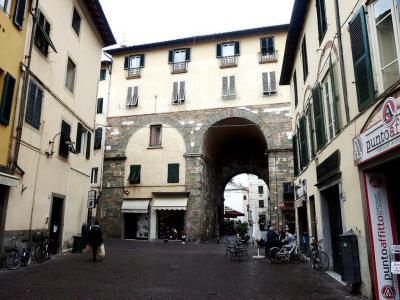
Walking Tours in Lucca, Italy

Create Your Own Walk in Lucca
Creating your own self-guided walk in Lucca is easy and fun. Choose the city attractions that you want to see and a walk route map will be created just for you. You can even set your hotel as the start point of the walk.
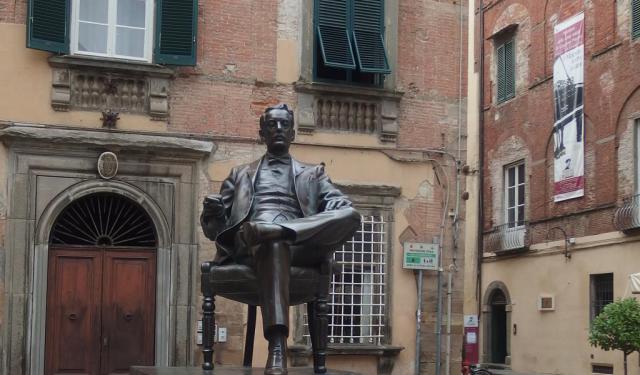
Discover Puccini's Lucca on Foot
One of the greatest musical talents of mankind, Italian composer Giacomo Puccini, was born and spent a substantial part of his life in the Tuscan city of Lucca. Today the legacy of Puccini resonates all over the world and even more so here.
Puccini's ancestors, also musicians, moved to Lucca in 1719. The future maestro was born in a house that had belonged to his family since 1815 – Casa... view more
Tour Duration: 1 Hour(s)
Travel Distance: 1.5 Km or 0.9 Miles
Puccini's ancestors, also musicians, moved to Lucca in 1719. The future maestro was born in a house that had belonged to his family since 1815 – Casa... view more
Tour Duration: 1 Hour(s)
Travel Distance: 1.5 Km or 0.9 Miles
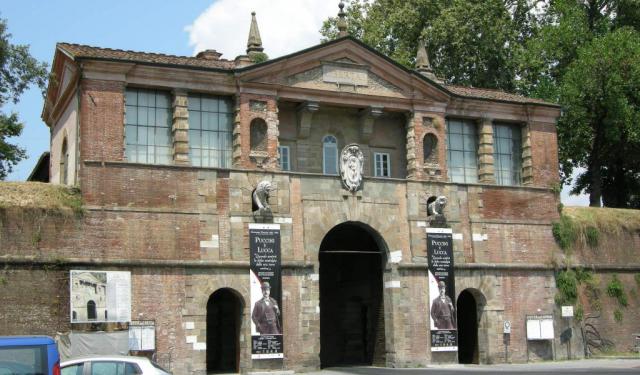
Lucca's City Wall and Gates Walking Tour
As one of Italy's Città d'arte's (arts towns), Lucca is famous, among other things, for its well-preserved ancient walls encircling the historic center. From about 570 AD until 1847 the city had been the center of the Longobard administration and the capital of old Tuscany, and as such required a defense system to render it an impenetrable fortress.
Back in the Middle Ages, the... view more
Tour Duration: 2 Hour(s)
Travel Distance: 3.7 Km or 2.3 Miles
Back in the Middle Ages, the... view more
Tour Duration: 2 Hour(s)
Travel Distance: 3.7 Km or 2.3 Miles
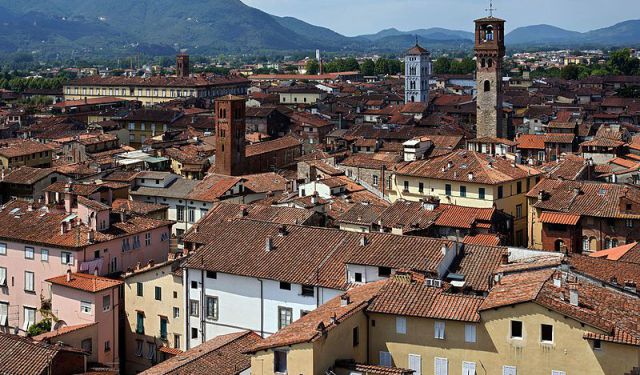
Lucca Old Town Walking Tour
Lucca is called many things: a city of arts, a city of churches, gardens, towers. Most of all it is known for its walls. From Roman times until now the walls have stood. It is the only city in Italy that has kept its walls intact.
The inner walled city is laid out in the ancient Roman grid plan. The Piazza San Michele is the site of the old forum. Bits of the Roman amphitheater can be found in... view more
Tour Duration: 2 Hour(s)
Travel Distance: 2.9 Km or 1.8 Miles
The inner walled city is laid out in the ancient Roman grid plan. The Piazza San Michele is the site of the old forum. Bits of the Roman amphitheater can be found in... view more
Tour Duration: 2 Hour(s)
Travel Distance: 2.9 Km or 1.8 Miles