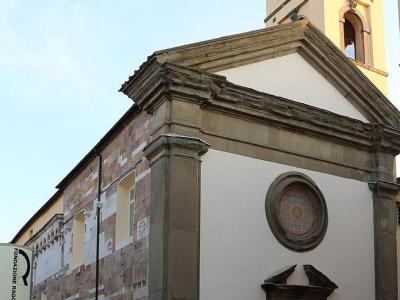


Church of San Micheletto, Lucca
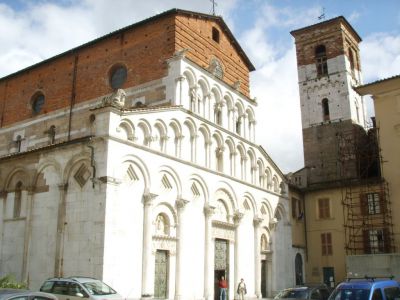
The Church of San Micheletto in Lucca is a historic Catholic church with origins tracing back to the eighth century. It was initially founded as San Michele in Cipriano in 720, outside the San Gervasio gate. Like many churches dedicated to the archangel Michael, it was established by the Lombards and became an important religious site. Today, only four small pillars from this ancient structure remain, embedded in the north wall, featuring spiral decorations of remarkable precision.
The church was rebuilt in the late 12th century, with the remaining north side showcasing refined masonry of sandstone and white limestone. Its portal, featuring a spiral plant motif and two figures, is attributed to Biduino's workshop, active in Lucca and Pisa.
In the fifteenth century, a monastic complex developed around the church, used by the Poor Clares. The cloister from this era, supported by octagonal pillars, remains a significant architectural feature. The entire structure was extensively renovated in the eighteenth century, though only the north side retains its original medieval appearance, with square ashlars topped by molded hanging arches.
The early nineteenth century brought drastic changes under the rule of Napoleon’s sister, Elisa Baciocchi, who sought to redesign this part of Lucca into a courtly district. The church and convent of San Micheletto were seized by the state and repurposed as stables and service rooms for nearby palaces. This reconfiguration was part of a larger urban project that included the renovation of Villa Bottini and the construction of new administrative buildings.
Today, the former church is owned by the Savings Bank of Lucca (Cassa di Risparmio di Lucca) and serves as a cultural center. It hosts the Licia and Carlo L. Ragghianti Art Study Center Foundation and the IMT Alti Studi Lucca State University. Numerous art and cultural initiatives take place within its walls, preserving the historical significance of this once-sacred space while adapting it to contemporary intellectual and artistic pursuits.
The church was rebuilt in the late 12th century, with the remaining north side showcasing refined masonry of sandstone and white limestone. Its portal, featuring a spiral plant motif and two figures, is attributed to Biduino's workshop, active in Lucca and Pisa.
In the fifteenth century, a monastic complex developed around the church, used by the Poor Clares. The cloister from this era, supported by octagonal pillars, remains a significant architectural feature. The entire structure was extensively renovated in the eighteenth century, though only the north side retains its original medieval appearance, with square ashlars topped by molded hanging arches.
The early nineteenth century brought drastic changes under the rule of Napoleon’s sister, Elisa Baciocchi, who sought to redesign this part of Lucca into a courtly district. The church and convent of San Micheletto were seized by the state and repurposed as stables and service rooms for nearby palaces. This reconfiguration was part of a larger urban project that included the renovation of Villa Bottini and the construction of new administrative buildings.
Today, the former church is owned by the Savings Bank of Lucca (Cassa di Risparmio di Lucca) and serves as a cultural center. It hosts the Licia and Carlo L. Ragghianti Art Study Center Foundation and the IMT Alti Studi Lucca State University. Numerous art and cultural initiatives take place within its walls, preserving the historical significance of this once-sacred space while adapting it to contemporary intellectual and artistic pursuits.
Want to visit this sight? Check out these Self-Guided Walking Tours in Lucca. Alternatively, you can download the mobile app "GPSmyCity: Walks in 1K+ Cities" from Apple App Store or Google Play Store. The app turns your mobile device to a personal tour guide and it works offline, so no data plan is needed when traveling abroad.
Download The GPSmyCity App



Church of San Micheletto on Map
Sight Name: Church of San Micheletto
Sight Location: Lucca, Italy (See walking tours in Lucca)
Sight Type: Religious
Sight Location: Lucca, Italy (See walking tours in Lucca)
Sight Type: Religious
Nearby Sights
Walking Tours in Lucca, Italy

Create Your Own Walk in Lucca
Creating your own self-guided walk in Lucca is easy and fun. Choose the city attractions that you want to see and a walk route map will be created just for you. You can even set your hotel as the start point of the walk.
Lucca Old Town Walking Tour
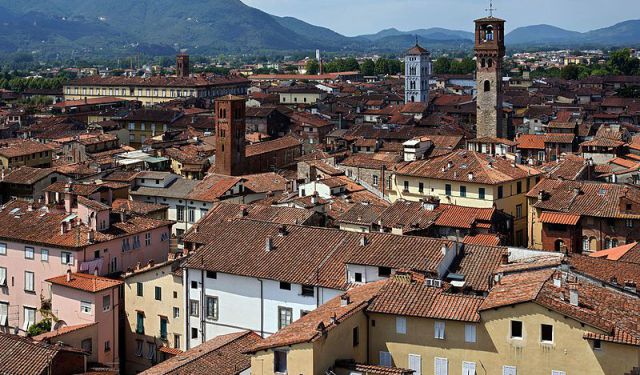
Lucca is called many things: a city of arts, a city of churches, gardens, towers. Most of all it is known for its walls. From Roman times until now the walls have stood. It is the only city in Italy that has kept its walls intact.
The inner walled city is laid out in the ancient Roman grid plan. The Piazza San Michele is the site of the old forum. Bits of the Roman amphitheater can be found in... view more
Tour Duration: 2 Hours
Travel Distance: 2.9 Km or 1.8 Miles
The inner walled city is laid out in the ancient Roman grid plan. The Piazza San Michele is the site of the old forum. Bits of the Roman amphitheater can be found in... view more
Tour Duration: 2 Hours
Travel Distance: 2.9 Km or 1.8 Miles
Discover Puccini's Lucca on Foot
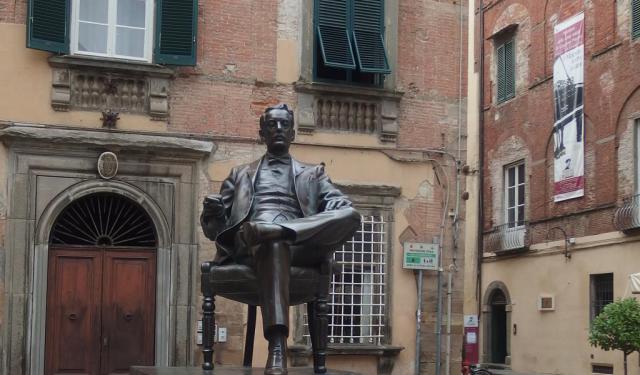
One of the greatest musical talents of mankind, Italian composer Giacomo Puccini, was born and spent a substantial part of his life in the Tuscan city of Lucca. Today the legacy of Puccini resonates all over the world and even more so here.
Puccini's ancestors, also musicians, moved to Lucca in 1719. The future maestro was born in a house that had belonged to his family since 1815 - Casa... view more
Tour Duration: 1 Hour
Travel Distance: 1.5 Km or 0.9 Miles
Puccini's ancestors, also musicians, moved to Lucca in 1719. The future maestro was born in a house that had belonged to his family since 1815 - Casa... view more
Tour Duration: 1 Hour
Travel Distance: 1.5 Km or 0.9 Miles
Lucca's City Wall and Gates Walking Tour
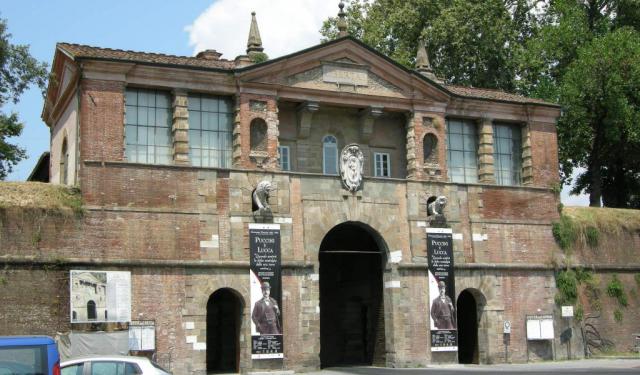
As one of Italy's Città d'arte's (arts towns), Lucca is famous, among other things, for its well-preserved ancient walls encircling the historic center. From about 570 AD until 1847 the city had been the center of the Longobard administration and the capital of old Tuscany, and as such required a defense system to render it an impenetrable fortress.
Back in the Middle Ages, the... view more
Tour Duration: 2 Hours
Travel Distance: 3.7 Km or 2.3 Miles
Back in the Middle Ages, the... view more
Tour Duration: 2 Hours
Travel Distance: 3.7 Km or 2.3 Miles