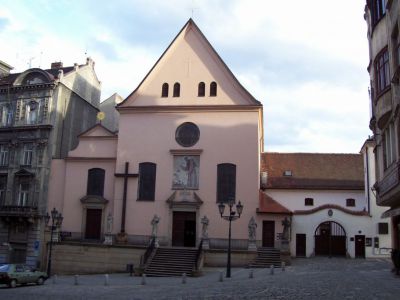


Church of the Holy Cross, Brno
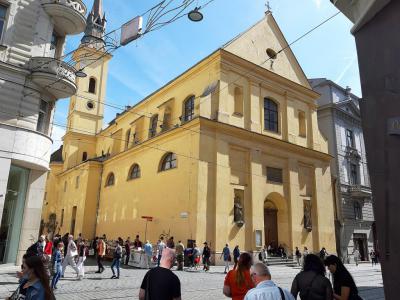
The Church of the Holy Cross (Kostel Nalezení Svatého Kříže) is a historic Baroque church situated on Capuchin Square in the heart of Brno. This sacred building was constructed by the Capuchin order in the 17th century to accommodate the growing number of their followers in the region.
The Capuchin friars arrived in Brno in 1604, invited by Bishop Franz von Dietrichstein. Initially, they settled near the Měnín Gate, but their monastery was destroyed during the Thirty Years' War by order of the town’s military commander, Jean-Louis Raduit de Souches, for defensive purposes. After temporary housing, they relocated to Uhelný, now Capuchin Square, where they built a new monastery.
The construction of the Church of the Holy Cross began at this new location and was completed in 1656 after eight years of challenges, including financial and technical difficulties. The church was consecrated on May 7, 1656. However, just six years later, structural issues due to poor construction and unstable foundations necessitated the removal of the original brick vaulted ceiling, which was temporarily replaced with a flat wooden ceiling.
In the 18th century, the church and the adjoining monastery underwent significant renovations. In 1753, the Chapel of Saint Fidelis of Sigmaringen was added, and a new vaulted ceiling replaced the wooden one. Additionally, the monastery was expanded with a new wing named after Baron Trenck. By 1764, a library was added to this wing, which has preserved its original Baroque furniture and houses a collection of 8,000 items. The library's ceiling is adorned with a fresco by the artist Josef Stern.
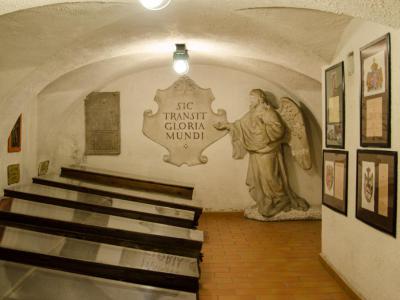
One of the church’s most notable features is the Capuchin crypt (Crypto Capuccinorum) beneath it, which served as a burial site for the friars, noblemen, and benefactors of the order. The crypt is unique for its naturally mummified human remains, which have been preserved by the air. Today, this crypt is open to the public, offering a glimpse into the history of the Capuchin order and the city of Brno.
The Capuchin friars arrived in Brno in 1604, invited by Bishop Franz von Dietrichstein. Initially, they settled near the Měnín Gate, but their monastery was destroyed during the Thirty Years' War by order of the town’s military commander, Jean-Louis Raduit de Souches, for defensive purposes. After temporary housing, they relocated to Uhelný, now Capuchin Square, where they built a new monastery.
The construction of the Church of the Holy Cross began at this new location and was completed in 1656 after eight years of challenges, including financial and technical difficulties. The church was consecrated on May 7, 1656. However, just six years later, structural issues due to poor construction and unstable foundations necessitated the removal of the original brick vaulted ceiling, which was temporarily replaced with a flat wooden ceiling.
In the 18th century, the church and the adjoining monastery underwent significant renovations. In 1753, the Chapel of Saint Fidelis of Sigmaringen was added, and a new vaulted ceiling replaced the wooden one. Additionally, the monastery was expanded with a new wing named after Baron Trenck. By 1764, a library was added to this wing, which has preserved its original Baroque furniture and houses a collection of 8,000 items. The library's ceiling is adorned with a fresco by the artist Josef Stern.
One of the church’s most notable features is the Capuchin crypt (Crypto Capuccinorum) beneath it, which served as a burial site for the friars, noblemen, and benefactors of the order. The crypt is unique for its naturally mummified human remains, which have been preserved by the air. Today, this crypt is open to the public, offering a glimpse into the history of the Capuchin order and the city of Brno.
Want to visit this sight? Check out these Self-Guided Walking Tours in Brno. Alternatively, you can download the mobile app "GPSmyCity: Walks in 1K+ Cities" from Apple App Store or Google Play Store. The app turns your mobile device to a personal tour guide and it works offline, so no data plan is needed when traveling abroad.
Download The GPSmyCity App



Church of the Holy Cross on Map
Sight Name: Church of the Holy Cross
Sight Location: Brno, Czech Republic (See walking tours in Brno)
Sight Type: Religious
Sight Location: Brno, Czech Republic (See walking tours in Brno)
Sight Type: Religious
Nearby Sights
Walking Tours in Brno, Czech Republic

Create Your Own Walk in Brno
Creating your own self-guided walk in Brno is easy and fun. Choose the city attractions that you want to see and a walk route map will be created just for you. You can even set your hotel as the start point of the walk.
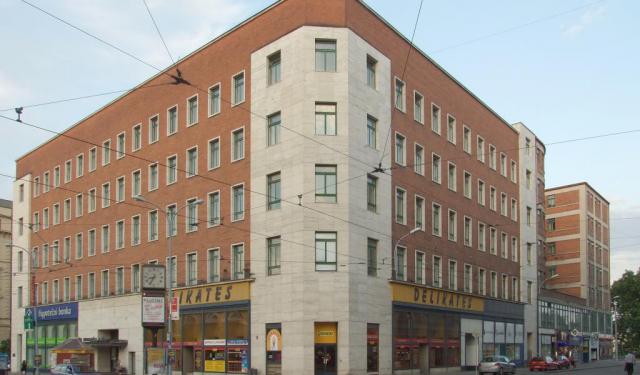
Explore Brno's Functionalist Architecture by Foot
Functionalist architecture, a style that sought to meet the needs of the rapidly evolving industrial society, emerged in Europe in the wake of World War I.
After Czechoslovakia gained independence in 1918, Brno, the second-largest city in the country, developed rapidly both economically and politically. Its architecture reflected a modernist approach that prioritized functionality and... view more
Tour Duration: 1 Hour
Travel Distance: 1.5 Km or 0.9 Miles
After Czechoslovakia gained independence in 1918, Brno, the second-largest city in the country, developed rapidly both economically and politically. Its architecture reflected a modernist approach that prioritized functionality and... view more
Tour Duration: 1 Hour
Travel Distance: 1.5 Km or 0.9 Miles
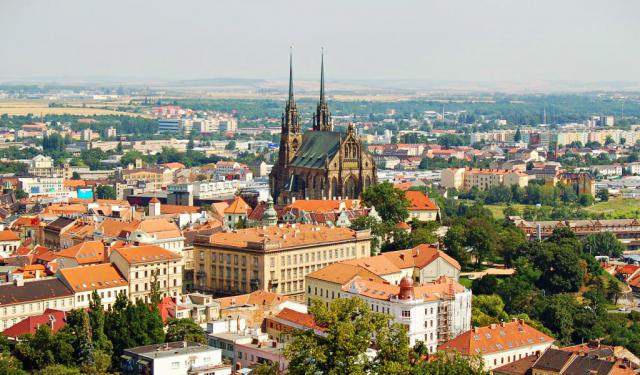
A Walk Through Brno's Compact and Charming Downtown
Brno is the second-largest city in the Czech Republic. Located in the South Moravian Region, it is the center of Czech's judiciary and the former capital of Moravia.
Brno is known for its exhibition center, one of the largest in Europe. It is also known for its international fireworks competition, Fire of Brno. The long history of fireworks and pyrotechnics are seen in the Spilberk Castle... view more
Tour Duration: 2 Hours
Travel Distance: 2.7 Km or 1.7 Miles
Brno is known for its exhibition center, one of the largest in Europe. It is also known for its international fireworks competition, Fire of Brno. The long history of fireworks and pyrotechnics are seen in the Spilberk Castle... view more
Tour Duration: 2 Hours
Travel Distance: 2.7 Km or 1.7 Miles
City Walks Overview
