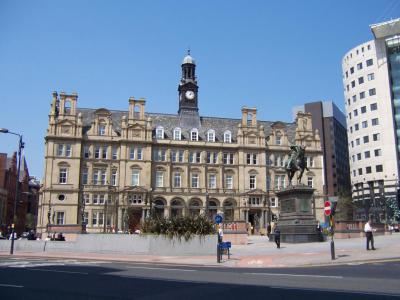


City Square, Leeds
City Square - one of Leeds' principal public spaces - is laid out in the style of an Italian piazza and decorated with an impressive collection of bronze statues. Its history dates back to the 1890s, when the old Cloth Hall and Quebec House were demolished to make way for a new General Post Office. Completed in 1896, this building still dominates one side of the square. You can recognize it by its elaborate stonework, rows of arched windows, and prominent clock tower. The square took its name from Leeds' newly acquired city status in 1893.
The most prominent monument stands in the open area of the square: a large bronze equestrian statue of Edward, the Black Prince. Created by sculptor Thomas Brock and unveiled in 1903, the monument honors the son of King Edward III, although he had no significant historical connection with Leeds.
Now, turn toward the former General Post Office, where four smaller bronze statues stand in a row. Each represents a notable figure associated with the city's history, and their names can be found on the pedestals. At one end, you'll see James Watt, the Scottish engineer whose improvements to the steam engine helped power the Industrial Revolution, and John Harrison, a 17th-century Leeds merchant and philanthropist who funded schools, almshouses, and a church. Further along stand Dr. Walter Farquhar Hook, the influential 19th-century Vicar of Leeds, and Joseph Priestley, the scientist and theologian best known for his experiments with gases, including oxygen.
Finally, turn back toward the Black Prince and notice the elegant female bronze figures arranged along the square's curved edge. These are the eight nymphs created by Alfred Drury in 1903, divided into two groups called Morn and Even. You can tell them apart by their poses: the four Morn figures raise lamps in their right hands while holding flowers in their left, whereas the four Even figures hold their lamps in their left hands and rest their right hands on their heads. Originally designed as ornamental lighting, they have been repositioned several times over the years. Together with the Black Prince and the four historical figures, they make City Square something of an open-air sculpture gallery, reflecting Leeds' civic pride at the turn of the 20th century.
Want to visit this sight? Check out these Self-Guided Walking Tours in Leeds. Alternatively, you can download the mobile app "GPSmyCity: Walks in 1K+ Cities" from Apple App Store or Google Play Store. The app turns your mobile device to a personal tour guide and it works offline, so no data plan is needed when traveling abroad.
Download The GPSmyCity App



City Square on Map
Sight Name: City Square
Sight Location: Leeds, England (See walking tours in Leeds)
Sight Type: Attraction/Landmark
Guide(s) Containing This Sight:
Sight Location: Leeds, England (See walking tours in Leeds)
Sight Type: Attraction/Landmark
Guide(s) Containing This Sight:
Nearby Sights


Walking Tours in Leeds, England
Create Your Own Walk in Leeds
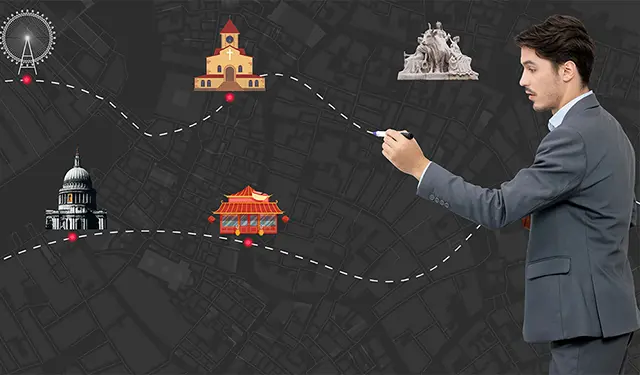
Creating your own self-guided walk in Leeds is easy and fun. Choose the city attractions that you want to see and a walk route map will be created just for you. You can even set your hotel as the start point of the walk.
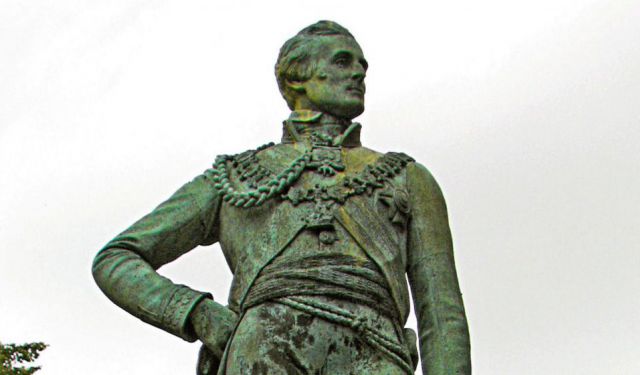
Discover Leeds' Historical Sculptures on Foot
In Leeds, statues adorn various corners, reflecting historical figures and cultural symbols. Some of them are hundreds of years old but still in remarkable condition.
One notable sculpture is that of Robert Peel, commemorating the 19th-century Prime Minister and founder of Britain's modern police force.
On the opposite side of the nearby Woodhouse Moor Park stands the regal Statue of... view more
Tour Duration: 2 Hours
Travel Distance: 3.2 Km or 2 Miles
One notable sculpture is that of Robert Peel, commemorating the 19th-century Prime Minister and founder of Britain's modern police force.
On the opposite side of the nearby Woodhouse Moor Park stands the regal Statue of... view more
Tour Duration: 2 Hours
Travel Distance: 3.2 Km or 2 Miles
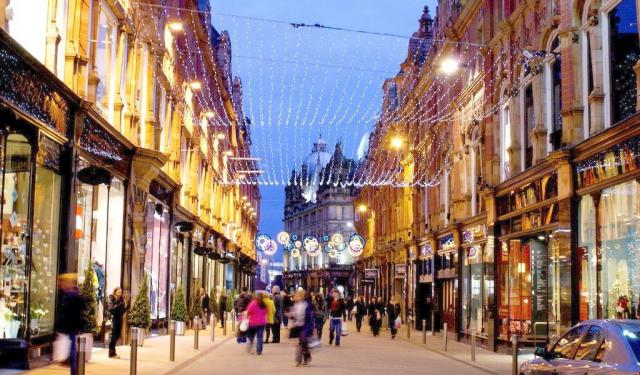
Explore Leeds' Historical Shopping Venues on Foot
Leeds is a shopaholic’s paradise and a true world of retail scaled down to the size of a downtown area. Compactly located within walking distance from each other, the city's best boutiques are never far away from an eager shopper.
Here, the biggest brands and small independents are housed in some of the city’s most iconic buildings. Among them is the historic Kirkgate Market, the... view more
Tour Duration: 1 Hour
Travel Distance: 1.2 Km or 0.7 Miles
Here, the biggest brands and small independents are housed in some of the city’s most iconic buildings. Among them is the historic Kirkgate Market, the... view more
Tour Duration: 1 Hour
Travel Distance: 1.2 Km or 0.7 Miles
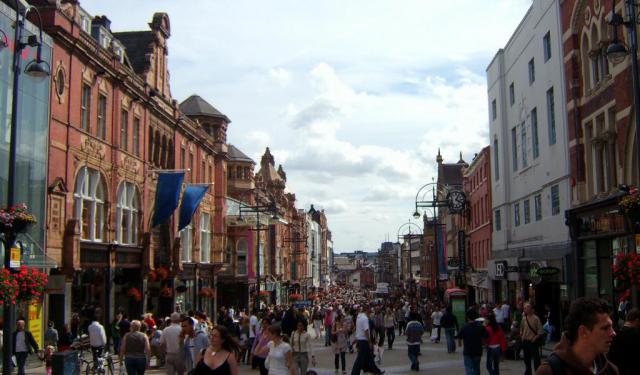
A Walking Guide To Leeds City Center
Leeds has come a long way from its beginnings as a small settlement beside the River Aire. Its name is possibly rooted in the ancient Brythonic word "Ladenses," which means "folks of the rapid river." In the 5th century, the area formed part of the kingdom of Elmet, and the 8th-century scholar, the Venerable Bede, referred to it as “Loidis.” Over time, the name evolved into... view more
Tour Duration: 2 Hours
Travel Distance: 2.7 Km or 1.7 Miles
Tour Duration: 2 Hours
Travel Distance: 2.7 Km or 1.7 Miles
City Walks Overview
