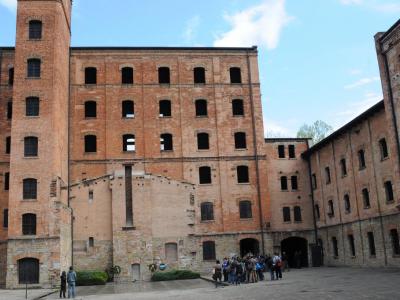


Civico Museo della Risiera di San Sabba (San Sabba Risiera Civic Museum), Trieste (must see)
The San Sabba Risiera (Risiera di San Sabba) is a five-story brick building erected in 1913 and intended as a rice-husking station. During World War II, the Risiera was a Nazi concentration camp used to detain and kill political dissidents and as a transit depot for Jews on their way to Auschwitz. Cremation spaces, the only ones built in Italy, were installed by Erwin Lambert, a SS operative and a stone mason on daily life.
Historians estimate that more than 3,000 people were executed at the Risiera camp. Thousands were interned there and shipped out to other death camps. Most prisoners were from the Friuli region in Italy and parts of Slovenia.
Boris Pahor, a world-famous novelist from Trieste, was imprisoned in the Risiera and later held for several years in the death-camp system. He survived and lived to be 100. The Risiera was designated Stalag 339. In October 1943, it became a Police Detention Camp. It was a transit depot, property storage, and death camp for Jews.
The entrance to the Risiera was an underground passage. The first room was the "death cell." Prisoners earmarked for execution were kept here, often sharing the cell with the bodies of those already executed and awaiting cremation. There were workshops for prisoner workers, SS quarters, and two cells reserved for torture.
When the torture cells were not being used, they held property and valuables taken from the prisoners. The inner courtyard housed the cremation ovens. The crematorium and its chimney were destroyed by the Nazis in 1945. They were trying to hide evidence. They did not succeed.
The Risiera, today San Sabba Risiera Civic Museum is open every day from 9 am to 7 pm. It is closed for only two days each year, 25 December and 1 January.
Historians estimate that more than 3,000 people were executed at the Risiera camp. Thousands were interned there and shipped out to other death camps. Most prisoners were from the Friuli region in Italy and parts of Slovenia.
Boris Pahor, a world-famous novelist from Trieste, was imprisoned in the Risiera and later held for several years in the death-camp system. He survived and lived to be 100. The Risiera was designated Stalag 339. In October 1943, it became a Police Detention Camp. It was a transit depot, property storage, and death camp for Jews.
The entrance to the Risiera was an underground passage. The first room was the "death cell." Prisoners earmarked for execution were kept here, often sharing the cell with the bodies of those already executed and awaiting cremation. There were workshops for prisoner workers, SS quarters, and two cells reserved for torture.
When the torture cells were not being used, they held property and valuables taken from the prisoners. The inner courtyard housed the cremation ovens. The crematorium and its chimney were destroyed by the Nazis in 1945. They were trying to hide evidence. They did not succeed.
The Risiera, today San Sabba Risiera Civic Museum is open every day from 9 am to 7 pm. It is closed for only two days each year, 25 December and 1 January.
Want to visit this sight? Check out these Self-Guided Walking Tours in Trieste. Alternatively, you can download the mobile app "GPSmyCity: Walks in 1K+ Cities" from Apple App Store or Google Play Store. The app turns your mobile device to a personal tour guide and it works offline, so no data plan is needed when traveling abroad.
Download The GPSmyCity App



Civico Museo della Risiera di San Sabba (San Sabba Risiera Civic Museum) on Map
Sight Name: Civico Museo della Risiera di San Sabba (San Sabba Risiera Civic Museum)
Sight Location: Trieste, Italy (See walking tours in Trieste)
Sight Type: Museum/Gallery
Sight Location: Trieste, Italy (See walking tours in Trieste)
Sight Type: Museum/Gallery
Nearby Sights

Walking Tours in Trieste, Italy

Create Your Own Walk in Trieste
Creating your own self-guided walk in Trieste is easy and fun. Choose the city attractions that you want to see and a walk route map will be created just for you. You can even set your hotel as the start point of the walk.
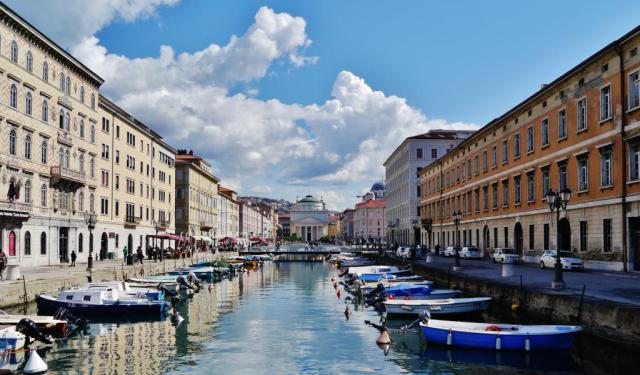
Trieste Introduction Walking Tour
Let’s drop into Trieste, a city that’s always had one foot in Central Europe and the other dipping into the Adriatic. It sits at Italy’s northeastern edge, pressed against Slovenia, where winds tear across the Karst Plateau and caves open like gateways underground. Some call it “Vienna by the Sea,” others swear it’s the “City of Coffee,” but labels never really fit. From the start,... view more
Tour Duration: 2 Hours
Travel Distance: 3.7 Km or 2.3 Miles
Tour Duration: 2 Hours
Travel Distance: 3.7 Km or 2.3 Miles
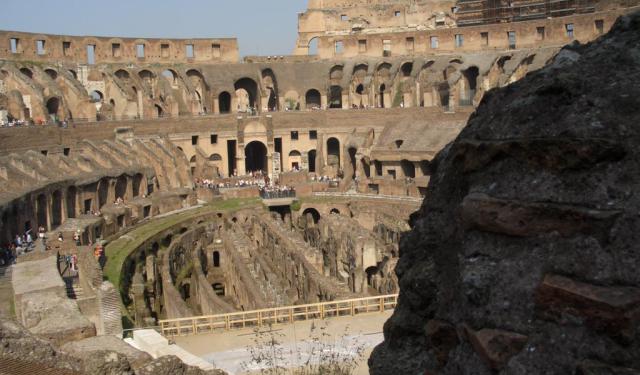
Trieste's Ancient Roman Sites Walking Tour
The Roman remains on Trieste extend along the northwestern slope of San Giusto Hill, overlooking the Gulf of Trieste. Wharves of sandstone slabs dating from the 1st century AD were found by the Roman Theatre. The city walls, ordered by Augustus, were converted to use as terraces.
The Propylaeum of the 1st century AD was the gateway to the sacred area of the Capitoline Temple. There are two... view more
Tour Duration: 1 Hour
Travel Distance: 0.9 Km or 0.6 Miles
The Propylaeum of the 1st century AD was the gateway to the sacred area of the Capitoline Temple. There are two... view more
Tour Duration: 1 Hour
Travel Distance: 0.9 Km or 0.6 Miles
City Walks Overview
