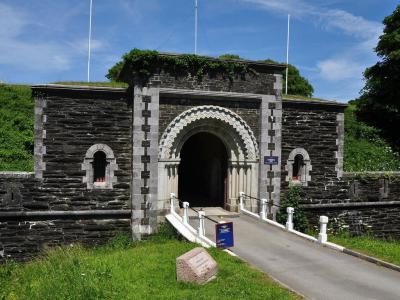


Crownhill Fort, Plymouth
Crownhill Fort, located in Crownhill, Plymouth, stands as a significant remnant of 19th-century military architecture. Constructed in the 1860s, it was part of Lord Palmerston's extensive ring of land defenses devised to protect Plymouth from potential threats, particularly from Napoleon III’s France. Designed by Captain Edmund Frederick Du Cane, Crownhill Fort was the largest and most strategically important of the North Eastern defenses intended to safeguard the Royal Dockyard at Devonport.
Crownhill Fort held significant roles over time. In World War I, it was a recruitment and transport hub for troops heading to Turkey and Africa, later serving as a demobilization center and home to the Royal Signals Corps. During World War II, it was equipped with anti-aircraft guns for defense. In the 1950s, a Gun Operations Room was added to its parade ground. The fort remained vital into the Falklands War, hosting the 59 Independent Commando Squadron Royal Engineers for troop and material deployment.
By 1986, Crownhill Fort was acquired by the Landmark Trust, a move that marked the beginning of its transformation into a historical site accessible to the public. The Trust’s restoration efforts, supported by grants from the European Committee, English Heritage, and the Heritage Lottery Fund, have ensured that Crownhill Fort remains the best-preserved example of Palmerston’s forts.
Today, Crownhill Fort is not only a monument to military history but a vibrant community space. It houses small businesses, museums, and exhibitions, and even features a holiday apartment accommodating up to eight guests. Open to the public on the last Friday of each month, the fort offers visitors a chance to explore its rich history through museum displays, Victorian firepower demonstrations, and guided tours of its intricate underground rooms and passages. Additionally, it hosts educational tours for local schools and community groups, making it a cherished historical and cultural landmark in Plymouth.
Crownhill Fort held significant roles over time. In World War I, it was a recruitment and transport hub for troops heading to Turkey and Africa, later serving as a demobilization center and home to the Royal Signals Corps. During World War II, it was equipped with anti-aircraft guns for defense. In the 1950s, a Gun Operations Room was added to its parade ground. The fort remained vital into the Falklands War, hosting the 59 Independent Commando Squadron Royal Engineers for troop and material deployment.
By 1986, Crownhill Fort was acquired by the Landmark Trust, a move that marked the beginning of its transformation into a historical site accessible to the public. The Trust’s restoration efforts, supported by grants from the European Committee, English Heritage, and the Heritage Lottery Fund, have ensured that Crownhill Fort remains the best-preserved example of Palmerston’s forts.
Today, Crownhill Fort is not only a monument to military history but a vibrant community space. It houses small businesses, museums, and exhibitions, and even features a holiday apartment accommodating up to eight guests. Open to the public on the last Friday of each month, the fort offers visitors a chance to explore its rich history through museum displays, Victorian firepower demonstrations, and guided tours of its intricate underground rooms and passages. Additionally, it hosts educational tours for local schools and community groups, making it a cherished historical and cultural landmark in Plymouth.
Want to visit this sight? Check out these Self-Guided Walking Tours in Plymouth. Alternatively, you can download the mobile app "GPSmyCity: Walks in 1K+ Cities" from Apple App Store or Google Play Store. The app turns your mobile device to a personal tour guide and it works offline, so no data plan is needed when traveling abroad.
Download The GPSmyCity App



Crownhill Fort on Map
Sight Name: Crownhill Fort
Sight Location: Plymouth, England (See walking tours in Plymouth)
Sight Type: Attraction/Landmark
Sight Location: Plymouth, England (See walking tours in Plymouth)
Sight Type: Attraction/Landmark
Nearby Sights



Walking Tours in Plymouth, England

Create Your Own Walk in Plymouth
Creating your own self-guided walk in Plymouth is easy and fun. Choose the city attractions that you want to see and a walk route map will be created just for you. You can even set your hotel as the start point of the walk.
Plymouth Hoe Walking Tour
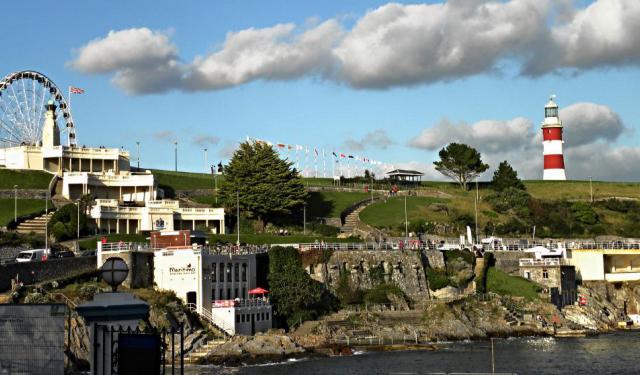
Plymouth Hoe, referred to locally as the Hoe, is a large south-facing open public space in Plymouth with commanding views of Plymouth Sound, Drake's Island, and further afield into Cornwall. The name derives from the Anglo-Saxon word hoh, which means a sloping ridge shaped like an inverted foot and heel.
This part of town has always been a meeting place, where people would come regularly... view more
Tour Duration: 1 Hour
Travel Distance: 0.7 Km or 0.4 Miles
This part of town has always been a meeting place, where people would come regularly... view more
Tour Duration: 1 Hour
Travel Distance: 0.7 Km or 0.4 Miles
Plymouth Old Town Walking Tour
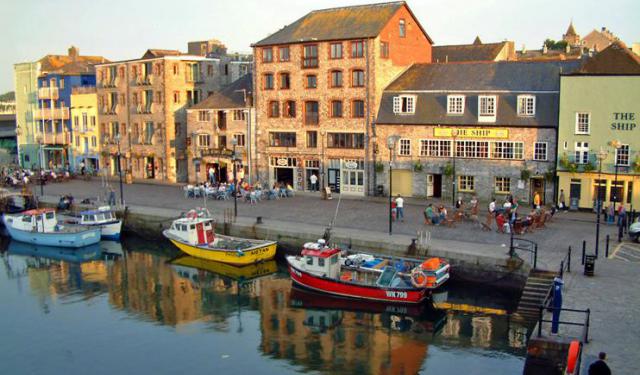
Plymouth's early history began in the Bronze Age when the first settlement emerged at Mount Batten. It is mentioned in Ptolemy's Geographia as a maritime outpost exporting bronze mirrors.
The settlement was a major port in the southwest of England in Roman times. It was surpassed as a port in the ninth century by the nearby wealthier village of Sutton, later called Plymouth.... view more
Tour Duration: 1 Hour
Travel Distance: 1.8 Km or 1.1 Miles
The settlement was a major port in the southwest of England in Roman times. It was surpassed as a port in the ninth century by the nearby wealthier village of Sutton, later called Plymouth.... view more
Tour Duration: 1 Hour
Travel Distance: 1.8 Km or 1.1 Miles

Walking Along Plymouth's Pilgrim Fathers Trail
Back in the early 17th century, a group of English Puritans - nowadays reverently referred to as the Pilgrim Fathers - fled religious persecution in their homeland and established a colony in North America that later became known as Plymouth, Massachusetts. The Pilgrims embarked on their perilous journey across the Atlantic from Plymouth, England in 1620 aboard a ship called the Mayflower, which... view more
Tour Duration: 1 Hour
Travel Distance: 0.6 Km or 0.4 Miles
Tour Duration: 1 Hour
Travel Distance: 0.6 Km or 0.4 Miles
City Walks Overview
