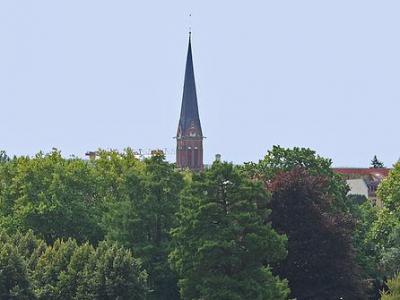


Erlöserkirche (Church of the Redeemer), Potsdam
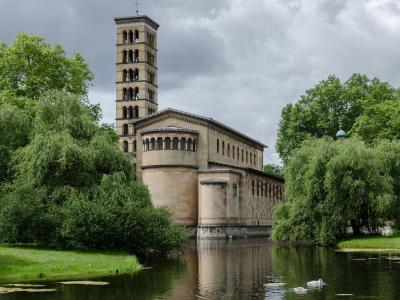
The Protestant Church of the Redeemer (Erlöserkirche) in Potsdam is a prominent neo-Gothic landmark situated in the Brandenburger Vorstadt district. Completed in 1898, the church was designed by renowned architects Gotthilf Ludwig Möckel, Ferdinand Krüger, and Arthur Kickton. Its 74-meter tall spire is a notable feature, visible from afar and serving as a navigational point within the Brandenburg suburb. The church, along with various associated community buildings and the adjacent Dr. Rudolf Tschäpe Square, is a listed heritage site. The square is home to an old copper beech tree, adding to the historic ambiance of the area.
During the final days of World War II, the Church of the Redeemer suffered significant damage but was partially restored by 1947. A comprehensive renovation took place in 1960, revitalizing both the interior and exterior of the building. The church's musical heritage is particularly noteworthy, with a long-standing tradition of church music. From the mid-20th century, this tradition was closely associated with Friedrich and Annemarie Meinel, and since 1997, conductor Ud Joffe has led the Potsdam choir and the music at the church.
In 1964, the original organ was replaced with a new instrument built by Alexander Schuke, featuring 36 registers across three manuals and a pedal. The church's bell tower houses three bronze bells, two of which were on permanent loan from the former garrison church, and a smaller bell added in 1991 completes the set.
Today, the Church of the Redeemer is not only a place of worship but also a cultural venue where visitors can enjoy organ concerts, making it a significant cultural and historical site in Potsdam.
During the final days of World War II, the Church of the Redeemer suffered significant damage but was partially restored by 1947. A comprehensive renovation took place in 1960, revitalizing both the interior and exterior of the building. The church's musical heritage is particularly noteworthy, with a long-standing tradition of church music. From the mid-20th century, this tradition was closely associated with Friedrich and Annemarie Meinel, and since 1997, conductor Ud Joffe has led the Potsdam choir and the music at the church.
In 1964, the original organ was replaced with a new instrument built by Alexander Schuke, featuring 36 registers across three manuals and a pedal. The church's bell tower houses three bronze bells, two of which were on permanent loan from the former garrison church, and a smaller bell added in 1991 completes the set.
Today, the Church of the Redeemer is not only a place of worship but also a cultural venue where visitors can enjoy organ concerts, making it a significant cultural and historical site in Potsdam.
Want to visit this sight? Check out these Self-Guided Walking Tours in Potsdam. Alternatively, you can download the mobile app "GPSmyCity: Walks in 1K+ Cities" from Apple App Store or Google Play Store. The app turns your mobile device to a personal tour guide and it works offline, so no data plan is needed when traveling abroad.
Download The GPSmyCity App



Erlöserkirche (Church of the Redeemer) on Map
Sight Name: Erlöserkirche (Church of the Redeemer)
Sight Location: Potsdam, Germany (See walking tours in Potsdam)
Sight Type: Religious
Sight Location: Potsdam, Germany (See walking tours in Potsdam)
Sight Type: Religious
Nearby Sights

Walking Tours in Potsdam, Germany

Create Your Own Walk in Potsdam
Creating your own self-guided walk in Potsdam is easy and fun. Choose the city attractions that you want to see and a walk route map will be created just for you. You can even set your hotel as the start point of the walk.
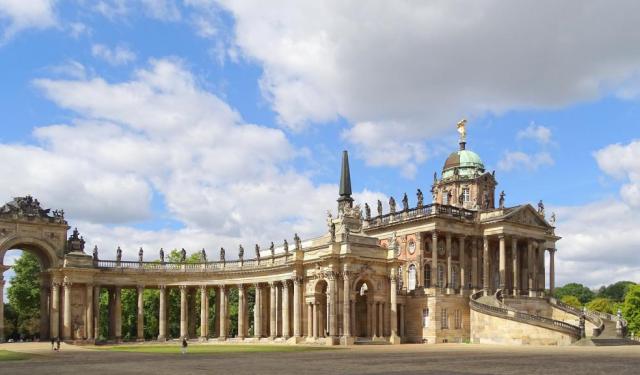
Potsdam City Center and Sanssouci Palace Walking Tour
Potsdam was likely founded during the seventh century by the Hevelli tribe. The town was mentioned by the name of Poztupimi in a document from Emperor Otto III. The name likely came from an old Western Slavonic term roughly meaning "beneath the oaks."
By the early 1300s, a small town had formed with a town charter. By 1573 the town had around 2,000 people living there. Potsdam rose to... view more
Tour Duration: 2 Hour(s)
Travel Distance: 3.8 Km or 2.4 Miles
By the early 1300s, a small town had formed with a town charter. By 1573 the town had around 2,000 people living there. Potsdam rose to... view more
Tour Duration: 2 Hour(s)
Travel Distance: 3.8 Km or 2.4 Miles
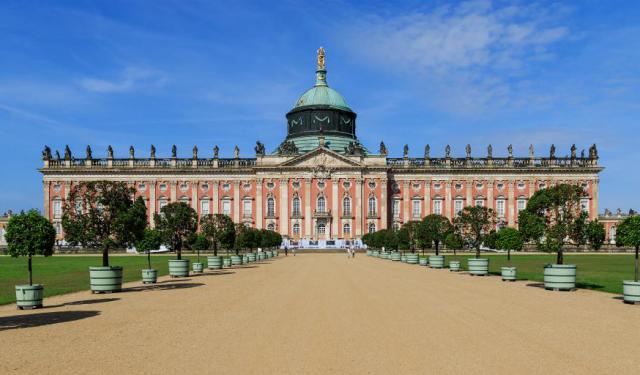
Sanssouci Park Walking Tour
Sanssouci Park is a unique Potsdam landmark that occupies 290 hectares in the heart of the city. The Park is named after the Sanssouci Palace that it surrounds, which in turn takes its name from the French phrase "sans souci", which means carefree, and implies that the palace was designated as a place of fun, rather than a seat of power.
Indeed, the Sanssouci Palace was built in 1747... view more
Tour Duration: 2 Hour(s)
Travel Distance: 3.9 Km or 2.4 Miles
Indeed, the Sanssouci Palace was built in 1747... view more
Tour Duration: 2 Hour(s)
Travel Distance: 3.9 Km or 2.4 Miles
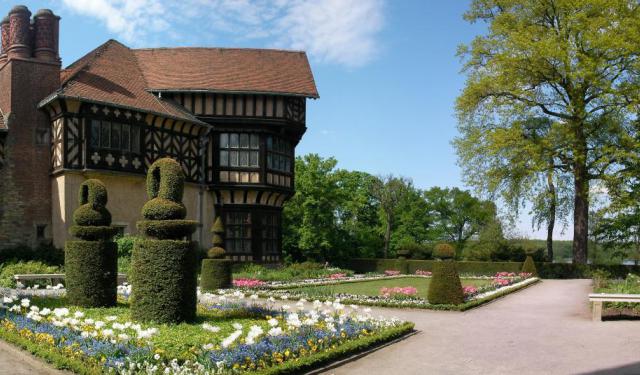
Neuer Garten Walking Tour
Laid out at the behest of Friedrich William II in 1787, Potsdam's Neuer Garten (New Garden) was indeed "new" compared to the already in place Sanssouci Park.
Between 1816 and 1828, the area was modified further as an English-style, open landscape garden, with an aim to reproduce nature – trees and plants were left to grow naturally, unshaped and untrimmed. Rural life was also... view more
Tour Duration: 2 Hour(s)
Travel Distance: 2.8 Km or 1.7 Miles
Between 1816 and 1828, the area was modified further as an English-style, open landscape garden, with an aim to reproduce nature – trees and plants were left to grow naturally, unshaped and untrimmed. Rural life was also... view more
Tour Duration: 2 Hour(s)
Travel Distance: 2.8 Km or 1.7 Miles