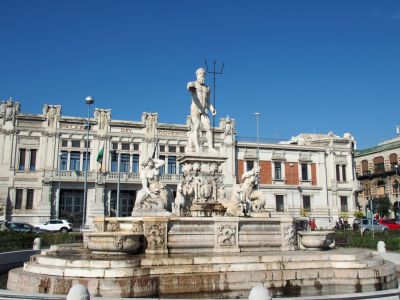


Fontana del Nettuno (Fountain of Neptune), Messina (must see)
The Fountain of Neptune is one of Messina’s finest Renaissance monuments and the second major fountain commissioned from Giovanni Angelo Montorsoli, the Florentine sculptor and collaborator of Michelangelo, following the success of his Fountain of Orion. Completed in 1557, it originally stood near the Town Hall and Messina’s historic waterfront.
The composition centers on the imposing figure of Neptune, god of the sea, standing triumphantly above the mythological monsters Scylla and Charybdis. According to Greek mythology, these creatures inhabited opposite sides of the Strait of Messina, making its dangerous waters a legendary obstacle for sailors, most famously in Homer’s Odyssey. In Montorsoli’s composition, the monsters struggle beneath Neptune, transforming the fountain into an allegory of humanity’s mastery over the treacherous waters of the strait.
Originally, Neptune faced away from the sea, symbolically presenting its riches to the city. The scholar Francesco Maurolico, who also collaborated with Montorsoli on the Fountain of Orion, contributed Latin verses to the monument.
Unlike many of Messina’s monuments, the fountain survived the devastating 1908 earthquake largely intact. Its surroundings, however, changed considerably over the centuries. Statues of Charles III of Bourbon and Francis I were added nearby in 1757 and 1832, respectively, but both were melted down during the 1848 revolution to produce projectiles.
In 1934, the fountain was moved to its present location in front of the Prefecture building. During the relocation, it was rotated 180 degrees, so Neptune now faces the sea rather than the city.
Visitors should also note that some of the sculptures are copies. The original statues of Neptune and Scylla are preserved in Messina’s Regional Museum, where they are protected from further exposure to the elements.
Want to visit this sight? Check out these Self-Guided Walking Tours in Messina. Alternatively, you can download the mobile app "GPSmyCity: Walks in 1K+ Cities" from Apple App Store or Google Play Store. The app turns your mobile device to a personal tour guide and it works offline, so no data plan is needed when traveling abroad.
Download The GPSmyCity App



Fontana del Nettuno (Fountain of Neptune) on Map
Sight Name: Fontana del Nettuno (Fountain of Neptune)
Sight Location: Messina, Italy (See walking tours in Messina)
Sight Type: Statue/Public Art
Guide(s) Containing This Sight:
Sight Location: Messina, Italy (See walking tours in Messina)
Sight Type: Statue/Public Art
Guide(s) Containing This Sight:
Nearby Sights


Walking Tours in Messina, Italy
Create Your Own Walk in Messina
Creating your own self-guided walk in Messina is easy and fun. Choose the city attractions that you want to see and a walk route map will be created just for you. You can even set your hotel as the start point of the walk.
Messina Introduction Walking Tour
When German writer Johann Wolfgang von Goethe arrived in Messina in 1787, he traveled past “ruin after ruin” before reaching his inn. He encountered a city still scarred by a devastating earthquake four years earlier.
Messina, standing at the northeastern tip of Sicily beside the narrow strait separating the island from mainland Italy, has been shaped by the sea for nearly three thousand... view more
Tour Duration: 2 Hours
Travel Distance: 3.4 Km or 2.1 Miles
Messina, standing at the northeastern tip of Sicily beside the narrow strait separating the island from mainland Italy, has been shaped by the sea for nearly three thousand... view more
Tour Duration: 2 Hours
Travel Distance: 3.4 Km or 2.1 Miles
City Walks Overview
