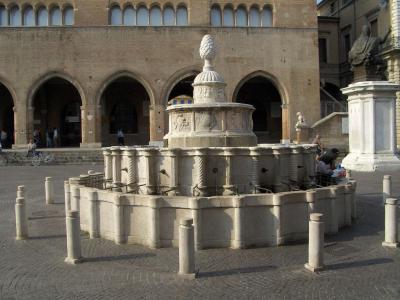


Fontana della Pigna (Pinecone Fountain), Rimini
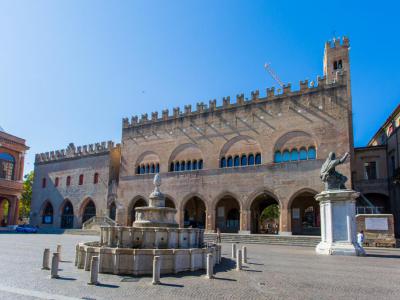
The Pinecone Fountain (Fontana della Pigna) stands as a testament to Rimini's layered history, gracing the historic Cavour Square (Piazza Cavour), where the city’s municipal buildings are located. Originating in Roman times, this fountain initially drew water from a well nearly 900 meters away. Its stone conduit was eventually replaced with cast iron and later upgraded to an underground system in 1835, routed through Castel Sismondo.
For centuries, the fountain provided Rimini's drinking water until the public aqueduct opened in 1912. Restored in 1543 by Giovanni da Carrara after fireworks damage, the renovation-funded by Pope Paul III-blended Roman stone fragments with Renaissance artistry, preserving the central drum's original bas-reliefs.
Initially crowned with a statue of Saint Paul in 1545, the fountain saw significant alterations during the Napoleonic era when French troops damaged its enclosure and stole bronze spouts. A restoration in 1807 replaced the statue with the pine cone sculpture (Pigna), which remains its defining feature today.
Architecturally, the Pinecone Fountain exemplifies Renaissance elegance. Its polygonal design includes two concentric basins from the fifteenth century, with the central drum-a relic from Roman times-adorned with intricate bas-reliefs. Fifteen spouts encircle the second tank, while panels framed by pillars and columns enhance its aesthetic appeal. The entire structure, made of white marble, was meticulously restored in 2002, ensuring its continued grandeur.
Adding to its historical allure is a famous visit by Leonardo da Vinci in 1502. Inspired by the fountain’s harmonious design, he left an enduring tribute: "Make a harmony with the different falls of water, as you saw at the fountain in Rimini, as you saw on the 5th of August 1502," engraved on one of the panels.
Today, the Pinecone Fountain is not only a symbol of Rimini’s past but also a celebration of its artistic and architectural legacy. Visitors can admire the commemorative plaques and inscriptions that tell the story of a city’s resilience and its fountain’s timeless charm.
For centuries, the fountain provided Rimini's drinking water until the public aqueduct opened in 1912. Restored in 1543 by Giovanni da Carrara after fireworks damage, the renovation-funded by Pope Paul III-blended Roman stone fragments with Renaissance artistry, preserving the central drum's original bas-reliefs.
Initially crowned with a statue of Saint Paul in 1545, the fountain saw significant alterations during the Napoleonic era when French troops damaged its enclosure and stole bronze spouts. A restoration in 1807 replaced the statue with the pine cone sculpture (Pigna), which remains its defining feature today.
Architecturally, the Pinecone Fountain exemplifies Renaissance elegance. Its polygonal design includes two concentric basins from the fifteenth century, with the central drum-a relic from Roman times-adorned with intricate bas-reliefs. Fifteen spouts encircle the second tank, while panels framed by pillars and columns enhance its aesthetic appeal. The entire structure, made of white marble, was meticulously restored in 2002, ensuring its continued grandeur.
Adding to its historical allure is a famous visit by Leonardo da Vinci in 1502. Inspired by the fountain’s harmonious design, he left an enduring tribute: "Make a harmony with the different falls of water, as you saw at the fountain in Rimini, as you saw on the 5th of August 1502," engraved on one of the panels.
Today, the Pinecone Fountain is not only a symbol of Rimini’s past but also a celebration of its artistic and architectural legacy. Visitors can admire the commemorative plaques and inscriptions that tell the story of a city’s resilience and its fountain’s timeless charm.
Want to visit this sight? Check out these Self-Guided Walking Tours in Rimini. Alternatively, you can download the mobile app "GPSmyCity: Walks in 1K+ Cities" from Apple App Store or Google Play Store. The app turns your mobile device to a personal tour guide and it works offline, so no data plan is needed when traveling abroad.
Download The GPSmyCity App



Fontana della Pigna (Pinecone Fountain) on Map
Sight Name: Fontana della Pigna (Pinecone Fountain)
Sight Location: Rimini, Italy (See walking tours in Rimini)
Sight Type: Attraction/Landmark
Sight Location: Rimini, Italy (See walking tours in Rimini)
Sight Type: Attraction/Landmark
Nearby Sights
Walking Tours in Rimini, Italy

Create Your Own Walk in Rimini
Creating your own self-guided walk in Rimini is easy and fun. Choose the city attractions that you want to see and a walk route map will be created just for you. You can even set your hotel as the start point of the walk.
Rimini's Historic Old Town Walking Tour
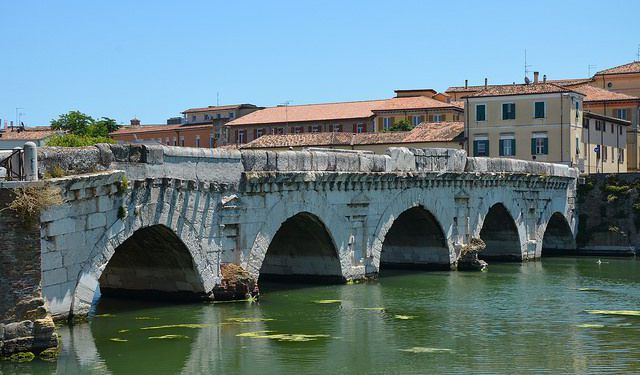
The Roman Republic founded an outpost called Ariminus at the mouth of the river Marecchia in 268 BC. Rimini was a center of civil wars and invasions. Julius Caesar made his famous "Rubicon" speech to his troops in the city forum.
The city was an all-important junction. The ancient Roman road, via Flaminia, ended in Rimini at the Arch of Augustus, erected in 27 BC. Another old Roman... view more
Tour Duration: 2 Hours
Travel Distance: 2.4 Km or 1.5 Miles
The city was an all-important junction. The ancient Roman road, via Flaminia, ended in Rimini at the Arch of Augustus, erected in 27 BC. Another old Roman... view more
Tour Duration: 2 Hours
Travel Distance: 2.4 Km or 1.5 Miles

Discover Rimini's Federico Fellini Sites on Foot
Even those vaguely familiar with cinema perhaps have heard of Federico Fellini. In recent history, the picturesque resort town of Rimini, on the Adriatic coast of Italy, "marked" itself primarily as the birthplace and the final resting place of this great film director.
Fellini lived in Rimini from January 1920, when he was born, until January 1939, when he moved out to Rome. While... view more
Tour Duration: 2 Hours
Travel Distance: 3.4 Km or 2.1 Miles
Fellini lived in Rimini from January 1920, when he was born, until January 1939, when he moved out to Rome. While... view more
Tour Duration: 2 Hours
Travel Distance: 3.4 Km or 2.1 Miles
City Walks Overview
