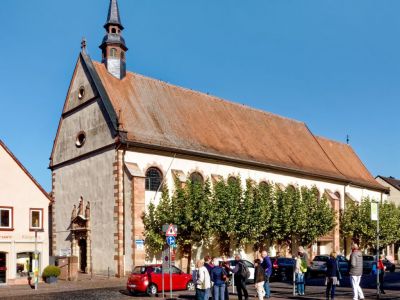


Franziskanerkirche (Franciscan Church), Miltenberg
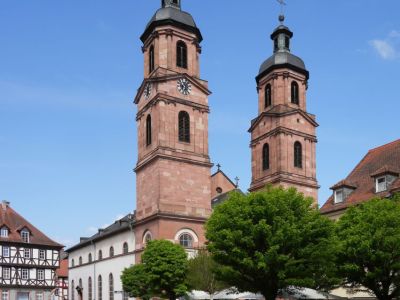
The Franciscan Church of the Immaculate Conception of Mary reflects more than three centuries of religious life and architectural tradition. Built as part of a larger monastery complex, it stands today as one of the town’s most impressive Baroque landmarks, recalling the presence of the Franciscan order that first settled here in the early 17th century.
The Franciscans arrived in Miltenberg around 1630 and soon established a permanent foundation. Their monastery was built between 1660 and 1662, and work on the church began in 1667 under the direction of Italian architect Antonio Petrini. Within two decades the nave and choir were completed, and the church was consecrated in 1688, giving the community a richly adorned place of worship.
Architecturally, the church is a seven-bay hall structure with a recessed two-bay choir, covered by a barrel-vaulted ceiling reinforced by arches. Highlights include the Rococo pulpit, decorated with gilded scrolls and twisted Solomonic columns, the organ case crafted by P. Adam Öhninger in 1681, and a number of side altars-some relocated from other sacred sites.
Beyond serving as a house of worship, the monastery and its church became a centre of learning and culture. Franciscan brothers lectured in philosophy and theology, while the monastery garden supported both spiritual contemplation and everyday needs. Like many religious institutions in Bavaria, it was reshaped by the secularisation of 1803, when church lands were seized by the state, yet the Franciscans continued to occupy parts of the complex for decades afterward.
The Franciscans arrived in Miltenberg around 1630 and soon established a permanent foundation. Their monastery was built between 1660 and 1662, and work on the church began in 1667 under the direction of Italian architect Antonio Petrini. Within two decades the nave and choir were completed, and the church was consecrated in 1688, giving the community a richly adorned place of worship.
Architecturally, the church is a seven-bay hall structure with a recessed two-bay choir, covered by a barrel-vaulted ceiling reinforced by arches. Highlights include the Rococo pulpit, decorated with gilded scrolls and twisted Solomonic columns, the organ case crafted by P. Adam Öhninger in 1681, and a number of side altars-some relocated from other sacred sites.
Beyond serving as a house of worship, the monastery and its church became a centre of learning and culture. Franciscan brothers lectured in philosophy and theology, while the monastery garden supported both spiritual contemplation and everyday needs. Like many religious institutions in Bavaria, it was reshaped by the secularisation of 1803, when church lands were seized by the state, yet the Franciscans continued to occupy parts of the complex for decades afterward.
Want to visit this sight? Check out these Self-Guided Walking Tours in Miltenberg. Alternatively, you can download the mobile app "GPSmyCity: Walks in 1K+ Cities" from Apple App Store or Google Play Store. The app turns your mobile device to a personal tour guide and it works offline, so no data plan is needed when traveling abroad.
Download The GPSmyCity App



Franziskanerkirche (Franciscan Church) on Map
Sight Name: Franziskanerkirche (Franciscan Church)
Sight Location: Miltenberg, Germany (See walking tours in Miltenberg)
Sight Type: Religious
Sight Location: Miltenberg, Germany (See walking tours in Miltenberg)
Sight Type: Religious
Nearby Sights
Walking Tours in Miltenberg, Germany

Create Your Own Walk in Miltenberg
Creating your own self-guided walk in Miltenberg is easy and fun. Choose the city attractions that you want to see and a walk route map will be created just for you. You can even set your hotel as the start point of the walk.
Miltenberg Introduction Walking Tour
Not even the small towns were safe from the wrath of the Nazis. Following the mass deportation of the Jewish population, the cobblestones of Miltenberg became dotted with brass Stolpersteine-stumbling stones-courtesy of artist Gunter Demnig.
Miltenberg’s name comes from the castle above the town-Mildenburg-from which the settlement below took its name.
Long before the Middle Ages, the area... view more
Tour Duration: 1 Hour(s)
Travel Distance: 1.7 Km or 1.1 Miles
Miltenberg’s name comes from the castle above the town-Mildenburg-from which the settlement below took its name.
Long before the Middle Ages, the area... view more
Tour Duration: 1 Hour(s)
Travel Distance: 1.7 Km or 1.1 Miles