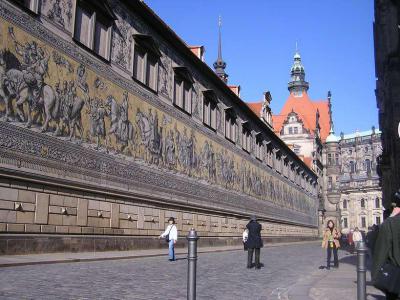


Fürstenzug (Procession of Princes), Dresden (must see)
The Procession of Princes is one of Dresden’s most remarkable outdoor artworks and one of the city’s most popular sights. Located along Augustus Street, outside the Stall Courtyard and beside Dresden’s Royal Palace, the enormous mural stretches for about 102 metres (or 335 feet). It depicts the rulers of the Wettin dynasty, which ruled Saxony for centuries, and was commissioned to celebrate the dynasty’s 800th anniversary in 1889.
The original mural was painted by Wilhelm Walther, who spent five years completing it in 1876. As the artwork began to fade, it was replaced between 1904 and 1907 with around 23,000 Meissen porcelain tiles, making it weather-resistant and creating what is considered the world’s largest porcelain artwork. Take a close look at the beginning of the mural to appreciate the seamless joinery of the weather-resistant porcelain tiles.
The mural portrays 35 margraves, electors, dukes, and kings of the House of Wettin, covering the period from 1127 to 1904. The procession begins with Conrad, Margrave of Meissen, and shows the rulers on horseback, with their names beneath them. Interestingly, Frederick Augustus III, the last King of Saxony, is not included. The rulers are accompanied by 59 other figures, including farmers, craftsmen, scientists, artists, and children.
A young girl among the children is the only female figure in the procession, while the final figure is the mural’s original creator, Wilhelm Walther. Take your time and walk slowly from east to west along the street, following the chronological order of the mounted rulers and reading the names inscribed beneath each horse until you reach the mention of Wilhelm Walther. Just a little bit east of Walther's depiction, you can find the young girl, wearing a wreath.
Moreover, look closely and you will notice that the mural was designed to resemble a giant tapestry. The upper edge features 38 decorative hanging knobs, while ornamental frames contain plants, butterflies, and birds.
Remarkably, the porcelain mural survived the 1945 bombing of Dresden with relatively little damage. For tourists, walking along the mural offers a chance to examine its detailed costumes, horses, and historical figures while enjoying a fascinating visual journey through Saxony’s past. It is free to view and accessible at any time, making it an easy stop while exploring Dresden’s Old Town.
The original mural was painted by Wilhelm Walther, who spent five years completing it in 1876. As the artwork began to fade, it was replaced between 1904 and 1907 with around 23,000 Meissen porcelain tiles, making it weather-resistant and creating what is considered the world’s largest porcelain artwork. Take a close look at the beginning of the mural to appreciate the seamless joinery of the weather-resistant porcelain tiles.
The mural portrays 35 margraves, electors, dukes, and kings of the House of Wettin, covering the period from 1127 to 1904. The procession begins with Conrad, Margrave of Meissen, and shows the rulers on horseback, with their names beneath them. Interestingly, Frederick Augustus III, the last King of Saxony, is not included. The rulers are accompanied by 59 other figures, including farmers, craftsmen, scientists, artists, and children.
A young girl among the children is the only female figure in the procession, while the final figure is the mural’s original creator, Wilhelm Walther. Take your time and walk slowly from east to west along the street, following the chronological order of the mounted rulers and reading the names inscribed beneath each horse until you reach the mention of Wilhelm Walther. Just a little bit east of Walther's depiction, you can find the young girl, wearing a wreath.
Moreover, look closely and you will notice that the mural was designed to resemble a giant tapestry. The upper edge features 38 decorative hanging knobs, while ornamental frames contain plants, butterflies, and birds.
Remarkably, the porcelain mural survived the 1945 bombing of Dresden with relatively little damage. For tourists, walking along the mural offers a chance to examine its detailed costumes, horses, and historical figures while enjoying a fascinating visual journey through Saxony’s past. It is free to view and accessible at any time, making it an easy stop while exploring Dresden’s Old Town.
Want to visit this sight? Check out these Self-Guided Walking Tours in Dresden. Alternatively, you can download the mobile app "GPSmyCity: Walks in 1K+ Cities" from Apple App Store or Google Play Store. The app turns your mobile device to a personal tour guide and it works offline, so no data plan is needed when traveling abroad.
Download The GPSmyCity App



Fürstenzug (Procession of Princes) on Map
Sight Name: Fürstenzug (Procession of Princes)
Sight Location: Dresden, Germany (See walking tours in Dresden)
Sight Type: Attraction/Landmark
Guide(s) Containing This Sight:
Sight Location: Dresden, Germany (See walking tours in Dresden)
Sight Type: Attraction/Landmark
Guide(s) Containing This Sight:
Nearby Sights
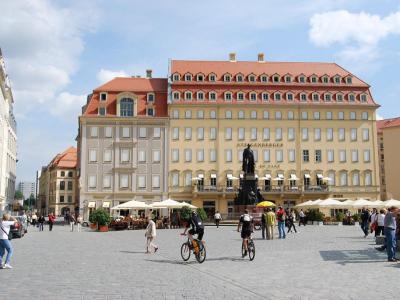
Walking Tours in Dresden, Germany

Create Your Own Walk in Dresden
Creating your own self-guided walk in Dresden is easy and fun. Choose the city attractions that you want to see and a walk route map will be created just for you. You can even set your hotel as the start point of the walk.
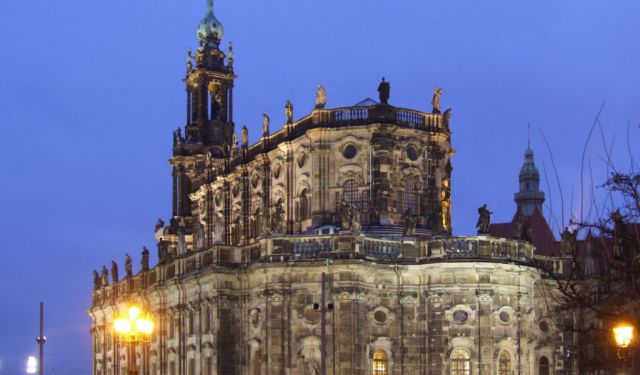
Dresden's Architectural Jewels
If there is one thing Dresden is particularly famous for, it is the magnificent architecture. Although known primarily for its Baroque buildings, the city has several other architectural styles present too, such as Renaissance, Historicism, Modernism and Post-modernism.
Much of downtown Dresden was destroyed in February 1945 by Allied bombing, which in turn prompted the rebuilding of the... view more
Tour Duration: 1 Hour
Travel Distance: 1.9 Km or 1.2 Miles
Much of downtown Dresden was destroyed in February 1945 by Allied bombing, which in turn prompted the rebuilding of the... view more
Tour Duration: 1 Hour
Travel Distance: 1.9 Km or 1.2 Miles
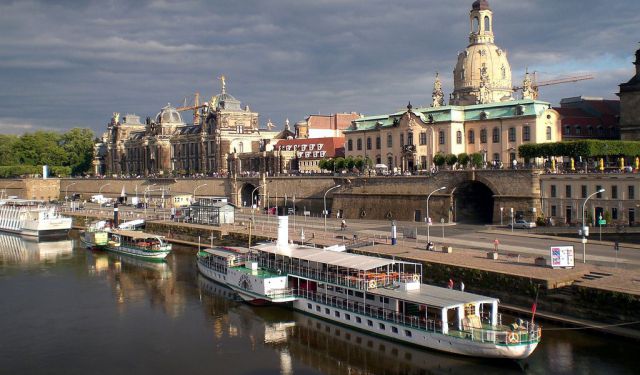
A Walk Through Dresden's Historic Old Town
Dresden’s reputation as a city of art and architecture has earned it the nickname “Florence on the Elbe.”
Dresden, the capital of Saxony, lies on the banks of the River Elbe in eastern Germany. The area may have been settled by Neolithic communities as early as 7500 BC, but Dresden’s documented history begins much later. The city developed within the Margraviate of Meissen, a territory... view more
Tour Duration: 2 Hours
Travel Distance: 2.5 Km or 1.6 Miles
Dresden, the capital of Saxony, lies on the banks of the River Elbe in eastern Germany. The area may have been settled by Neolithic communities as early as 7500 BC, but Dresden’s documented history begins much later. The city developed within the Margraviate of Meissen, a territory... view more
Tour Duration: 2 Hours
Travel Distance: 2.5 Km or 1.6 Miles
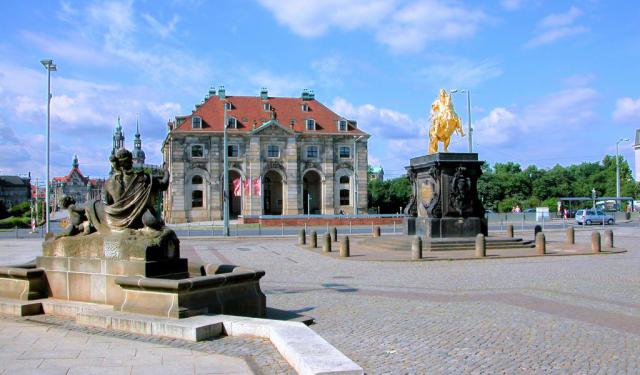
Exploring Dresden New Town on Foot
Dresden’s New Town occupies the northern bank of the Elbe, directly opposite the historic Old Town. Despite its name, it is far from new. The area was settled in the Middle Ages and was historically known as Old Dresden. It was incorporated into Dresden in 1549 under Elector Moritz but remained a relatively modest settlement for centuries compared with the more prestigious city on the opposite... view more
Tour Duration: 1 Hour
Travel Distance: 2.2 Km or 1.4 Miles
Tour Duration: 1 Hour
Travel Distance: 2.2 Km or 1.4 Miles