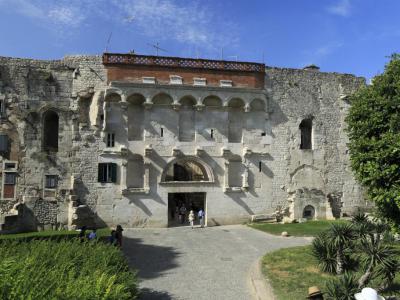


Golden Gate, Split
Now, imagine Emperor Diocletian, who has officially clocked out of ruling the Roman Empire-so, no more edicts, no rebellions-sailing home to his seaside villa. The word “villa”, however, might be an understatement for a fortress with a sea view...
He steps ashore, dusts off his toga, and walks straight through one of the four entrances to what is now the Old Town of Split, though in Diocletian’s day it was simply his palace. The Romans, being Romans, built it as the so-called "propugnaculum"-the double doors for defensive purposes.
Today, we call it the Golden Gate. Back then, it was known as Porta Septemtrionalis, or the Northern Gate. In the Middle Ages, it became the Roman Gate. The name “Golden Gate” didn’t appear until 1553. Same structure, different branding. History loves to rebrand...
Take a closer look at the façade, and you’ll spot niches designed for statues of the ruling power squad: the four Tetrarchs. That’s Diocletian himself, alongside his imperial colleagues, namely Maximian, Galerius, and Constantius Chlorus-the men who split the empire into manageable pieces and hoped it would behave. Above the outer section of the gate, the small 6th-century Church of Saint Martin quietly perches, as if keeping watch over centuries of comings and goings.
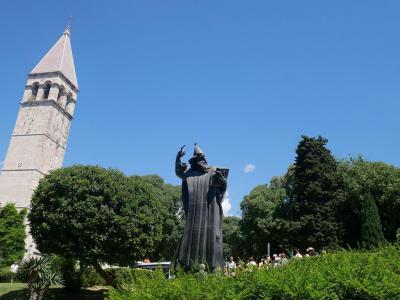
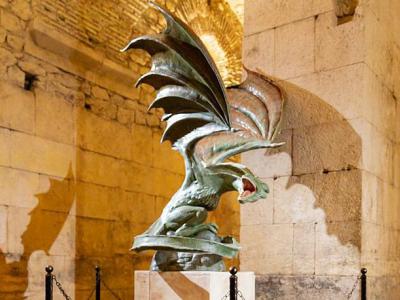
Ironically, most modern visitors enter from the sea, through the southern or eastern gates. The Golden Gate-the grand, ceremonial main entrance-doesn’t always get the spotlight it was built for. But step outside, and you can’t miss the towering 28-foot statue of Saint Gregory of Nin, standing guard just beyond the gate. Bronze, bold, and impossible to ignore.
So, whenever you pass through, just imagine the emperor himself doing the same-retired, powerful, and very pleased with his new address...
He steps ashore, dusts off his toga, and walks straight through one of the four entrances to what is now the Old Town of Split, though in Diocletian’s day it was simply his palace. The Romans, being Romans, built it as the so-called "propugnaculum"-the double doors for defensive purposes.
Today, we call it the Golden Gate. Back then, it was known as Porta Septemtrionalis, or the Northern Gate. In the Middle Ages, it became the Roman Gate. The name “Golden Gate” didn’t appear until 1553. Same structure, different branding. History loves to rebrand...
Take a closer look at the façade, and you’ll spot niches designed for statues of the ruling power squad: the four Tetrarchs. That’s Diocletian himself, alongside his imperial colleagues, namely Maximian, Galerius, and Constantius Chlorus-the men who split the empire into manageable pieces and hoped it would behave. Above the outer section of the gate, the small 6th-century Church of Saint Martin quietly perches, as if keeping watch over centuries of comings and goings.
Ironically, most modern visitors enter from the sea, through the southern or eastern gates. The Golden Gate-the grand, ceremonial main entrance-doesn’t always get the spotlight it was built for. But step outside, and you can’t miss the towering 28-foot statue of Saint Gregory of Nin, standing guard just beyond the gate. Bronze, bold, and impossible to ignore.
So, whenever you pass through, just imagine the emperor himself doing the same-retired, powerful, and very pleased with his new address...
Want to visit this sight? Check out these Self-Guided Walking Tours in Split. Alternatively, you can download the mobile app "GPSmyCity: Walks in 1K+ Cities" from Apple App Store or Google Play Store. The app turns your mobile device to a personal tour guide and it works offline, so no data plan is needed when traveling abroad.
Download The GPSmyCity App



Golden Gate on Map
Sight Name: Golden Gate
Sight Location: Split, Croatia (See walking tours in Split)
Sight Type: Attraction/Landmark
Guide(s) Containing This Sight:
Sight Location: Split, Croatia (See walking tours in Split)
Sight Type: Attraction/Landmark
Guide(s) Containing This Sight:
Nearby Sights
Walking Tours in Split, Croatia

Create Your Own Walk in Split
Creating your own self-guided walk in Split is easy and fun. Choose the city attractions that you want to see and a walk route map will be created just for you. You can even set your hotel as the start point of the walk.
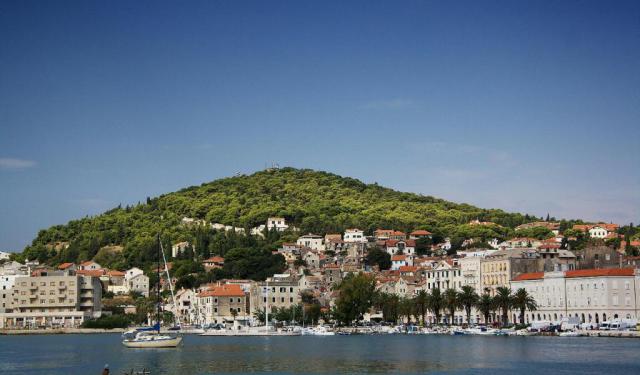
Marjan Hill Walking Tour
Marjan Hill is a picturesque natural wonder – a unique landform – located on the Split peninsula in Croatia. The majestic hill (or the low mountain, if you like) is surrounded by the sea and the city, and represents the green oasis ideal for walks, excursions, and rock climbing. Visitors to the area are greeted with a plethora of sights catering to various interests and equally enjoyed by... view more
Tour Duration: 1 Hour(s)
Travel Distance: 1.4 Km or 0.9 Miles
Tour Duration: 1 Hour(s)
Travel Distance: 1.4 Km or 0.9 Miles
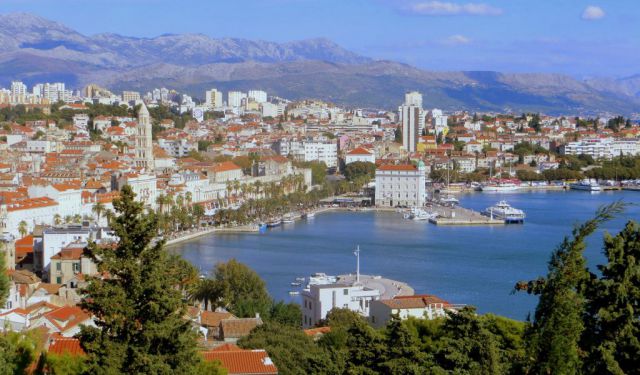
Split Old Town Walking Tour
Welcome to Split, Dalmatia’s sun-drenched heart and, believe it or not, the ultimate ancient retirement plan.
Its story has a bit of a botanical side and dates back more than two millennia, when Greek settlers from Issa (or modern-day Vis) founded here a colony they called Aspalathos, named after a prickly, yellow-flowering shrub that still dots the coastline. The Romans called it Spalatum,... view more
Tour Duration: 1 Hour(s)
Travel Distance: 1.2 Km or 0.7 Miles
Its story has a bit of a botanical side and dates back more than two millennia, when Greek settlers from Issa (or modern-day Vis) founded here a colony they called Aspalathos, named after a prickly, yellow-flowering shrub that still dots the coastline. The Romans called it Spalatum,... view more
Tour Duration: 1 Hour(s)
Travel Distance: 1.2 Km or 0.7 Miles
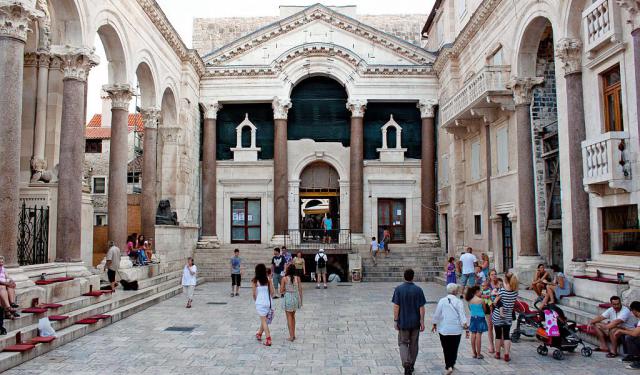
Diocletian Palace Tour
One of the best-preserved monuments of Roman architecture in the world, Diocletian’s Palace is also probably the most impressive “retirement home” in history. Imagine quitting a job at the age of sixty and deciding your quiet seaside cottage should also function as a fortress. That was exactly the plan of Roman emperor Diocletian... In 305 AD, after abdicating-which is something Roman... view more
Tour Duration: 1 Hour(s)
Travel Distance: 0.6 Km or 0.4 Miles
Tour Duration: 1 Hour(s)
Travel Distance: 0.6 Km or 0.4 Miles