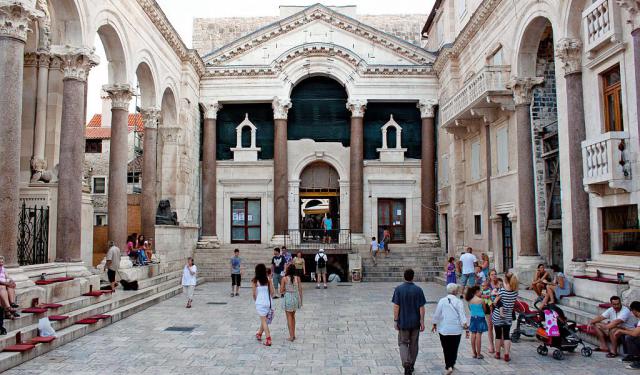


Diocletian Palace Tour, Split

Diocletian Palace Tour (Self Guided), Split

One of the best-preserved monuments of Roman architecture in the world, Diocletian’s Palace is also probably the most impressive “retirement home” in history. Imagine quitting a job at the age of sixty and deciding your quiet seaside cottage should also function as a fortress. That was exactly the plan of Roman emperor Diocletian... In 305 AD, after abdicating—which is something Roman emperors were not particularly famous for—he chose this Adriatic location for its mild climate and strategic position.

Conceived as both a luxurious villa and a fortified military complex, the massive structure resembles a stronghold, enclosed by thick walls, defensive towers, and a grid of two main streets dividing it into four neat sections—because emperors, of all people, appreciate good urban planning... The complex combined imperial apartments, temples, soldiers’ quarters, and storage areas.

But here’s the twist: as Roman authority declined and new powers emerged, the palace did not fall into a romantic ruin, no. Instead, it gradually evolved into the living core of Split. Locals adapted its spaces to suit their needs, building houses, churches, and shops within the ancient walls.

Although these changes significantly altered both the interior and exterior, the outlines of the original Roman structure remain clearly visible. Medieval, Renaissance, and Baroque layers settled comfortably onto Roman foundations, creating a city that grew inside a palace. Today, this former retirement project makes up nearly half of Split’s Old Town and has been a UNESCO World Heritage Site since 1979.

Enter through the Bronze Gate from the waterfront, and you’ll find the Podrum—the original storage cellars—now filled with market stalls instead of imperial supplies. Step up into the circular Vestibule, once designed to impress ambassadors with its acoustics. Ahead lies the Peristyle, where the Cathedral of St. Domnius stands inside what was once Diocletian’s own mausoleum—a remarkable bit of historical irony... Just nearby, the Temple of Jupiter quietly reminds you of the place’s pagan origins.

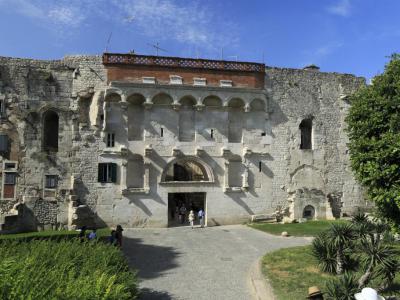
The Golden Gate still makes the grandest statement, while the Silver and Iron Gates link the palace to later medieval streets. The Church of Our Lady of the Bell Tower and the small Church of Saint Martin add further historical layers, while museums like the Ethnographic Museum and the City Museum of Split, complete with everyday life, continue to animate the stone.

So, don’t just admire Diocletian’s Palace from afar. Walk its streets. Touch the walls. Look up. Seventeen centuries are layered above and beneath you—and in this palace, history doesn’t quietly whisper. It lives on.
How it works: Download the app "GPSmyCity: Walks in 1K+ Cities" from Apple App Store or Google Play Store to your mobile phone or tablet. The app turns your mobile device into a personal tour guide and its built-in GPS navigation functions guide you from one tour stop to next. The app works offline, so no data plan is needed when traveling abroad.

Download The GPSmyCity App

Diocletian Palace Tour Map

Guide Name: Diocletian Palace Tour
Guide Location: Croatia » Split (See other walking tours in Split)
Guide Type: Self-guided Walking Tour (Sightseeing)
# of Attractions: 11
Tour Duration: 1 Hour(s)
Travel Distance: 0.6 Km or 0.4 Miles
Author: DanaOffice
Sight(s) Featured in This Guide:
  • Bronze Gate
  • Ethnographic Museum
  • Vestibule
  • Podrum (Cellars of Diocletian's Palace)
  • Cathedral of St. Domnius
  • Temple of Jupiter
  • Iron Gate and Church of Our Lady of the Bell Tower
  • Silver Gate
  • City Museum of Split
  • Church of Saint Martin
  • Golden Gate
1
Bronze Gate

1) Bronze Gate

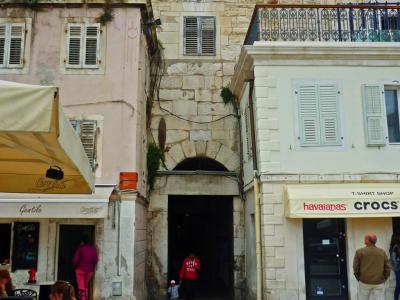
Begin your acquaintance with Diocletian's Palace at its southern entrance — the Bronze Gate or, as the Romans used to call it, Porta Meridionalis. If you’re expecting grandeur, columns, dramatic statues — lower those expectations just a notch. This one is small. Plain. No ornament. No flanking towers flexing imperial muscle. In fact, compared to other gates, it feels almost… shy.

But that understated look hides a clever purpose, as the gate had a very specific job. It opened straight to the sea and doubled as an emergency exit if trouble came from the land. Practical. Efficient. Very Roman. In the Middle Ages, it even picked up the nickname “the security gate,” which sounds far less glamorous but wonderfully pragmatic.

Back in Diocletian’s day, there was no sunny promenade outside, no cafés, no strolling crowds. The sea reached right up to the southern wall. Imagine waves brushing the stones. The emperor could sail in and step directly into his residence — no traffic, no ceremony, just a smooth imperial arrival. Not a bad commute for a retired ruler...

Today, things look very different. The Riva promenade stretches along the waterfront, and the Bronze Gate has become the palace’s busiest entrance. It now channels visitors from the seafront straight toward the Cathedral, and many guided — or self-guided — tours begin right here. What was once a discreet imperial entry is now the people’s gateway.

And here’s a detail worth noting: Diocletian’s private apartments occupied the southern half of the complex. Naturally, that meant the southern side — below the east–west decumanus street — was the more luxurious zone. Proximity to the sea meant better views, cooler air, and a touch of quiet exclusivity. Indeed, even in retirement, the emperor knew exactly where the premium real estate was.
2
Ethnographic Museum

2) Ethnographic Museum

If you, at some point, need a break from emperors, mausoleums, and dramatic power moves while in Split, step into the Ethnographic Museum—where history swaps its marble toga for everyday clothing. Founded in 1910, this compact museum focuses on life in Dalmatia, past and present.

Think traditional costumes, intricate embroidery, hand-knitted pieces, and the kind of trade goods that kept coastal communities ticking. You’ll see wood carvings, pottery, jewelry, even weapons—because daily life wasn’t always peaceful. And keep an eye out for the famously delicate lace from the islands of Pag and Hvar. It’s the sort of craftsmanship that makes you reconsider what “handmade” really means.

Location-wise, the museum doesn’t get more central. It sits right beside the Peristyle, the ceremonial heart of the imperial complex. On the ground floor, you’ll find the 7th-century Church of Saint Andrew de Fenestris—quietly sharing walls with what were once Emperor Diocletian’s own sleeping quarters. Yes, the ruler of a vast empire once dozed off roughly where you’re now standing.

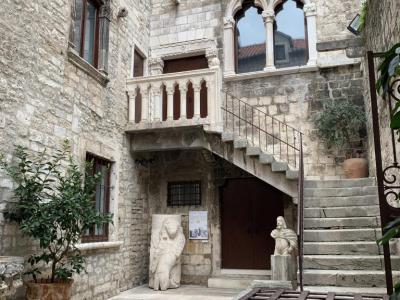
From here, climb the staircase to the Renaissance terrace above the Vestibule. The views are well worth the effort—and your camera roll will thank you.

What makes this place special is its focus. This isn’t about grand conquests or political drama. It’s about ordinary people: how they dressed, worked, crafted, traded, and celebrated across centuries in Dalmatia. It’s history at ground level—textured, practical, and surprisingly relatable.

There’s a small admission fee, with a discount if you’re carrying a Split Card. A modest price, really, for a reminder that while emperors built the palace, it is everyday people who truly made it home.
3
Vestibule

3) Vestibule

Now and then, something magical happens in the Vestibule of Diocletian's Palace. A klapa group quietly gathers, forms a small circle, clears a throat or two—and suddenly, traditional Dalmatian a cappella fills the air. No instruments, no microphones. Just voices rising, blending, and bouncing off ancient stone. If emperors have ghosts, you can almost picture Diocletian pausing mid-haunt to listen.

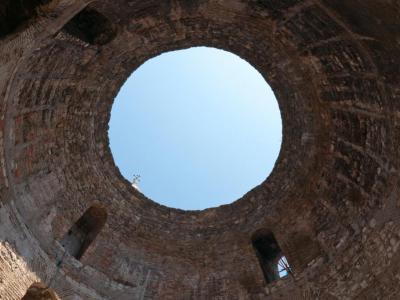
Glance upward. The Vestibule is a rotunda with its dome missing, replaced by a perfect round window of blue sky. It feels a bit like an ancient temple open to the heavens. Long ago, smoke from pagan rituals would have drifted upward. Today, it is harmonies that spiral into the open air—no fire and sacrifice, just tenor and baritone...

Architecturally, this space served as a grand reception hall. It linked the Peristyle to the emperor’s private apartments and was designed to impress ambassadors before they even laid eyes on the ruler himself. Imagine the scene: polished marble, guarded entrances, visiting dignitaries rehearsing their speeches. The room was built to command attention.

So, why do klapa singers choose this very spot? Quite simple—for its acoustics. The curved stone walls act like a giant resonating chamber. Every note expands, deepens, and returns richer than before. The space doesn’t just carry sound—it embraces it. And for a few minutes, under that open circle of sky, Roman architecture becomes the world’s most dramatic concert hall...
4
Podrum (Cellars of Diocletian's Palace)

4) Podrum (Cellars of Diocletian's Palace)

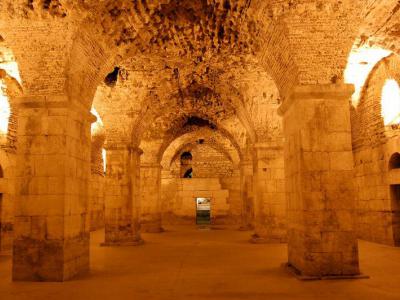
Hidden just beneath Diocletian’s lavish imperial apartments lies a labyrinth few emperors could boast about: the mighty Podrum, or cellars. Built in the 4th century to mirror and support the grand halls above, these vaulted chambers span about one-eighth of the entire palace, and to this day, you can still see the remnants of a large wine and olive press used in Roman times. And yes, there was even a small nymphaeum: a shrine to the nymphs said to guard the precious fresh water flowing through the palace.

As centuries rolled on and Split grew, the palace transformed from an emperor’s retirement retreat into a refuge. When Salona fell in the 7th century, refugees found shelter within its sturdy walls. Over time, residents above broke through vaults to build basements or storerooms—early medieval real-estate hacks, you might call them.

In modern times, Podrum’s fame soared thanks to its role in “Game of Thrones.” Fans will instantly recognize the cellars as the location where Daenerys Targaryen kept her dragons chained in Meereen. These scenes were filmed in the central halls, turning ancient stone into television legend.

Today, you enter this underground world either through the Bronze Gate on the Riva or a staircase from the Peristyle. The western part has been carefully preserved and opened to the public in 1959, used for exhibitions, artisan fairs, and occasional concerts under soaring arches. The eastern section (which collapsed in medieval times) is now mostly restored and accessible since the 1990s.

Walking through these cool, echoing halls, you’re literally walking in the footsteps—and stone foundations—of emperors, traders, refugees, and storytellers. Here, the past thrives beneath your feet, merging Roman ambition with modern fascination, one vaulted chamber after another.
5
Cathedral of St. Domnius

5) Cathedral of St. Domnius (must see)

In 305 AD, Emperor Diocletian, known for his brutal persecution of Christians, retired to sunny Dalmatia to cultivate cabbages and built himself a magnificent mausoleum at the heart of his new palace. A few centuries later, that same mausoleum was transformed into a cathedral dedicated to one of the very martyrs he had executed. What a dramatic irony of history...

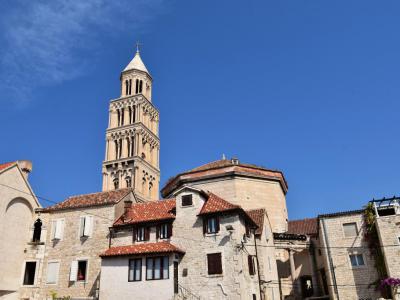
The structure we see today was expertly crafted from white marble, limestone, and brick around the late third century. By the seventh century, refugees from destroyed Salona, who settled in the palace walls, consecrated it as a Christian church dedicated to the Virgin Mary. A choir was later added, and by the 12th century, the elegant bell tower honoring Bishop Domnius rose above the ancient stone.

Saint Domnius himself was the Bishop of Salona, born in Antioch and beheaded in 304 alongside other Christians, ironically dying just a year before Diocletian abdicated. Today, this cathedral is still in use within its original structure, making it the oldest Catholic cathedral in the world still used in its primary form.

As you approach the cathedral, you’ll walk along the same main north-south and east-west streets that guided pilgrims through the palace centuries ago. At their crossing lies the Peristyle, a grand courtyard that serves as the main entrance to the cathedral.

Cross the threshold, and you’re stepping into over 1,700 years of layered history: from an emperor’s resting place to a medieval choir loft, through the Romanesque tower, and into a treasury. The latter is filled with numerous masterpieces such as the 13th-century Madonna and Child panel, intricately crafted reliquaries, ceremonial chalices, and manuscripts spanning from the 6th to the 19th centuries.

It is fair to say that nowhere else do imperial power, medieval devotion, and contemporary faith converge so elegantly, especially when viewed through the lens of fate’s own historical twist...
6
Temple of Jupiter

6) Temple of Jupiter

Just a few steps from the Peristyle, in the western stretch of Diocletian's Palace, stands a compact but powerful survivor: the Temple of Jupiter. Built around the year 300 AD, it began as a shrine to Jupiter—Roman Zeus and, conveniently, Emperor Diocletian’s so-called “divine father.” Because when you rule the empire, it helps to keep the king of the gods in the family...

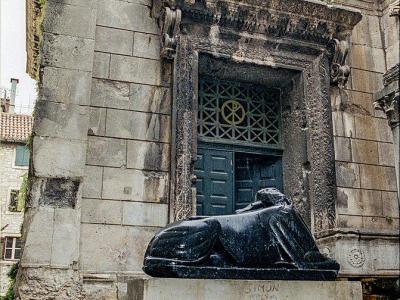
Out front, you’ll meet one of the twelve sphinxes Diocletian imported from Egypt. Yes, imported. Apparently, retirement plans included a touch of Nile-side décor. Above the entrance, reliefs line up like a mythological guest list: Victoria, Triton, Helios, Hercules, Apollo... Heroes, sea gods, sun gods—everyone showed up. Or almost everyone. Parts of the palace were still unfinished when the emperor returned rather suddenly after his abdication. Even divine sons, it seems, don’t always stick to the construction schedule...

Then history pivoted. In the sixth century, the pagan temple became a baptistery dedicated to Saint John the Baptist. The pagan gods stepped aside; the Christian saints stepped in. Inside, you’ll find the sarcophagi of early archbishops Ivan of Ravenna and Lovre, linking the space to Split’s Christian story. And Saint John himself appears in striking form—a large bronze statue, adding a bold 20th-century presence to a 4th-century shell.

Raise your gaze, and you’ll notice yet another layer: an 11th-century Romanesque bell tower rising above the vault. Pagan temple, Christian baptistery, medieval addition—this small structure carries centuries with surprising confidence.

And one final twist: in 1907, the surrounding houses that had grown tightly against its walls were cleared away, finally giving the temple room to breathe again. So, standing here, be aware—you’re not merely looking at ancient stone, you’re watching a building that has reinvented itself for more than 1,700 years, without ever losing its sense of drama...
7
Iron Gate and Church of Our Lady of the Bell Tower

7) Iron Gate and Church of Our Lady of the Bell Tower

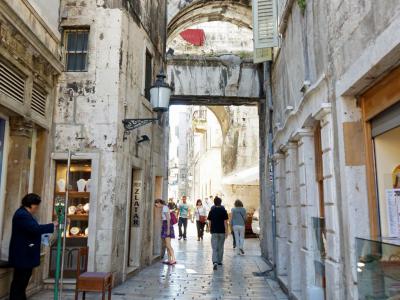
On the western side of Diocletian’s Palace stands the West Gate—better known as the Iron Gate—one of the four original entrances into the emperor’s fortified retirement dream. Today, it opens straight into the lively fabric of Split, where the palace walls blend seamlessly with People’s Square. Around you rise the old City Hall, the clock tower, and a lineup of aristocratic residences—the Nakić, Karepić, Cambi, and Cipriani palaces—proof that prime real estate has always been in demand...

But don’t let the cafés and chatter distract you. The Iron Gate still carries traces of its defensive past. Look closely, and you’ll notice the ancient rampart and what was once a double-door security chamber—an early version of “authorized personnel only.” Above the passage sits the Church of Our Lady of the Bell Tower, a narrow, almost hidden sacred space tucked into the thickness of the walls. Like the chapels above the other gates, it makes impressive use of very limited square footage. In the 11th century, a bell tower was added, giving the structure a new vertical accent and a fresh medieval identity layered onto its Roman bones.

And here’s a detail many pass by without noticing: on the northern wall of the rampart, behind what was once a sealed medieval niche, a sculpture was discovered—hands holding a crown. Carefully restored and returned to its original position, it now quietly watches over the gate once more.

So, as you step through the Iron Gate, remember—while entering this square, you’re crossing a threshold guarded by emperors, nobles, and a pair of stone hands still holding on to their crown...
8
Silver Gate

8) Silver Gate

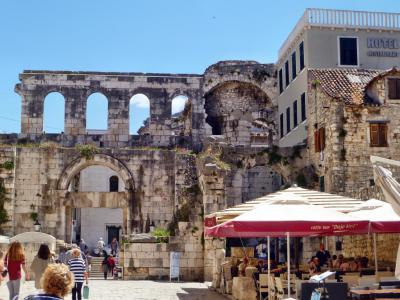
Four gates guard the Old Town of Split, and the Romans, never ones to miss a directional detail, named them appropriately. The Silver Gate faces east, toward the ancient Roman town of Epetia, so they called it Porta Orientalis—literally, the “eastern gate.” Straightforward, efficient, and very Roman. The other entrances' names are all about metals and practicality: Golden Gate, Iron Gate, and Bronze Gate. Diocletian may have retired from power, but he certainly didn’t retire from branding...

After Salona, the nearby Roman capital, was destroyed by Avars and Slavs around the 7th century AD, refugees took shelter within the sturdy walls of Diocletian’s Palace. The space inside was tight, so what they did was build upward. Above the Silver Gate, in a narrow corridor, they tucked in a mini-church dedicated to Saint Apolinar. Yes, a chapel above a gateway. And since good ideas travel fast, similar little churches eventually appeared above other gates, too. Medieval multitasking at its finest...

By the 18th century, the Venetians decided the Silver Gate needed a sidekick. So, they added a “small gate” next to it—because, apparently, even ancient Roman entrances benefit from a practical shortcut.

Stepping outside the Silver Gate, you can’t help noticing a lively market scene. Just opposite stands the 17th-century monastery and church of Saint Catherine of Alexandria, built by the Dominicans. From imperial fortifications to monastic calm, all within a few steps.

And history doesn’t stop there. In the year 2000, Pope John Paul II passed through the Silver Gate in his Popemobile en route to visit the Cathedral of Saint Domnius. Indeed, not every Roman gate can say it has welcomed both an emperor and a pope.

So, as you walk through, don’t just pass under the arch—listen closely. These gates have seen empires rise, refugees arrive, Venetians renovate, and popes roll through. Not bad for an old doorway...
9
City Museum of Split

9) City Museum of Split

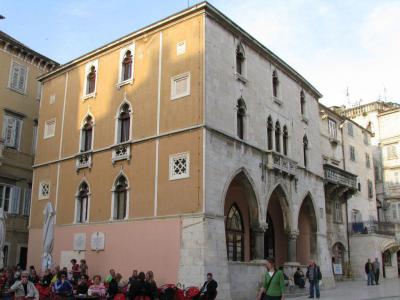
The City Museum of Split has been telling Split’s story since 1946, although the building itself had already been around for a few centuries before that. Tucked into the northeastern corner of Diocletian's Palace, inside the former Papalić Palace, it was once home to one of Split’s noble families. Just pause here for a closer look at the portal, and you’ll spot their coat of arms.

The palace was designed in the 15th century by Juraj of Dalmatia. The courtyard alone is worth a pause: a richly decorated portal, an elegant loggia, and a Renaissance hall crowned with a beautifully preserved wooden ceiling. In essence, this wasn't any average medieval townhouse. This was the kind of place where architecture quietly shows off.

Head upstairs, and the story of Split unfolds in layers. The permanent collection walks you from Roman times—back to Diocletian—through the centuries when Split functioned as an autonomous medieval commune, and onward into later periods. Expect medieval weaponry, paintings, fragments of sculptures once attached to city buildings, and stone monuments that have seen more history than most textbooks.

One room even recreates the Papalić family dining hall, fully furnished to reflect the noble life of the time. It’s like stepping into a dinner party where everyone has been waiting 500 years for dessert.

You’ll also find the city’s statute, seal, and coins, Romanesque sculptures from the cathedral’s belfry dating to Venetian rule, and a wealth of documents, maps, and photographs tracing Split’s more recent past. And just when you think you’ve reached the end, there’s a gallery dedicated to Emanuel Vidović, one of the leading figures of Croatian modern painting—proof that Split didn’t stop creating after the Renaissance...

So, take your time and pay attention—because in this palace within a palace, history isn’t some background noise; it’s the main storyteller...
10
Church of Saint Martin

10) Church of Saint Martin

High above the Golden Gate of Diocletian's Palace—in what used to be a narrow guard corridor—you’ll find one of Split’s smallest and most surprising sanctuaries: the Church of Saint Martin. Blink, and you might miss it. Step inside, and you’re suddenly standing in a space no larger than a hallway, transformed into a chapel sometime in the 6th century, when waves of refugees sought shelter within the palace walls. A guard post turned into a house of prayer—history does love a plot twist...

Today, the church is cared for by Dominican sisters, and for a small fee, you can squeeze in to admire its quiet treasures. The highlight is an 11th-century marble chancel screen, delicately carved with grapevines and griffins—symbols of life, faith, and perhaps a touch of medieval flair. The main altar dates back to the 9th century, proving that even the tiniest spaces can hold a very long history...

Saint Martin’s wasn’t alone up there. Similar little churches once crowned the Silver, Iron, and Bronze Gates. Where Roman niches once displayed statues of imperial tetrarchs, later generations installed saints instead—Saint Theodore guarding the West Gate, Saint Apollinaris the East, and Saint Julian the South. Empires fade; saints move in.

And then there’s the mystery. In 1929, a stone tablet was discovered in a sealed window. It read: “The unworthy servant, priest Dominic…” A gravestone, perhaps? A humble signature? No remains were ever found, so the story lingers—half fact, half whisper.

Standing underneath the Golden Gate, don’t just look forward. Look up. Because sometimes the most remarkable chapter of a 1,700-year-old palace is hiding in a space barely wider than your outstretched arms.
11
Golden Gate

11) Golden Gate

Now, imagine Emperor Diocletian, who has officially clocked out of ruling the Roman Empire—so, no more edicts, no rebellions—sailing home to his seaside villa. The word “villa”, however, might be an understatement for a fortress with a sea view...

He steps ashore, dusts off his toga, and walks straight through one of the four entrances to what is now the Old Town of Split, though in Diocletian’s day it was simply his palace. The Romans, being Romans, built it as the so-called "propugnaculum"—the double doors for defensive purposes.

Today, we call it the Golden Gate. Back then, it was known as Porta Septemtrionalis, or the Northern Gate. In the Middle Ages, it became the Roman Gate. The name “Golden Gate” didn’t appear until 1553. Same structure, different branding. History loves to rebrand...

Take a closer look at the façade, and you’ll spot niches designed for statues of the ruling power squad: the four Tetrarchs. That’s Diocletian himself, alongside his imperial colleagues, namely Maximian, Galerius, and Constantius Chlorus—the men who split the empire into manageable pieces and hoped it would behave. Above the outer section of the gate, the small 6th-century Church of Saint Martin quietly perches, as if keeping watch over centuries of comings and goings.

Ironically, most modern visitors enter from the sea, through the southern or eastern gates. The Golden Gate—the grand, ceremonial main entrance—doesn’t always get the spotlight it was built for. But step outside, and you can’t miss the towering 28-foot statue of Saint Gregory of Nin, standing guard just beyond the gate. Bronze, bold, and impossible to ignore.

So, whenever you pass through, just imagine the emperor himself doing the same—retired, powerful, and very pleased with his new address...

Walking Tours in Split, Croatia

Create Your Own Walk in Split

Create Your Own Walk in Split

Creating your own self-guided walk in Split is easy and fun. Choose the city attractions that you want to see and a walk route map will be created just for you. You can even set your hotel as the start point of the walk.
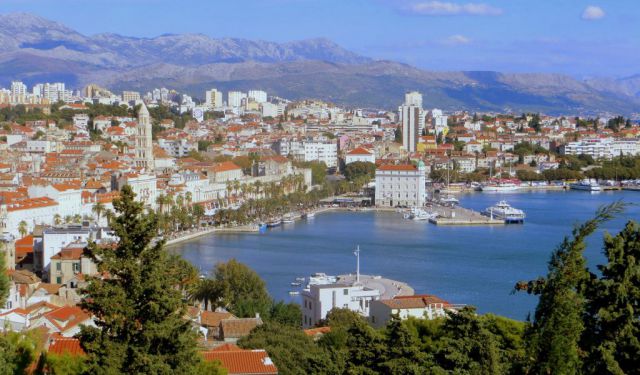
Marjan Hill Walking Tour

Marjan Hill Walking Tour

Marjan Hill is a picturesque natural wonder – a unique landform – located on the Split peninsula in Croatia. The majestic hill (or the low mountain, if you like) is surrounded by the sea and the city, and represents the green oasis ideal for walks, excursions, and rock climbing. Visitors to the area are greeted with a plethora of sights catering to various interests and equally enjoyed by...  view more

Tour Duration: 1 Hour(s)
Travel Distance: 1.4 Km or 0.9 Miles
Split Introduction Walking Tour

Split Introduction Walking Tour

Welcome to Split, Dalmatia’s sun-drenched heart and, believe it or not, the ultimate ancient retirement plan.

Its story has a bit of a botanical side and dates back more than two millennia, when Greek settlers from Issa (or modern-day Vis) founded here a colony they called Aspalathos, named after a prickly, yellow-flowering shrub that still dots the coastline. The Romans called it Spalatum,...  view more

Tour Duration: 1 Hour(s)
Travel Distance: 1.2 Km or 0.7 Miles