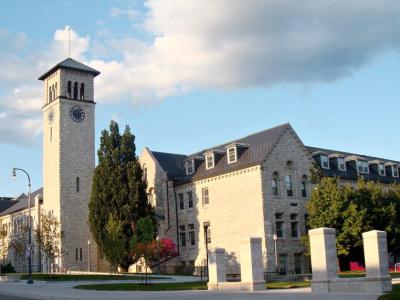


Grant Hall, Kingston
Grant Hall, completed in 1905, stands as the most recognizable landmark on the campus of Queen’s University in Kingston. Located on University Avenue just north of Bader Lane, this limestone-clad building is crowned with a Romanesque-style clock tower and stained-glass windows-a visual anchor of Queen’s identity and spirit.
Named after Principal George Monro Grant, the hall honors his legacy and the admiration of Queen’s students. Originally planned as Frontenac Hall, the project lost county support in 1901, likely due to Grant’s anti-prohibition stance. Students raised the $35,000 needed, many despite financial hardship. Grant died before its completion, and the building was named for him posthumously.
Designed by the Toronto-based firm Symons and Rae, who also worked on Kingston and Ontario Halls, Grant Hall embodies the Victorian Romanesque style. The original clock mechanism was the work of Queen’s professor Nathan Dupuis and his colleague James Connell. Though charming, the clock proved unreliable and was replaced in 1993 by an electric version-again funded by students, this time in celebration of the Faculty of Engineering's centenary.
With a seating capacity of 900, Grant Hall has long served as the ceremonial heart of the university. From convocation ceremonies and concerts to public lectures and exams, its role is largely symbolic and celebratory rather than academic. During World War I, the hall functioned as a military hospital, and in World War II, it was repurposed as an entertainment and meal center for troops.
Today, Grant Hall continues to represent Queen’s enduring traditions, student dedication, and the powerful legacy of George Monro Grant.
Named after Principal George Monro Grant, the hall honors his legacy and the admiration of Queen’s students. Originally planned as Frontenac Hall, the project lost county support in 1901, likely due to Grant’s anti-prohibition stance. Students raised the $35,000 needed, many despite financial hardship. Grant died before its completion, and the building was named for him posthumously.
Designed by the Toronto-based firm Symons and Rae, who also worked on Kingston and Ontario Halls, Grant Hall embodies the Victorian Romanesque style. The original clock mechanism was the work of Queen’s professor Nathan Dupuis and his colleague James Connell. Though charming, the clock proved unreliable and was replaced in 1993 by an electric version-again funded by students, this time in celebration of the Faculty of Engineering's centenary.
With a seating capacity of 900, Grant Hall has long served as the ceremonial heart of the university. From convocation ceremonies and concerts to public lectures and exams, its role is largely symbolic and celebratory rather than academic. During World War I, the hall functioned as a military hospital, and in World War II, it was repurposed as an entertainment and meal center for troops.
Today, Grant Hall continues to represent Queen’s enduring traditions, student dedication, and the powerful legacy of George Monro Grant.
Want to visit this sight? Check out these Self-Guided Walking Tours in Kingston. Alternatively, you can download the mobile app "GPSmyCity: Walks in 1K+ Cities" from Apple App Store or Google Play Store. The app turns your mobile device to a personal tour guide and it works offline, so no data plan is needed when traveling abroad.
Download The GPSmyCity App



Grant Hall on Map
Sight Name: Grant Hall
Sight Location: Kingston, Canada (See walking tours in Kingston)
Sight Type: Attraction/Landmark
Sight Location: Kingston, Canada (See walking tours in Kingston)
Sight Type: Attraction/Landmark
Nearby Sights
Walking Tours in Kingston, Ontario

Create Your Own Walk in Kingston
Creating your own self-guided walk in Kingston is easy and fun. Choose the city attractions that you want to see and a walk route map will be created just for you. You can even set your hotel as the start point of the walk.
Barriefield Heritage Village and Royal Military College Tour
Barriefield Heritage Village and the Royal Military College (RMC) in Kingston, Ontario, offer rich insights into Canada’s historical and military heritage. Connected to Kingston via a bridge across the lake, the historic Barriefield Village, established in 1814, is one of Ontario's oldest and most picturesque neighborhoods, designated as a heritage conservation district. The charming area... view more
Tour Duration: 2 Hour(s)
Travel Distance: 3.4 Km or 2.1 Miles
Tour Duration: 2 Hour(s)
Travel Distance: 3.4 Km or 2.1 Miles

Kingston Downtown Walking Tour
Kingston, Ontario, known as the "Limestone City" due to its numerous heritage buildings made from local limestone, has a rich history that began with European exploration in the 17th century. The French established a trading post and military fort in 1673 strategically located at the head of the Saint Lawrence River and the mouth of the Cataraqui River that drains into Lake Ontario. This... view more
Tour Duration: 2 Hour(s)
Travel Distance: 3.5 Km or 2.2 Miles
Tour Duration: 2 Hour(s)
Travel Distance: 3.5 Km or 2.2 Miles