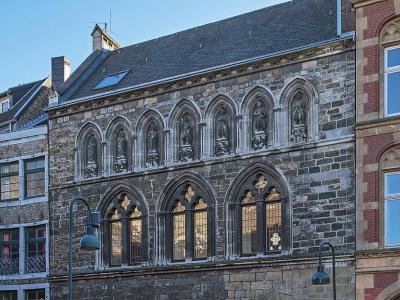


Grashaus (Grass House), Aachen
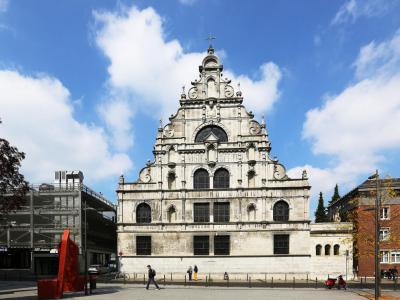
Grashaus is one of the oldest non-religious buildings still standing in the area. It was built in the early 13th century, around 1260–1267, and served as the first town hall. This was a time when local citizens began running their own affairs instead of depending mainly on church or royal power. City meetings and legal decisions were held here, making it an important place for early local government.
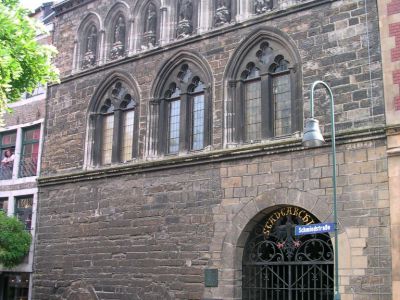
The exterior shows Gothic features like pointed arches, narrow windows, and thick stone walls. Above the windows are stone figures added in the 14th century, usually identified as the Seven Electors who chose the Holy Roman Emperor. Some research suggests King Richard of Cornwall may be among them. The design is simple and solid, shaped by public use rather than decoration.
Inside, the Grashaus once held offices, a courtroom, and later a prison, where serious crimes were judged and executions took place nearby. After a new town hall replaced it in the 14th century, it was reused as a granary and later as the city archive for over 100 years. Today, it is part of the Route Charlemagne as “Station Europa” and serves as an educational center, with interior visits mainly possible through guided tours, often on the first Saturday of the month.
The exterior shows Gothic features like pointed arches, narrow windows, and thick stone walls. Above the windows are stone figures added in the 14th century, usually identified as the Seven Electors who chose the Holy Roman Emperor. Some research suggests King Richard of Cornwall may be among them. The design is simple and solid, shaped by public use rather than decoration.
Inside, the Grashaus once held offices, a courtroom, and later a prison, where serious crimes were judged and executions took place nearby. After a new town hall replaced it in the 14th century, it was reused as a granary and later as the city archive for over 100 years. Today, it is part of the Route Charlemagne as “Station Europa” and serves as an educational center, with interior visits mainly possible through guided tours, often on the first Saturday of the month.
Want to visit this sight? Check out these Self-Guided Walking Tours in Aachen. Alternatively, you can download the mobile app "GPSmyCity: Walks in 1K+ Cities" from Apple App Store or Google Play Store. The app turns your mobile device to a personal tour guide and it works offline, so no data plan is needed when traveling abroad.
Download The GPSmyCity App



Grashaus (Grass House) on Map
Sight Name: Grashaus (Grass House)
Sight Location: Aachen, Germany (See walking tours in Aachen)
Sight Type: Attraction/Landmark
Guide(s) Containing This Sight:
Sight Location: Aachen, Germany (See walking tours in Aachen)
Sight Type: Attraction/Landmark
Guide(s) Containing This Sight:
Nearby Sights
Walking Tours in Aachen, Germany

Create Your Own Walk in Aachen
Creating your own self-guided walk in Aachen is easy and fun. Choose the city attractions that you want to see and a walk route map will be created just for you. You can even set your hotel as the start point of the walk.
A Walking Tour of Aachen's Historic Old Town
Welcome to Aachen, a city with roots stretching back to Neolithic times. For thousands of years, people have been drawn here by its mineral springs. Archaeologists have uncovered evidence of settlements dating back to the Bronze and Iron Ages. In those ancient days, the Celts made their home here, likely to worship Grannus, the god of light and healing.
By the second century, the Romans had... view more
Tour Duration: 1 Hour(s)
Travel Distance: 1.4 Km or 0.9 Miles
By the second century, the Romans had... view more
Tour Duration: 1 Hour(s)
Travel Distance: 1.4 Km or 0.9 Miles
Aachen's Historical Buildings Tour
Evolved from an ancient Roman settlement, Aachen is one of the oldest and most historic cities in Germany. At one time it served as the capital of Holy Roman Empire. Today's Aachen is just a small city yet with a very rich history and stunning architecture. Despite being heavily damaged during World War II, some of its historical buildings have survived to our days courtesy of the strenuous... view more
Tour Duration: 1 Hour(s)
Travel Distance: 1.7 Km or 1.1 Miles
Tour Duration: 1 Hour(s)
Travel Distance: 1.7 Km or 1.1 Miles