

Aachen's Historical Buildings Tour (Self Guided), Aachen
Evolved from an ancient Roman settlement, Aachen is one of the oldest and most historic cities in Germany. At one time it served as the capital of Holy Roman Empire. Today's Aachen is just a small city yet with a very rich history and stunning architecture. Despite being heavily damaged during World War II, some of its historical buildings have survived to our days courtesy of the strenuous reconstruction effort started almost immediately after the war.
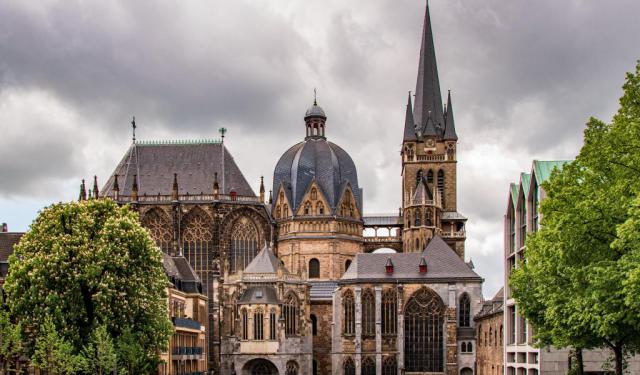
As the royal residence of the emperor Charlemagne, Aachen was the principal coronation site of Holy Roman emperors and German kings from the Middle Ages to the Reformation. The Palatine Chapel, a masterpiece of the distinctive Carolingian architecture, incorporated within Aachener Dom (Aachen Cathedral), was designated a UNESCO World Heritage site in 1978. The Cathedral itself, an eye-catching monument to Europe's illustrious past, is a fine mix of Carolingian and Gothic styles. Luckily, it suffered relatively little damage during WWII, and is currently one of the most influential buildings on the continent – architecturally, historically and religiously.
Also noteworthy are the well-preserved medieval churches such as St Foillan and St Nicholas, as well as the Rathaus (Town Hall), a wonderful stately edifice constructed circa 1530 on the ruins of Charlemagne’s palace and containing the magnificent Hall of the Emperors. Its renown was so great that later many town halls throughout Medieval Europe were modeled on it. Another monument still extant, originally a portion of the Charlemagne imperial palace, is the Granusturm (Granus Tower).
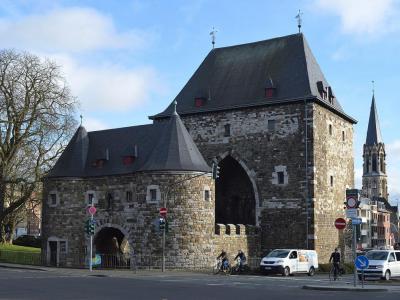
One more relic from the times when Aachen was a Free Imperial City is the Ponttor, a 14th-century gate once manned by soldiers, now used by German Youth and Scout groups.
There are quite a few historical buildings in Aachen where you can learn much about the city's glorious past. To explore the most spectacular of them in your good time and at your own pace, take this self-guided walking tour.
As the royal residence of the emperor Charlemagne, Aachen was the principal coronation site of Holy Roman emperors and German kings from the Middle Ages to the Reformation. The Palatine Chapel, a masterpiece of the distinctive Carolingian architecture, incorporated within Aachener Dom (Aachen Cathedral), was designated a UNESCO World Heritage site in 1978. The Cathedral itself, an eye-catching monument to Europe's illustrious past, is a fine mix of Carolingian and Gothic styles. Luckily, it suffered relatively little damage during WWII, and is currently one of the most influential buildings on the continent – architecturally, historically and religiously.
Also noteworthy are the well-preserved medieval churches such as St Foillan and St Nicholas, as well as the Rathaus (Town Hall), a wonderful stately edifice constructed circa 1530 on the ruins of Charlemagne’s palace and containing the magnificent Hall of the Emperors. Its renown was so great that later many town halls throughout Medieval Europe were modeled on it. Another monument still extant, originally a portion of the Charlemagne imperial palace, is the Granusturm (Granus Tower).
One more relic from the times when Aachen was a Free Imperial City is the Ponttor, a 14th-century gate once manned by soldiers, now used by German Youth and Scout groups.
There are quite a few historical buildings in Aachen where you can learn much about the city's glorious past. To explore the most spectacular of them in your good time and at your own pace, take this self-guided walking tour.
How it works: Download the app "GPSmyCity: Walks in 1K+ Cities" from Apple App Store or Google Play Store to your mobile phone or tablet. The app turns your mobile device into a personal tour guide and its built-in GPS navigation functions guide you from one tour stop to next. The app works offline, so no data plan is needed when traveling abroad.
Aachen's Historical Buildings Tour Map
Guide Name: Aachen's Historical Buildings Tour
Guide Location: Germany » Aachen (See other walking tours in Aachen)
Guide Type: Self-guided Walking Tour (Sightseeing)
# of Attractions: 9
Tour Duration: 1 Hour(s)
Travel Distance: 1.7 Km or 1.1 Miles
Author: leticia
Sight(s) Featured in This Guide:
Guide Location: Germany » Aachen (See other walking tours in Aachen)
Guide Type: Self-guided Walking Tour (Sightseeing)
# of Attractions: 9
Tour Duration: 1 Hour(s)
Travel Distance: 1.7 Km or 1.1 Miles
Author: leticia
Sight(s) Featured in This Guide:
- St. Nikolaus Kirche (St. Nicholas Church)
- Rathaus (Town Hall)
- Granusturm (Granus Tower)
- Sankt Foillan (St. Foillan's Church)
- Aachener Dom (Aachen Cathedral)
- Grashaus (Grass House)
- Theresienkirche (St. Theresa's Church)
- Heilig-Kreuz-Kirche (Holy Cross Church)
- Ponttor Gate
1) St. Nikolaus Kirche (St. Nicholas Church)
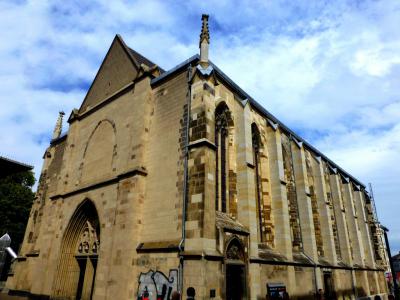
St. Nikolaus Kirche has a history of more than a thousand years. The site was first mentioned in 1005, when a small church or chapel already stood here. Around 1222, the Franciscans took over the site and later built a Gothic monastery church in 1327. Because it had parish status, the church survived the secularization of the early 19th century, when many monasteries were closed.
The building was badly damaged during the fighting and bombing of 1944 and reopened after reconstruction in 1951. The post-war design is simple and functional, with a bright interior, large windows, and an open layout. Decoration is kept to a minimum. Some older elements remain, including parts of the foundations from 1630 and the basic Gothic hall structure.
Since 2001, the church has been known as the Citykirche and is managed jointly by Catholic and Protestant groups. It now works as an ecumenical city church, hosting concerts, exhibitions, discussions, and social support activities. The interior was also damaged by a fire on New Year’s Eve 2010–2011 and later restored.
The building was badly damaged during the fighting and bombing of 1944 and reopened after reconstruction in 1951. The post-war design is simple and functional, with a bright interior, large windows, and an open layout. Decoration is kept to a minimum. Some older elements remain, including parts of the foundations from 1630 and the basic Gothic hall structure.
Since 2001, the church has been known as the Citykirche and is managed jointly by Catholic and Protestant groups. It now works as an ecumenical city church, hosting concerts, exhibitions, discussions, and social support activities. The interior was also damaged by a fire on New Year’s Eve 2010–2011 and later restored.
2) Rathaus (Town Hall) (must see)
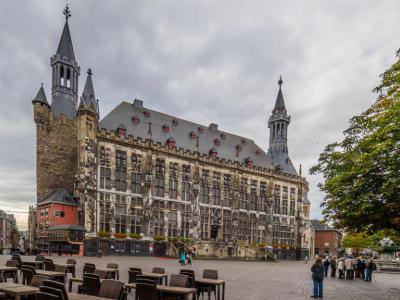
Built in the early 14th century, the Aachen Town Hall has long been used for local government. In the Middle Ages, it was closely linked to imperial ceremonies. After being crowned in the nearby cathedral, rulers came here for official banquets. Between 936 and 1531, 31 Holy Roman Emperors were crowned. The Coronation Hall is still one of the most important rooms, and visitors can see replicas of imperial objects such as the crown, sword, and gospel book.
The building stands on the remains of Charlemagne’s palace from the late 8th century. When the medieval town hall was built, parts of this earlier complex were reused. Some of this early stonework is still visible today, especially on the south wall, where older masonry survived later rebuilding. These remains link the building to both medieval rule and Charlemagne’s earlier imperial center.
Over the centuries, fires and changing tastes altered the town hall’s appearance. After a large fire in 1656, the roof and towers were rebuilt in baroque style. During the 18th century, many Gothic details were removed. In the 19th century, a neo-Gothic restoration brought back medieval elements and added wall paintings showing scenes from Charlemagne’s life, along with statues on the façade. The towers were badly damaged during the Second World War and rebuilt by the late 1960s.
Today, the town hall is also known for hosting the Charlemagne Prize ceremony, which honors efforts toward European cooperation. Past recipients include Pope John Paul II, Bill Clinton, and Angela Merkel, showing that the building still plays a role in international political life.
The building stands on the remains of Charlemagne’s palace from the late 8th century. When the medieval town hall was built, parts of this earlier complex were reused. Some of this early stonework is still visible today, especially on the south wall, where older masonry survived later rebuilding. These remains link the building to both medieval rule and Charlemagne’s earlier imperial center.
Over the centuries, fires and changing tastes altered the town hall’s appearance. After a large fire in 1656, the roof and towers were rebuilt in baroque style. During the 18th century, many Gothic details were removed. In the 19th century, a neo-Gothic restoration brought back medieval elements and added wall paintings showing scenes from Charlemagne’s life, along with statues on the façade. The towers were badly damaged during the Second World War and rebuilt by the late 1960s.
Today, the town hall is also known for hosting the Charlemagne Prize ceremony, which honors efforts toward European cooperation. Past recipients include Pope John Paul II, Bill Clinton, and Angela Merkel, showing that the building still plays a role in international political life.
3) Granusturm (Granus Tower)
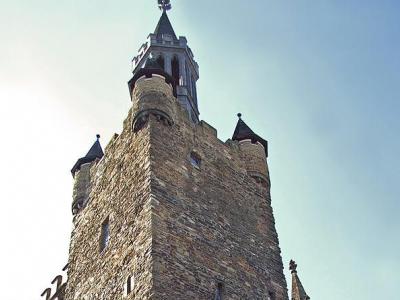
Granusturm is much older than many visitors expect. It was completed around 788 AD as part of Charlemagne’s palace complex, built alongside the King’s Hall. Today it forms one side of the Town Hall building, because the later Gothic hall from the 14th century was raised on the palace remains and reused parts of the older structure.
The tower is square, not round. Each side measures about 8.85 meters, and the oldest part is the lower section: the first four storeys, up to about 20 meters high, still belong to the Carolingian period. Later centuries added extra upper storeys, and the spire you see today is modern (rebuilt in 1979 after earlier damage over time).
Its original purpose is still discussed. One well-supported idea is that it worked mainly as a staircase tower, with stairs winding around inner rooms and linking different levels of the palace buildings and galleries. The name “Granus Tower” is linked to Grannus, a Celtic healing god, but the naming itself became common much later-especially in the Renaissance, when people connected old ruins with Roman stories.
The tower is square, not round. Each side measures about 8.85 meters, and the oldest part is the lower section: the first four storeys, up to about 20 meters high, still belong to the Carolingian period. Later centuries added extra upper storeys, and the spire you see today is modern (rebuilt in 1979 after earlier damage over time).
Its original purpose is still discussed. One well-supported idea is that it worked mainly as a staircase tower, with stairs winding around inner rooms and linking different levels of the palace buildings and galleries. The name “Granus Tower” is linked to Grannus, a Celtic healing god, but the naming itself became common much later-especially in the Renaissance, when people connected old ruins with Roman stories.
4) Sankt Foillan (St. Foillan's Church)
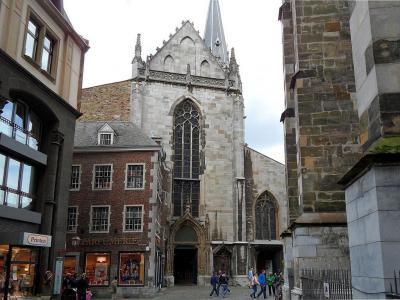
Saint Foillan Church is dedicated to an Irish missionary saint known under several names, including Foillan and Feuillien. It is the only church in the German-speaking world with this dedication, which suggests that early Christian influence here came from western regions. The church stands very close to the cathedral complex, with only a narrow passage separating the two buildings.
The first church on this site was built around 1180 and was one of the earliest parish churches in the area. It was replaced by a larger three-nave Gothic church, consecrated in 1482. Only a few parts of this late medieval building remain today, such as sections of the choir and parts of the façade. Much of the exterior, including the tower, dates from 1888 or later. In 1944, a bombing raid almost completely destroyed the church.
Between 1956 and 1958, the church was rebuilt, and the remaining Gothic parts were reused with modern construction methods. Inside, the blue stone altar from 1962 stands in the center of the choir, surrounded by reliefs with 32 scenes from the story of Salvation. Above it hangs a bronze crucifix from the same year. Another important artwork is the Soft Style Madonna from around 1410, known for its calm expression and gentle forms.
The first church on this site was built around 1180 and was one of the earliest parish churches in the area. It was replaced by a larger three-nave Gothic church, consecrated in 1482. Only a few parts of this late medieval building remain today, such as sections of the choir and parts of the façade. Much of the exterior, including the tower, dates from 1888 or later. In 1944, a bombing raid almost completely destroyed the church.
Between 1956 and 1958, the church was rebuilt, and the remaining Gothic parts were reused with modern construction methods. Inside, the blue stone altar from 1962 stands in the center of the choir, surrounded by reliefs with 32 scenes from the story of Salvation. Above it hangs a bronze crucifix from the same year. Another important artwork is the Soft Style Madonna from around 1410, known for its calm expression and gentle forms.
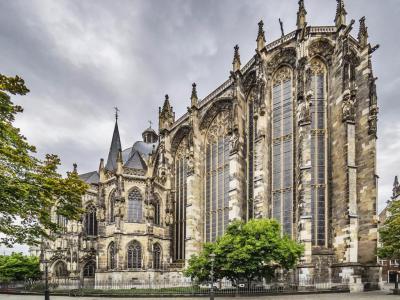
5) Aachener Dom (Aachen Cathedral) (must see)
Aachen Cathedral, also known as the Imperial Cathedral, was built in the late 8th century on the orders of Charlemagne. It is one of the oldest cathedrals in Europe and became the first German site added to the UNESCO World Heritage list in 1978. From the start, the building was meant to express political authority as well as religious power.
At the center of the complex is the Palatine Chapel, completed around 805. Its octagonal plan reflects strong Byzantine influence, especially the church of San Vitale in Ravenna. The number eight had Christian meaning, linked to resurrection and renewal. The design also follows strict proportions: both the dome height and the diameter measure 100 Carolingian feet. In medieval thinking, multiples of ten symbolized order and completeness, reinforcing the chapel’s role as a sacred and carefully planned space.
After Charlemagne’s death, the chapel became his burial place. Over time, the cathedral gained major political importance. Between 936 and 1531, 31 German kings and 12 queens were crowned here, making it a central stage for imperial ceremony in the Holy Roman Empire.
The cathedral’s Treasury is one of the most important church treasuries in Europe. Its objects include the Throne of Charlemagne, the four large Aachen relics-among them a cloth linked by tradition to the Virgin Mary-and the Pala d’Oro, a gold altar screen decorated with detailed metalwork.
The building did not remain unchanged. Later centuries added new structures around the original chapel. The most striking addition is the Gothic choir hall from the 13th century, built with tall walls and large stained-glass windows. Its height and light contrast clearly with the solid, compact form of the Carolingian core, showing how the cathedral reflects many phases of European history within a single structure.
At the center of the complex is the Palatine Chapel, completed around 805. Its octagonal plan reflects strong Byzantine influence, especially the church of San Vitale in Ravenna. The number eight had Christian meaning, linked to resurrection and renewal. The design also follows strict proportions: both the dome height and the diameter measure 100 Carolingian feet. In medieval thinking, multiples of ten symbolized order and completeness, reinforcing the chapel’s role as a sacred and carefully planned space.
After Charlemagne’s death, the chapel became his burial place. Over time, the cathedral gained major political importance. Between 936 and 1531, 31 German kings and 12 queens were crowned here, making it a central stage for imperial ceremony in the Holy Roman Empire.
The cathedral’s Treasury is one of the most important church treasuries in Europe. Its objects include the Throne of Charlemagne, the four large Aachen relics-among them a cloth linked by tradition to the Virgin Mary-and the Pala d’Oro, a gold altar screen decorated with detailed metalwork.
The building did not remain unchanged. Later centuries added new structures around the original chapel. The most striking addition is the Gothic choir hall from the 13th century, built with tall walls and large stained-glass windows. Its height and light contrast clearly with the solid, compact form of the Carolingian core, showing how the cathedral reflects many phases of European history within a single structure.
6) Grashaus (Grass House)
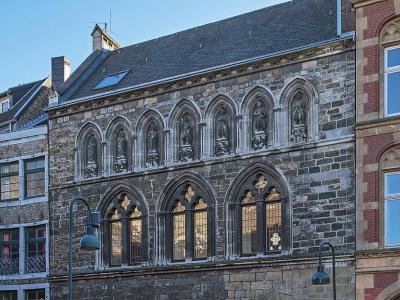
Grashaus is one of the oldest non-religious buildings still standing in the area. It was built in the early 13th century, around 1260–1267, and served as the first town hall. This was a time when local citizens began running their own affairs instead of depending mainly on church or royal power. City meetings and legal decisions were held here, making it an important place for early local government.
The exterior shows Gothic features like pointed arches, narrow windows, and thick stone walls. Above the windows are stone figures added in the 14th century, usually identified as the Seven Electors who chose the Holy Roman Emperor. Some research suggests King Richard of Cornwall may be among them. The design is simple and solid, shaped by public use rather than decoration.
Inside, the Grashaus once held offices, a courtroom, and later a prison, where serious crimes were judged and executions took place nearby. After a new town hall replaced it in the 14th century, it was reused as a granary and later as the city archive for over 100 years. Today, it is part of the Route Charlemagne as “Station Europa” and serves as an educational center, with interior visits mainly possible through guided tours, often on the first Saturday of the month.
The exterior shows Gothic features like pointed arches, narrow windows, and thick stone walls. Above the windows are stone figures added in the 14th century, usually identified as the Seven Electors who chose the Holy Roman Emperor. Some research suggests King Richard of Cornwall may be among them. The design is simple and solid, shaped by public use rather than decoration.
Inside, the Grashaus once held offices, a courtroom, and later a prison, where serious crimes were judged and executions took place nearby. After a new town hall replaced it in the 14th century, it was reused as a granary and later as the city archive for over 100 years. Today, it is part of the Route Charlemagne as “Station Europa” and serves as an educational center, with interior visits mainly possible through guided tours, often on the first Saturday of the month.
7) Theresienkirche (St. Theresa's Church)
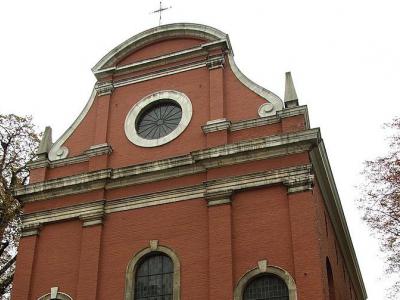
Theresienkirche (St. Theresa’s Church) began as the church of a Carmelite convent dedicated to Saint Teresa of Ávila. The present building was constructed in the 18th century, mainly between 1739 and 1745, under Laurenz Mefferdatis, with interior work linked to Johann Joseph Couven. Its layout follows the line of an 18th-century street rather than the usual east–west axis.
Inside, the church shows Baroque forms with Rococo details. The main altar is a small columned structure made of oak, with gilded Corinthian capitals and carved angel figures. To create a more regular interior shape, Mefferdatis used a triangular staircase, allowing the floor plan to appear largely rectangular.
During the Second World War, the church burned out in 1943, and it was rebuilt in the 1950s in a way that aimed to restore its earlier appearance. Today it is no longer a standard Catholic parish church; it is used by the “Holy Trinity” Romanian Orthodox community, which holds services here on Sundays.
Inside, the church shows Baroque forms with Rococo details. The main altar is a small columned structure made of oak, with gilded Corinthian capitals and carved angel figures. To create a more regular interior shape, Mefferdatis used a triangular staircase, allowing the floor plan to appear largely rectangular.
During the Second World War, the church burned out in 1943, and it was rebuilt in the 1950s in a way that aimed to restore its earlier appearance. Today it is no longer a standard Catholic parish church; it is used by the “Holy Trinity” Romanian Orthodox community, which holds services here on Sundays.
8) Heilig-Kreuz-Kirche (Holy Cross Church)
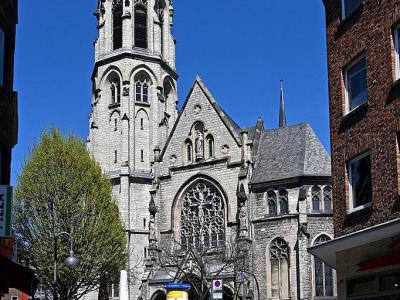
Heilig-Kreuz-Kirche is a Roman Catholic parish church built in the early 20th century. Construction began in 1900, and it was consecrated in 1902. The site has been used for religious buildings since 1363. Designed by Josef Buchkremer, the church features a Historicist style with German and French High Gothic influences and a cross-shaped, three-aisle basilica plan.
The exterior features a tall tower, solid stone walls, and clear Gothic shapes. On the façade is the Latin motto “Stat crux, dum volvitur orbis” (“The cross stands firm while the world turns”), along with a statue of Saint Helena at the top of the gable, linked to the discovery of the True Cross. The church was heavily damaged in the Second World War and rebuilt between 1947 and 1949. The flat wooden ceilings in the side aisles date from this post-war reconstruction.
Inside, the layout is open and filled with light. The interior was redesigned in the late 1960s and renovated again in 2006. Stained glass by artists such as Maria Katzgrau and Paul Weigmann focuses on color and symbolic forms rather than detailed scenes. The church remains active today, hosting regular services as well as organ concerts and other musical events, helped by its good acoustics.
The exterior features a tall tower, solid stone walls, and clear Gothic shapes. On the façade is the Latin motto “Stat crux, dum volvitur orbis” (“The cross stands firm while the world turns”), along with a statue of Saint Helena at the top of the gable, linked to the discovery of the True Cross. The church was heavily damaged in the Second World War and rebuilt between 1947 and 1949. The flat wooden ceilings in the side aisles date from this post-war reconstruction.
Inside, the layout is open and filled with light. The interior was redesigned in the late 1960s and renovated again in 2006. Stained glass by artists such as Maria Katzgrau and Paul Weigmann focuses on color and symbolic forms rather than detailed scenes. The church remains active today, hosting regular services as well as organ concerts and other musical events, helped by its good acoustics.
9) Ponttor Gate
Ponttor Gate is one of the few surviving gates from the medieval city walls, built in the early 14th century. It marked the northern entrance and stood on key routes toward Maastricht and Liège. Merchants and travelers passed through under guard control, where access was checked and taxes were collected on goods.
The structure shows how medieval defense worked. A fortified fore-gate with two round towers is linked to an inner gate by a narrow passage. Thick walls, small openings, and portcullis slots highlight its defensive role. Inside, vaulted ceilings, stair remains, and openings used against attackers can still be seen, showing that function mattered more than decoration.
When the city walls lost their defensive role, most were removed, but this gate remained in use. It later served as a prison, a school, and a youth hostel, which helped protect it from demolition. Today, it is always visible from the outside and is occasionally open during tours or events, allowing visitors to see how a medieval city gate was used.
The structure shows how medieval defense worked. A fortified fore-gate with two round towers is linked to an inner gate by a narrow passage. Thick walls, small openings, and portcullis slots highlight its defensive role. Inside, vaulted ceilings, stair remains, and openings used against attackers can still be seen, showing that function mattered more than decoration.
When the city walls lost their defensive role, most were removed, but this gate remained in use. It later served as a prison, a school, and a youth hostel, which helped protect it from demolition. Today, it is always visible from the outside and is occasionally open during tours or events, allowing visitors to see how a medieval city gate was used.
Walking Tours in Aachen, Germany

Create Your Own Walk in Aachen
Creating your own self-guided walk in Aachen is easy and fun. Choose the city attractions that you want to see and a walk route map will be created just for you. You can even set your hotel as the start point of the walk.
Aachen Introduction Walking Tour
Welcome to Aachen, a city with roots stretching back to Neolithic times. For thousands of years, people have been drawn here by its mineral springs. Archaeologists have uncovered evidence of settlements dating back to the Bronze and Iron Ages. In those ancient days, the Celts made their home here, likely to worship Grannus, the god of light and healing.
By the second century, the Romans had... view more
Tour Duration: 1 Hour(s)
Travel Distance: 1.4 Km or 0.9 Miles
By the second century, the Romans had... view more
Tour Duration: 1 Hour(s)
Travel Distance: 1.4 Km or 0.9 Miles
The Most Popular Cities
/ view all