

Great Palaestra, Pompei
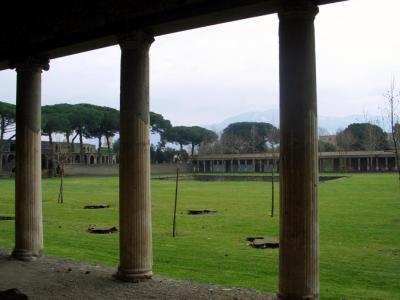
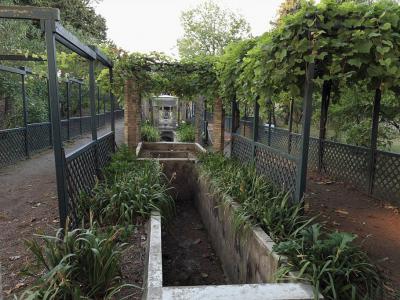
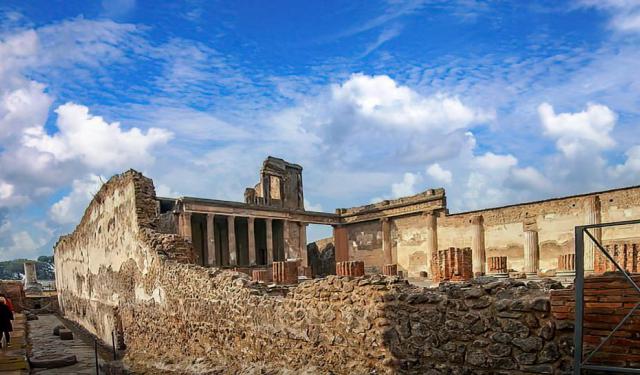
The Great Palaestra of Pompeii was built during the Augustan period, in the early 1st century AD, as a large open-air exercise complex for young men. It was connected with the Iuventus Pompeiana, a youth organization encouraged under Augustus, and served as a place for physical training, public gatherings, and civic discipline. The complex is rectangular, with porticoes on three sides, a central exercise area, and a swimming pool at its centre.
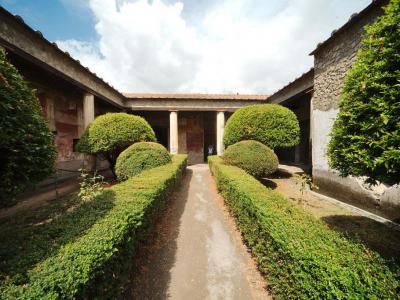
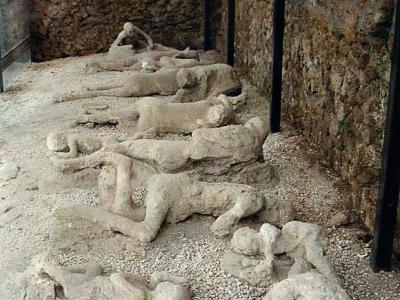
After the dense streets, houses, shops, and baths of Pompeii, the Great Palaestra feels unusually spacious. Visitors can imagine young Pompeiians running, wrestling, training, or resting beneath the shaded porticoes. Behind the portico, a double row of sycamore trees once offered shade, and their roots have been recreated with plaster casts, just as the shapes of buried human remains were preserved. A room in the western portico was set aside for emperor worship.
At the time of the eruption in AD 79, parts of the eastern entrances and the north wall were still being restored after earthquake damage from AD 62. On the south side, visitors can also see the remains of a latrine, supplied with water carried from the pool.
After the dense streets, houses, shops, and baths of Pompeii, the Great Palaestra feels unusually spacious. Visitors can imagine young Pompeiians running, wrestling, training, or resting beneath the shaded porticoes. Behind the portico, a double row of sycamore trees once offered shade, and their roots have been recreated with plaster casts, just as the shapes of buried human remains were preserved. A room in the western portico was set aside for emperor worship.
At the time of the eruption in AD 79, parts of the eastern entrances and the north wall were still being restored after earthquake damage from AD 62. On the south side, visitors can also see the remains of a latrine, supplied with water carried from the pool.
Want to visit this sight? Check out these Self-Guided Walking Tours in Pompei. Alternatively, you can download the mobile app "GPSmyCity: Walks in 1K+ Cities" from Apple App Store or Google Play Store. The app turns your mobile device to a personal tour guide and it works offline, so no data plan is needed when traveling abroad.
Download The GPSmyCity App



Great Palaestra on Map
Sight Name: Great Palaestra
Sight Location: Pompei, Italy (See walking tours in Pompei)
Sight Type: Attraction/Landmark
Guide(s) Containing This Sight:
Sight Location: Pompei, Italy (See walking tours in Pompei)
Sight Type: Attraction/Landmark
Guide(s) Containing This Sight:
Nearby Sights

Walking Tours in Pompei, Italy

Create Your Own Walk in Pompei
Creating your own self-guided walk in Pompei is easy and fun. Choose the city attractions that you want to see and a walk route map will be created just for you. You can even set your hotel as the start point of the walk.
Pompeii Introduction Walk II
Frozen at the moment it was buried under the thick blanket of ash and pumice, the city of Pompeii (now excavated) remains a unique window into the past, offering a snapshot of everyday life back in the 1st century AD Roman Empire. Aside from causing quick and unexpected death to the city, the huge eruption of Vesuvius in 79 AD did have one positive outcome - it preserved everything (properties,... view more
Tour Duration: 3 Hours
Travel Distance: 2.3 Km or 1.4 Miles
Tour Duration: 3 Hours
Travel Distance: 2.3 Km or 1.4 Miles
Pompeii Introduction Walk I
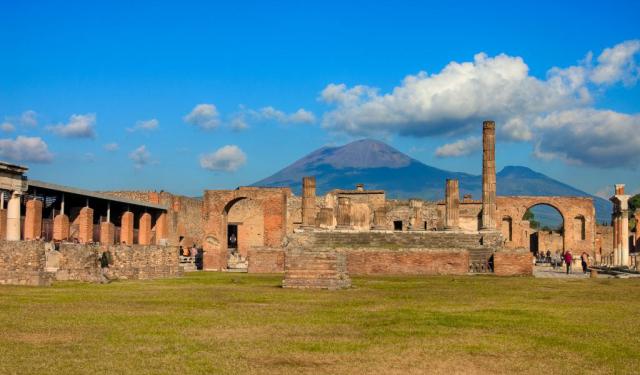
Modern-day Pompei is best known for its ancient predecessor, the Roman city of Pompeii, that fell victim to the massive eruption of Mount Vesuvius in 79 AD. The ruins of Pompeii, first uncovered in the late 18th century, were declared a World Heritage Site by UNESCO in 1997. Presently, this is one of the most popular tourist attractions in Italy, drawing annually up to 2.5 million visitors.
The... view more
Tour Duration: 2 Hours
Travel Distance: 2 Km or 1.2 Miles
The... view more
Tour Duration: 2 Hours
Travel Distance: 2 Km or 1.2 Miles
City Walks Overview
