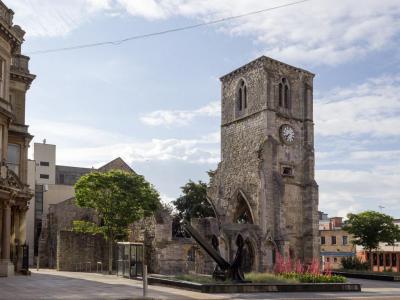


Holyrood Church, Southampton
Standing in front of Holyrood Church on Southampton's High Street, take a moment to look at its surviving stone walls and tall Gothic tower. Although much of the building is now open to the sky, this was once one of the five churches serving Southampton's medieval walled town. The church's origins go back to at least 1160, when King Henry II granted it to the monks of Saint Denys. The building you see today dates largely from 1320, although it underwent significant rebuilding in the 19th century.
Now, look up at the tower on the right-hand side of the façade. Notice the large clock, and just below it, two small figures holding hammers beside the bells. These are the famous Quarter Jacks, which strike every fifteen minutes. Ironically, they were already considered old in 1760.
Lower your gaze to the tower's western face. Here, you will find a memorial plaque dedicated to Charles Dibdin, a Southampton-born poet, dramatist, and composer, who was particularly famous for his maritime songs, including "Tom Bowling" and "Poor Jack."
As you step into the roofless church, look around at the surviving walls. The tower stands at the southwestern corner, while the remains of the chancel are at the eastern end. Sections of the northern wall have also survived. The central nave, however, was largely destroyed during the German bombing of Southampton on November 30, 1940. The wooden spire and grand west window were also lost.
Now, turn to see the stone memorial fountain beneath the tower, near the entrance. Supported by four columns and topped with a small domed canopy, it commemorates the crew members who died aboard the RMS Titanic when it sank in 1912. Look closely at the curved stone panels to see carvings of the famous ship. The monument was unveiled in 1915, originally near Southampton Common, and was moved here in 1972.
As you explore the open space, notice the large maritime anchor and the nearby memorial plaque. These commemorate the sailors of the Merchant Navy who lost their lives at sea. In 1957, the ruined church was officially preserved as a memorial and garden of remembrance.
Though just a shell of its former self, Holyrood Church is more than a medieval ruin; it is a moving testament to Southampton's religious heritage, wartime destruction, and long connection with the sea.
Want to visit this sight? Check out these Self-Guided Walking Tours in Southampton. Alternatively, you can download the mobile app "GPSmyCity: Walks in 1K+ Cities" from Apple App Store or Google Play Store. The app turns your mobile device to a personal tour guide and it works offline, so no data plan is needed when traveling abroad.
Download The GPSmyCity App



Holyrood Church on Map
Sight Name: Holyrood Church
Sight Location: Southampton, England (See walking tours in Southampton)
Sight Type: Religious
Guide(s) Containing This Sight:
Sight Location: Southampton, England (See walking tours in Southampton)
Sight Type: Religious
Guide(s) Containing This Sight:
Nearby Sights



Walking Tours in Southampton, England

Create Your Own Walk in Southampton
Creating your own self-guided walk in Southampton is easy and fun. Choose the city attractions that you want to see and a walk route map will be created just for you. You can even set your hotel as the start point of the walk.

Titanic Tour in Southampton
Over a hundred years since the sinking of the Titanic, the echo of that tragedy still reverberates throughout Southampton. Indeed, nowhere else was the pain of the Titanic loss, one of the deadliest in maritime history, felt more intensely than here.
When the ship set sail for New York on April 10, 1912, most of its roughly 900 crew members were locals. Just five days later, in the early hours... view more
Tour Duration: 2 Hours
Travel Distance: 3.9 Km or 2.4 Miles
When the ship set sail for New York on April 10, 1912, most of its roughly 900 crew members were locals. Just five days later, in the early hours... view more
Tour Duration: 2 Hours
Travel Distance: 3.9 Km or 2.4 Miles

Southampton Waterfront Walk
A major seaport on the south coast of England, the city of Southampton abounds in attractions of various sorts. Southampton Waterfront, in particular, holds significant historical and cultural value, offering ample opportunities for sightseeing, shopping, dining, recreation, and entertainment.
At the heart of this vibrant area is the Pilgrims Fathers Memorial, commemorating the departure of... view more
Tour Duration: 1 Hour
Travel Distance: 1.9 Km or 1.2 Miles
At the heart of this vibrant area is the Pilgrims Fathers Memorial, commemorating the departure of... view more
Tour Duration: 1 Hour
Travel Distance: 1.9 Km or 1.2 Miles

Walking Through Southampton's Historic Old Town
Southampton is one of England’s most important port cities, with a history stretching back thousands of years. Archaeological evidence suggests that people have lived in this area since as early as the Stone Age. The Romans later established a settlement called Clausentum, near present-day Bitterne Manor, which served as a defensive outpost.
By the 8th century, the Anglo-Saxons had developed... view more
Tour Duration: 2 Hours
Travel Distance: 3 Km or 1.9 Miles
By the 8th century, the Anglo-Saxons had developed... view more
Tour Duration: 2 Hours
Travel Distance: 3 Km or 1.9 Miles
City Walks Overview
