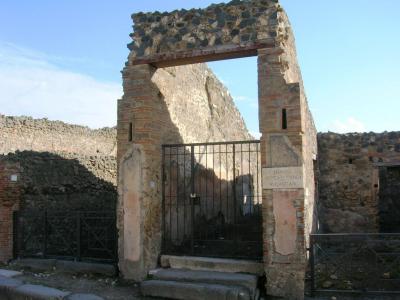


House of the Cithara Player, Pompei
The House of the Cithara Player stands as a testament to the opulence and grandeur of ancient Pompeii. Named after the striking statue of Apollo the Citharist discovered within its confines, this expansive residence occupies a vast city block, encompassing an area of approximately 2700 square meters. Belonging to a wealthy family, likely the influential Popidii clan, the house was a hub of luxury and prestige, indicative of the social and economic prominence of its owners.
Originally comprised of several buildings, the House of the Cithara Player evolved through the progressive amalgamation of adjacent properties. This complex construction process resulted in an irregular plan, characterized by two atriums and three peristyles, showcasing the architectural innovation and adaptability of its creators.
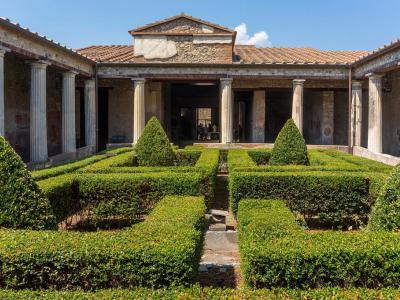
Central to the residence's splendor is its central peristyle, featuring a mesmerizing swimming pool as its focal point. Surrounding this aquatic centerpiece were bronze sculptures depicting scenes of nature, including a wild boar under attack by two dogs, a lion, a deer, and a snake, all adorned with fountain jets that contributed to the creation of spectacular water features. These features echo the opulent decorations seen in Vesuvian villas, highlighting the house's aristocratic extravagance.
Dating back to the 1st century BC, the House of the Cithara Player reached its zenith during a period of flourishing cultural and economic prosperity in Pompeii. Graffiti and electoral inscriptions discovered within the residence suggest its association with the powerful Popidii family, further reinforcing its significance within the social and political landscape of the ancient city.
Originally comprised of several buildings, the House of the Cithara Player evolved through the progressive amalgamation of adjacent properties. This complex construction process resulted in an irregular plan, characterized by two atriums and three peristyles, showcasing the architectural innovation and adaptability of its creators.
Central to the residence's splendor is its central peristyle, featuring a mesmerizing swimming pool as its focal point. Surrounding this aquatic centerpiece were bronze sculptures depicting scenes of nature, including a wild boar under attack by two dogs, a lion, a deer, and a snake, all adorned with fountain jets that contributed to the creation of spectacular water features. These features echo the opulent decorations seen in Vesuvian villas, highlighting the house's aristocratic extravagance.
Dating back to the 1st century BC, the House of the Cithara Player reached its zenith during a period of flourishing cultural and economic prosperity in Pompeii. Graffiti and electoral inscriptions discovered within the residence suggest its association with the powerful Popidii family, further reinforcing its significance within the social and political landscape of the ancient city.
Want to visit this sight? Check out these Self-Guided Walking Tours in Pompei. Alternatively, you can download the mobile app "GPSmyCity: Walks in 1K+ Cities" from Apple App Store or Google Play Store. The app turns your mobile device to a personal tour guide and it works offline, so no data plan is needed when traveling abroad.
Download The GPSmyCity App



House of the Cithara Player on Map
Sight Name: House of the Cithara Player
Sight Location: Pompei, Italy (See walking tours in Pompei)
Sight Type: Attraction/Landmark
Sight Location: Pompei, Italy (See walking tours in Pompei)
Sight Type: Attraction/Landmark
Nearby Sights

Walking Tours in Pompei, Italy

Create Your Own Walk in Pompei
Creating your own self-guided walk in Pompei is easy and fun. Choose the city attractions that you want to see and a walk route map will be created just for you. You can even set your hotel as the start point of the walk.
Pompeii Introduction Walk I
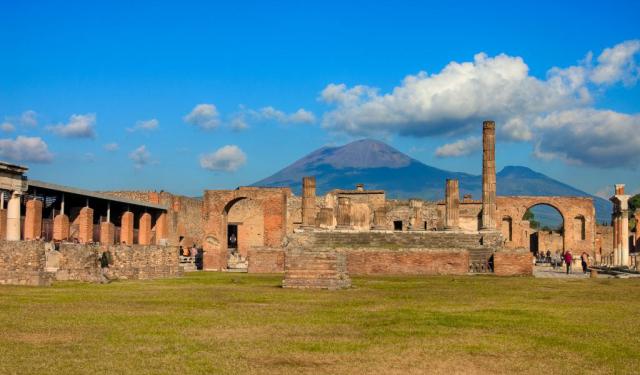
Modern-day Pompei is best known for its ancient predecessor, the Roman city of Pompeii, that fell victim to the massive eruption of Mount Vesuvius in 79 AD. The ruins of Pompeii, first uncovered in the late 18th century, were declared a World Heritage Site by UNESCO in 1997. Presently, this is one of the most popular tourist attractions in Italy, drawing annually up to 2.5 million visitors.
The... view more
Tour Duration: 2 Hours
Travel Distance: 2 Km or 1.2 Miles
The... view more
Tour Duration: 2 Hours
Travel Distance: 2 Km or 1.2 Miles
Pompeii Introduction Walk II
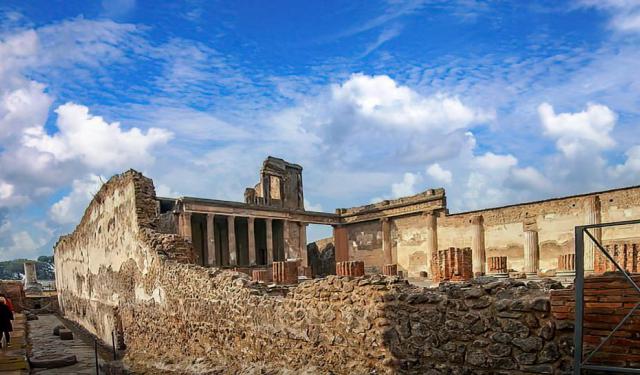
Frozen at the moment it was buried under the thick blanket of ash and pumice, the city of Pompeii (now excavated) remains a unique window into the past, offering a snapshot of everyday life back in the 1st century AD Roman Empire. Aside from causing quick and unexpected death to the city, the huge eruption of Vesuvius in 79 AD did have one positive outcome - it preserved everything (properties,... view more
Tour Duration: 3 Hours
Travel Distance: 2.3 Km or 1.4 Miles
Tour Duration: 3 Hours
Travel Distance: 2.3 Km or 1.4 Miles
City Walks Overview
