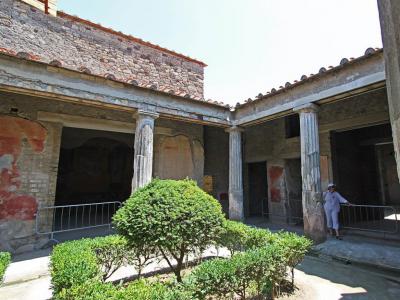


House of the Tragic Poet, Pompei
The House of the Tragic Poet is also known as the Homeric or Iliadic House. It is a fairly typical Roman-era residential building, built in the 2nd century BC. It is famous for a series of elaborate mosaics and frescoes depicting scenes from Greek mythology. It has attracted interest from writers and academics ever since it was unearthed in November 1824. The artworks discovered there are among the finest ever found in Pompeii. This is unusual, given that the house itself is unremarkable in size compared to some of the city’s larger villas. Little is known about the family that owned the house, except that they were most likely killed in the 79 AD eruption of Vesuvius.
There are frescoes and mosaics throughout the House of the Tragic Poet, so it's natural they are the highlights worth seeing. As soon as you step foot into the entrance hall, look down to observe a masterfully crafted black-and-white tile mosaic. The figure is depicted as a snarling, chained guard dog with the Latin words ‘Beware of the dog’ written underneath.
If you want to explore how the family gathered inside, step past this entrance vestibule directly into the center of the main hall to examine the large rectangular impluvium. This central, sunken stone water basin sits directly beneath an open ceiling layout, positioned perfectly to collect fresh rainwater falling into the heart of the home.
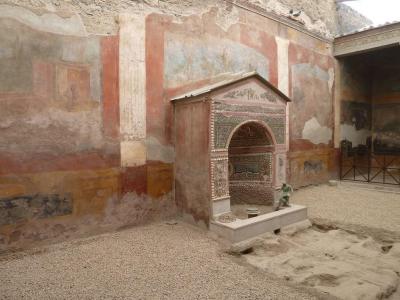
The house’s atrium and peristyle feature frescoes depicting several Greek Gods, including Zeus, Aphrodite, Achilles and Poseidon, amongst others. The atrium section, in particular, contains a few partially preserved frescoes. The moment you enter it from the vestibule, look at the wall to your left, the western wall. Here, you can find the Abduction of Amphitrite, which depicts Poseidon's myth but is largely destroyed, showing only an intact bottom half where Eros rides a dolphin and carries a trident. Right beside it sits the Wrath of Achilles, another heavily damaged scene where almost nothing survives except for visible feet and drapery matching historical depictions of Achilles being restrained by Athena.
This mysterious building has captivated many literary figures across generations, famously serving as the home of Glaucus in Edward Bulwer-Lytton's 1834 novel The Last Days of Pompeii, and later inspiring modern authors such as Czech poet Vladimír Janovic, who penned an epic poem centred on the building’s mythological art.
There are frescoes and mosaics throughout the House of the Tragic Poet, so it's natural they are the highlights worth seeing. As soon as you step foot into the entrance hall, look down to observe a masterfully crafted black-and-white tile mosaic. The figure is depicted as a snarling, chained guard dog with the Latin words ‘Beware of the dog’ written underneath.
If you want to explore how the family gathered inside, step past this entrance vestibule directly into the center of the main hall to examine the large rectangular impluvium. This central, sunken stone water basin sits directly beneath an open ceiling layout, positioned perfectly to collect fresh rainwater falling into the heart of the home.
The house’s atrium and peristyle feature frescoes depicting several Greek Gods, including Zeus, Aphrodite, Achilles and Poseidon, amongst others. The atrium section, in particular, contains a few partially preserved frescoes. The moment you enter it from the vestibule, look at the wall to your left, the western wall. Here, you can find the Abduction of Amphitrite, which depicts Poseidon's myth but is largely destroyed, showing only an intact bottom half where Eros rides a dolphin and carries a trident. Right beside it sits the Wrath of Achilles, another heavily damaged scene where almost nothing survives except for visible feet and drapery matching historical depictions of Achilles being restrained by Athena.
This mysterious building has captivated many literary figures across generations, famously serving as the home of Glaucus in Edward Bulwer-Lytton's 1834 novel The Last Days of Pompeii, and later inspiring modern authors such as Czech poet Vladimír Janovic, who penned an epic poem centred on the building’s mythological art.
Want to visit this sight? Check out these Self-Guided Walking Tours in Pompei. Alternatively, you can download the mobile app "GPSmyCity: Walks in 1K+ Cities" from Apple App Store or Google Play Store. The app turns your mobile device to a personal tour guide and it works offline, so no data plan is needed when traveling abroad.
Download The GPSmyCity App



House of the Tragic Poet on Map
Sight Name: House of the Tragic Poet
Sight Location: Pompei, Italy (See walking tours in Pompei)
Sight Type: Attraction/Landmark
Guide(s) Containing This Sight:
Sight Location: Pompei, Italy (See walking tours in Pompei)
Sight Type: Attraction/Landmark
Guide(s) Containing This Sight:
Nearby Sights
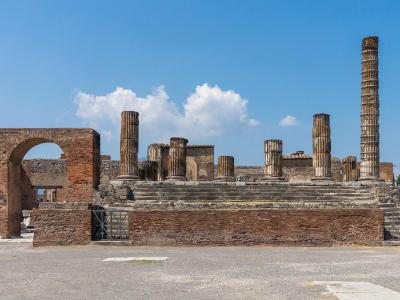
Walking Tours in Pompei, Italy

Create Your Own Walk in Pompei
Creating your own self-guided walk in Pompei is easy and fun. Choose the city attractions that you want to see and a walk route map will be created just for you. You can even set your hotel as the start point of the walk.
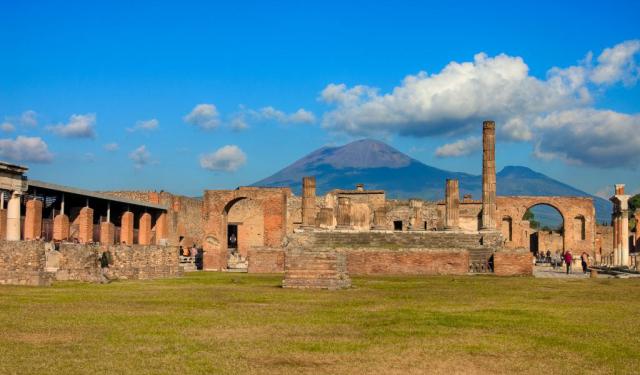
Pompeii Introduction Walk I
Modern-day Pompei is best known for its ancient predecessor, the Roman city of Pompeii, that fell victim to the massive eruption of Mount Vesuvius in 79 AD. The ruins of Pompeii, first uncovered in the late 18th century, were declared a World Heritage Site by UNESCO in 1997. Presently, this is one of the most popular tourist attractions in Italy, drawing annually up to 2.5 million visitors.
The... view more
Tour Duration: 2 Hour(s)
Travel Distance: 2.0 Km or 1.2 Miles
The... view more
Tour Duration: 2 Hour(s)
Travel Distance: 2.0 Km or 1.2 Miles
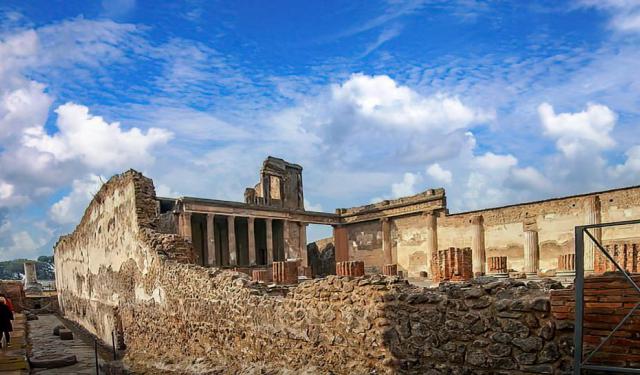
Pompeii Introduction Walk II
Frozen at the moment it was buried under the thick blanket of ash and pumice, the city of Pompeii (now excavated) remains a unique window into the past, offering a snapshot of everyday life back in the 1st century AD Roman Empire. Aside from causing quick and unexpected death to the city, the huge eruption of Vesuvius in 79 AD did have one positive outcome – it preserved everything (properties,... view more
Tour Duration: 3 Hour(s)
Travel Distance: 2.3 Km or 1.4 Miles
Tour Duration: 3 Hour(s)
Travel Distance: 2.3 Km or 1.4 Miles