


Iglesia de Nostra Senyora dels Angels de la Porciuncula, Palma de Mallorca
Nestled just south-east of Palma’s bustling centre, the Church of Our Lady of the Angels of the Porziuncola (Iglesia de Nostra Senyora dels Àngels de la Porciúncula) - commonly known as La Porciúncula or the “Church of Glass” - is a remarkable piece of modern religious architecture and a serene stop for visitors exploring the Playa de Palma area. Built between 1964 and 1968 under the design of Majorcan architect Josep Ferragut Pou in collaboration with Fra Antoni Bauzà Gayà, this oval-shaped church of reinforced concrete was consecrated in October 1968.
From the outside, the plain grey concrete exterior is adorned by thirty-six slender stained-glass panels, which give way to an interior flooded with kaleidoscopic colour and light. Around the oval nave sit thirty-nine stained-glass windows, spanning some 600 square meters of glass, depicting vivid scenes from the life of Saint Francis, the four seasons, biblical themes, and even references to Dante and the Mallorcan mystic Ramon Llull. The flooring of multicoloured tiles and subtle sculptural details further enhances the contemplative ambiance.
Just a few steps away is a small museum founded in 1971 by Fray Joan Llabrés. It houses three rooms of archaeological, ethnographic, and numismatic collections, alongside personal artefacts brought back by Franciscan missionaries from Peru. A visit typically costs around €5 and includes access to the museum, making it a worthy stop for culture-minded travellers seeking something off the well-trodden tourist circuit.
In short, La Porciúncula offers a unique blend of modernist design, spiritual resonance, and artistic splendour - an atmospheric place to pause, reflect, and admire a lesser-known jewel in Palma de Mallorca’s cultural heritage.
From the outside, the plain grey concrete exterior is adorned by thirty-six slender stained-glass panels, which give way to an interior flooded with kaleidoscopic colour and light. Around the oval nave sit thirty-nine stained-glass windows, spanning some 600 square meters of glass, depicting vivid scenes from the life of Saint Francis, the four seasons, biblical themes, and even references to Dante and the Mallorcan mystic Ramon Llull. The flooring of multicoloured tiles and subtle sculptural details further enhances the contemplative ambiance.
Just a few steps away is a small museum founded in 1971 by Fray Joan Llabrés. It houses three rooms of archaeological, ethnographic, and numismatic collections, alongside personal artefacts brought back by Franciscan missionaries from Peru. A visit typically costs around €5 and includes access to the museum, making it a worthy stop for culture-minded travellers seeking something off the well-trodden tourist circuit.
In short, La Porciúncula offers a unique blend of modernist design, spiritual resonance, and artistic splendour - an atmospheric place to pause, reflect, and admire a lesser-known jewel in Palma de Mallorca’s cultural heritage.
Want to visit this sight? Check out these Self-Guided Walking Tours in Palma de Mallorca. Alternatively, you can download the mobile app "GPSmyCity: Walks in 1K+ Cities" from Apple App Store or Google Play Store. The app turns your mobile device to a personal tour guide and it works offline, so no data plan is needed when traveling abroad.
Download The GPSmyCity App



Iglesia de Nostra Senyora dels Angels de la Porciuncula on Map
Sight Name: Iglesia de Nostra Senyora dels Angels de la Porciuncula
Sight Location: Palma de Mallorca, Spain (See walking tours in Palma de Mallorca)
Sight Type: Religious
Sight Location: Palma de Mallorca, Spain (See walking tours in Palma de Mallorca)
Sight Type: Religious
Nearby Sights

Walking Tours in Palma de Mallorca, Spain

Create Your Own Walk in Palma de Mallorca
Creating your own self-guided walk in Palma de Mallorca is easy and fun. Choose the city attractions that you want to see and a walk route map will be created just for you. You can even set your hotel as the start point of the walk.
Historical Buildings Walking Tour
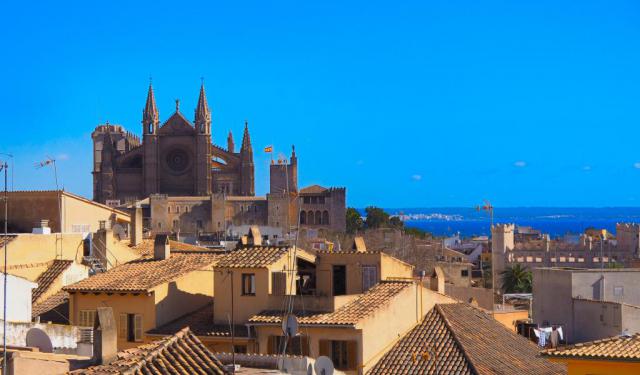
Fervent devotees of the past will undoubtedly find Palma de Mallorca's old town quite alluring for a chance to get closer to the island's culture and discover firsthand the unspoiled Mallorca as it once was. Indeed, the historic center of the city is ideal for an acquaintance with the local heritage richly presented in the form of multiple historic buildings.
Some of them, like the... view more
Tour Duration: 2 Hours
Travel Distance: 3 Km or 1.9 Miles
Some of them, like the... view more
Tour Duration: 2 Hours
Travel Distance: 3 Km or 1.9 Miles
Palma de Mallorca Introduction Walking Tour
French author Aurore Dupin, better known by her pen name George Sand, spent the winter of 1838-1839 in Mallorca together with the famous Polish composer Frédéric Chopin. Despite the cold weather, she wrote that Mallorca was “all that a poet or a painter might dream of.”
The first part of city’s name, Palma, is traditionally linked to the Latin word that means “palm tree,” a symbol... view more
Tour Duration: 2 Hours
Travel Distance: 2.4 Km or 1.5 Miles
The first part of city’s name, Palma, is traditionally linked to the Latin word that means “palm tree,” a symbol... view more
Tour Duration: 2 Hours
Travel Distance: 2.4 Km or 1.5 Miles
City Walks Overview
