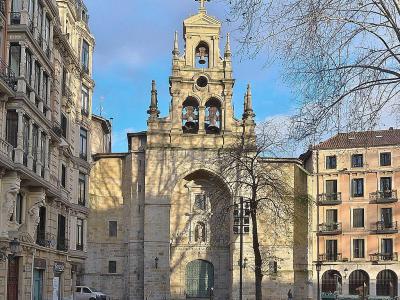


Iglesia de San Vicente de Abando (Church of Saint Vicente de Abando), Bilbao
The Church of Saint Vincent of Abando, built between the 16th and 17th centuries, replaced an earlier Gothic church from 1190, and has since emerged as one of the most exquisite examples of columnar Renaissance architecture in the Basque Country.
A defining feature of the church’s architecture is its hall-plan structure, comprising three naves of equal height supported by eight tall, smooth Tuscan columns with Doric capitals. The vaulting, designed by Martín Ibáñez de Zalbidea, features elaborately ribbed and nine-keyed vaults that enrich the otherwise austere elegance of the interior.
The church’s elegant exterior showcases a Renaissance-style façade, including a monumental yet restrained main portal crafted in 1556 by the workshop of Juan de la Peña. Inside, visitors are greeted by five gilded wooden altarpieces, with the main altarpiece standing out for its intricate detail and fine sculpture work.
Beyond its architectural splendor, the church plays a significant role in Bilbao’s religious and cultural life. It serves as the canonical seat of The Brotherhood of the Passion, which takes part in several heartfelt Semana Santa processions, including the Procession of the Virgen de los Dolores on Good Friday and the popular The Palm Sunday Procession of the Little Donkey procession on Palm Sunday.
A defining feature of the church’s architecture is its hall-plan structure, comprising three naves of equal height supported by eight tall, smooth Tuscan columns with Doric capitals. The vaulting, designed by Martín Ibáñez de Zalbidea, features elaborately ribbed and nine-keyed vaults that enrich the otherwise austere elegance of the interior.
The church’s elegant exterior showcases a Renaissance-style façade, including a monumental yet restrained main portal crafted in 1556 by the workshop of Juan de la Peña. Inside, visitors are greeted by five gilded wooden altarpieces, with the main altarpiece standing out for its intricate detail and fine sculpture work.
Beyond its architectural splendor, the church plays a significant role in Bilbao’s religious and cultural life. It serves as the canonical seat of The Brotherhood of the Passion, which takes part in several heartfelt Semana Santa processions, including the Procession of the Virgen de los Dolores on Good Friday and the popular The Palm Sunday Procession of the Little Donkey procession on Palm Sunday.
Want to visit this sight? Check out these Self-Guided Walking Tours in Bilbao. Alternatively, you can download the mobile app "GPSmyCity: Walks in 1K+ Cities" from Apple App Store or Google Play Store. The app turns your mobile device to a personal tour guide and it works offline, so no data plan is needed when traveling abroad.
Download The GPSmyCity App



Iglesia de San Vicente de Abando (Church of Saint Vicente de Abando) on Map
Sight Name: Iglesia de San Vicente de Abando (Church of Saint Vicente de Abando)
Sight Location: Bilbao, Spain (See walking tours in Bilbao)
Sight Type: Religious
Sight Location: Bilbao, Spain (See walking tours in Bilbao)
Sight Type: Religious
Nearby Sights
Walking Tours in Bilbao, Spain

Create Your Own Walk in Bilbao
Creating your own self-guided walk in Bilbao is easy and fun. Choose the city attractions that you want to see and a walk route map will be created just for you. You can even set your hotel as the start point of the walk.
Bilbao Introduction Walking Tour
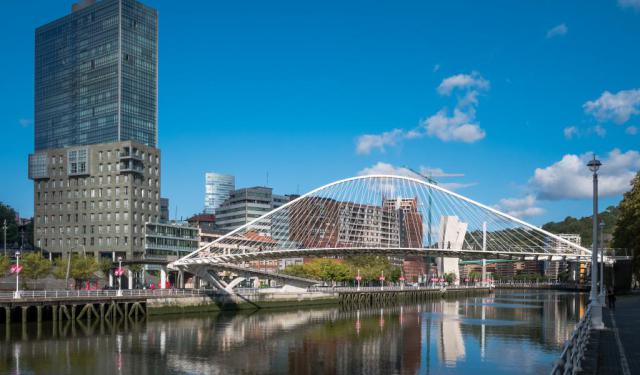
Officially founded in 1300 AD by the Lord of Biscay, Bilbao began as a small port settlement. Its sheltered estuary allowed ships to load wool, iron, and other goods bound for northern Europe, while merchants imported salt, wine, and luxury items. The name "Bilbao" likely comes from the Basque words bil, meaning "settlement," and bao, meaning "estuary"-a fitting... view more
Tour Duration: 2 Hour(s)
Travel Distance: 4.1 Km or 2.5 Miles
Tour Duration: 2 Hour(s)
Travel Distance: 4.1 Km or 2.5 Miles
Bilbao's Old Town Walking Tour
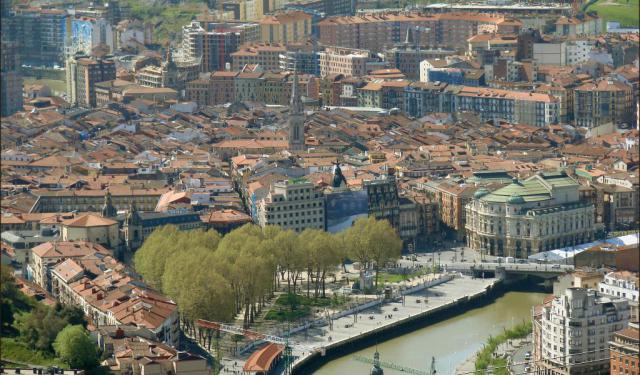
Bilbao's old town, also known as The Seven Streets, is the medieval heart of the city. Indeed, this ancient neighborhood, a place where the city began and which had been fortified by walls until the late 19th century, today consists of seven main streets and many narrow alleys – called cantons (kantoi, cantón) – that connect them.
Often regarded as a jewel of Basque architecture and... view more
Tour Duration: 1 Hour(s)
Travel Distance: 1.6 Km or 1 Miles
Often regarded as a jewel of Basque architecture and... view more
Tour Duration: 1 Hour(s)
Travel Distance: 1.6 Km or 1 Miles