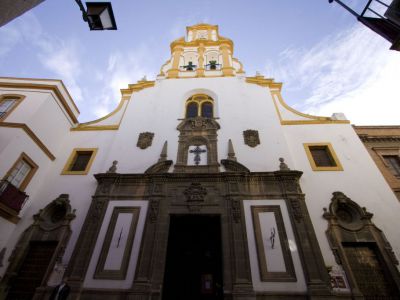


Iglesia de Santa Cruz (Church of the Holy Cross), Seville
The Church of the Holy Cross stands on Mateos Gago Street, just a short walk from the cathedral in the historic Holy Cross Neighborhood. While it bears the name of the district's central square, it is not actually located within it; rather, it occupies the site of the former Convent of the Holy Spirit. The church is deeply connected to the history of the area, which once formed the Jewish quarter of medieval Seville. Today, it serves as the headquarters of the Brotherhood of the Holy Cross, a prominent religious confraternity.
Construction of the building began in 1655 and was completed in 1672 to serve the Minor Clerics, only becoming the parish church of the Holy Cross in the 19th century after the original church in the nearby square was demolished. The main chapel, designed by architect José Tirado, was added in 1728. The interior features three naves and a magnificent altarpiece from 1735. Neoclassical refinements continued into the late 18th century, including the installation of 46 choir stalls made of mahogany and pine in 1800, salvaged from the Convent of Saint Augustine.
After centuries of appearing unfinished and plain, it was enhanced with a Neo-Baroque façade between 1926 and 1929 by architect Juan Talavera y Heredia, giving the building its current decorative character.
While the church itself sits on a bustling street, Holy Cross Square remains a peaceful retreat nearby. Shaded by orange trees and centered around a famous 17th-century wrought-iron cross, the square marks the site where the original church once stood and where the painter Bartolomé Esteban Murillo is buried.
Construction of the building began in 1655 and was completed in 1672 to serve the Minor Clerics, only becoming the parish church of the Holy Cross in the 19th century after the original church in the nearby square was demolished. The main chapel, designed by architect José Tirado, was added in 1728. The interior features three naves and a magnificent altarpiece from 1735. Neoclassical refinements continued into the late 18th century, including the installation of 46 choir stalls made of mahogany and pine in 1800, salvaged from the Convent of Saint Augustine.
After centuries of appearing unfinished and plain, it was enhanced with a Neo-Baroque façade between 1926 and 1929 by architect Juan Talavera y Heredia, giving the building its current decorative character.
While the church itself sits on a bustling street, Holy Cross Square remains a peaceful retreat nearby. Shaded by orange trees and centered around a famous 17th-century wrought-iron cross, the square marks the site where the original church once stood and where the painter Bartolomé Esteban Murillo is buried.
Want to visit this sight? Check out these Self-Guided Walking Tours in Seville. Alternatively, you can download the mobile app "GPSmyCity: Walks in 1K+ Cities" from Apple App Store or Google Play Store. The app turns your mobile device to a personal tour guide and it works offline, so no data plan is needed when traveling abroad.
Download The GPSmyCity App



Iglesia de Santa Cruz (Church of the Holy Cross) on Map
Sight Name: Iglesia de Santa Cruz (Church of the Holy Cross)
Sight Location: Seville, Spain (See walking tours in Seville)
Sight Type: Religious
Guide(s) Containing This Sight:
Sight Location: Seville, Spain (See walking tours in Seville)
Sight Type: Religious
Guide(s) Containing This Sight:
Walking Tours in Seville, Spain

Create Your Own Walk in Seville
Creating your own self-guided walk in Seville is easy and fun. Choose the city attractions that you want to see and a walk route map will be created just for you. You can even set your hotel as the start point of the walk.
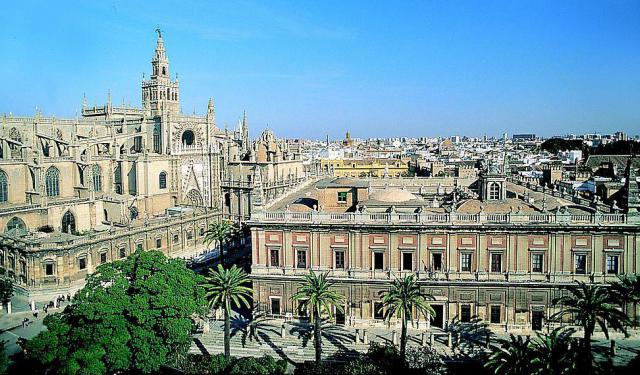
Old Seville Walking Tour
In his famous book Don Quixote, Spanish writer Miguel de Cervantes referred to Seville as a city where the bustle of life never seemed to stop.
Old Seville, the historic heart of the Andalusian capital, reflects more than two thousand years of cultural layers. The area developed along the banks of the Guadalquivir River, which for centuries connected the city to the wider Mediterranean world.... view more
Tour Duration: 1 Hour(s)
Travel Distance: 2.4 Km or 1.5 Miles
Old Seville, the historic heart of the Andalusian capital, reflects more than two thousand years of cultural layers. The area developed along the banks of the Guadalquivir River, which for centuries connected the city to the wider Mediterranean world.... view more
Tour Duration: 1 Hour(s)
Travel Distance: 2.4 Km or 1.5 Miles
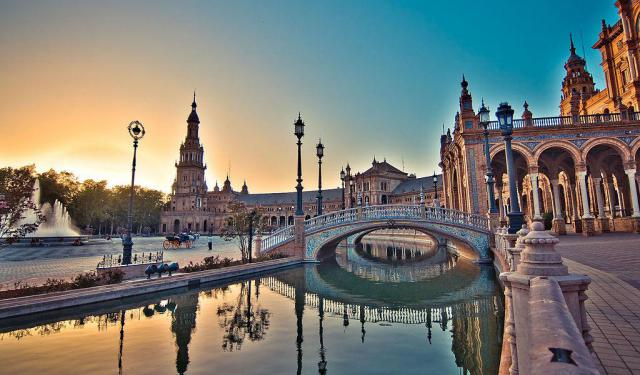
Seville Introduction Walking Tour
19th-century American writer Washington Irving noted that in Seville “the past lingers like perfume.”
Seville is the largest city and provincial capital of Andalusia, located on the banks of the Guadalquivir River. Ancient tradition credits the city’s foundation to Hercules. Historically, early Phoenician settlers called the site Hisbaal, invoking the god Baal, a name later Latinised by... view more
Tour Duration: 2 Hour(s)
Travel Distance: 4.9 Km or 3 Miles
Seville is the largest city and provincial capital of Andalusia, located on the banks of the Guadalquivir River. Ancient tradition credits the city’s foundation to Hercules. Historically, early Phoenician settlers called the site Hisbaal, invoking the god Baal, a name later Latinised by... view more
Tour Duration: 2 Hour(s)
Travel Distance: 4.9 Km or 3 Miles
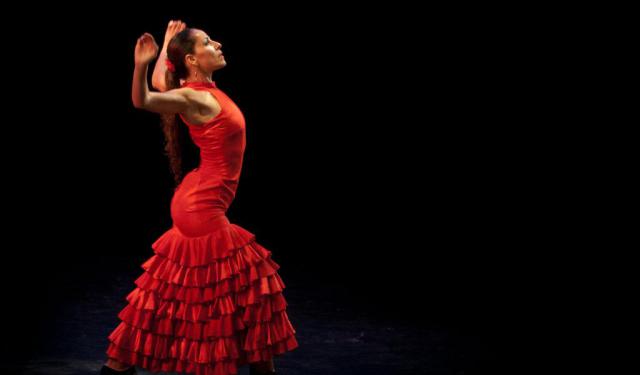
Flamenco Walking Tour
They say if it's Flamenco – it's Andalusia, and if it's Andalusia – it's all about Seville. Indeed, with its roots deeply embedded in the Andalusian culture, Seville is a prime destination for experiencing the essence of Flamenco and is largely considered to be the home of this fiery dance.
Flamenco sites are found all over the city – in bars, theaters, or specialized... view more
Tour Duration: 1 Hour(s)
Travel Distance: 2.7 Km or 1.7 Miles
Flamenco sites are found all over the city – in bars, theaters, or specialized... view more
Tour Duration: 1 Hour(s)
Travel Distance: 2.7 Km or 1.7 Miles
Useful Travel Guides for Planning Your Trip

16 Uniquely Spanish Things to Buy in Seville
Immortalized by Gioachino Rossini in his famous The Barber of Seville opera, the city of Seville is a major historic and cultural sight adorning the face of modern Spain. Much of the city's character is reflected in the locally-made products that can make for a great gift or trip memento...