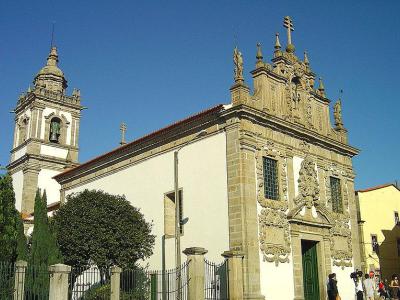


Igreja de Sao Vicente (St. Vincent's Church), Braga
The history of Saint Vincent's Church dates back to a primitive temple, which may have been destroyed during the Muslim invasion of the Iberian Peninsula. A significant artifact from this earlier period is a Visigothic tombstone with an epigraphic inscription, now displayed on the sacristy wall. It bears an inscription that reads: "Here rests Remisnuera, since the first of May 656 (= 618), day Monday, in peace, Amen." This inscription is notably one of the earliest references to the day of the week known as Monday.
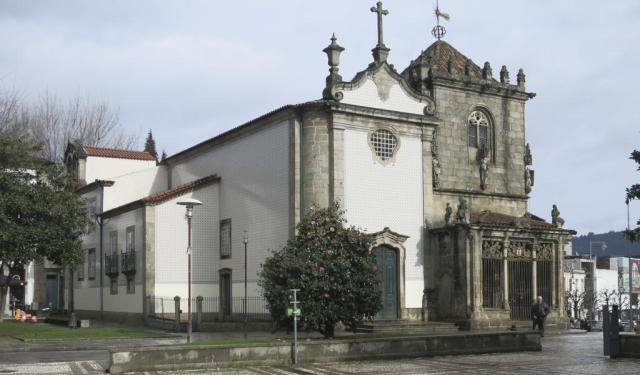
The current church, dedicated to Saint Vincent, was rebuilt in the mid-16th century. The façade, with Mannerist and Baroque influences, is characterized by its harmonious rise and intricate Baroque decorations. At the top of the façade, a niche houses the image of the patron saint, Saint Vincent.
The church features a bell tower situated behind the main chapel. Historically, the tower was the tallest structure in the city, making it susceptible to lightning strikes. As a result, it underwent reconstruction, most notably in 1812. At one point, a majestic weather vane crowned the tower, which was crafted by the renowned blacksmith João de Araújo Faúlhas in 1743. In 1813, the Brotherhood of São Vicente decided to protect the tower from future thunderstorms by placing a lead box containing several relics next to the tower's roof.
Inside the church, visitors can admire various notable features. The church houses an organ crafted by the master organ maker Francisco António Solha in 1769. The tile panels, created in 1873 by the Fábrica de Cerâmica das Devesas, add to the church's decorative charm. The walls of the Igreja de São Vicente display two large paintings by Carlos António Leoni. These paintings depict scenes from the martyrdom of Saint Vincent, providing a visual narrative of the church's patron saint.
The current church, dedicated to Saint Vincent, was rebuilt in the mid-16th century. The façade, with Mannerist and Baroque influences, is characterized by its harmonious rise and intricate Baroque decorations. At the top of the façade, a niche houses the image of the patron saint, Saint Vincent.
The church features a bell tower situated behind the main chapel. Historically, the tower was the tallest structure in the city, making it susceptible to lightning strikes. As a result, it underwent reconstruction, most notably in 1812. At one point, a majestic weather vane crowned the tower, which was crafted by the renowned blacksmith João de Araújo Faúlhas in 1743. In 1813, the Brotherhood of São Vicente decided to protect the tower from future thunderstorms by placing a lead box containing several relics next to the tower's roof.
Inside the church, visitors can admire various notable features. The church houses an organ crafted by the master organ maker Francisco António Solha in 1769. The tile panels, created in 1873 by the Fábrica de Cerâmica das Devesas, add to the church's decorative charm. The walls of the Igreja de São Vicente display two large paintings by Carlos António Leoni. These paintings depict scenes from the martyrdom of Saint Vincent, providing a visual narrative of the church's patron saint.
Want to visit this sight? Check out these Self-Guided Walking Tours in Braga. Alternatively, you can download the mobile app "GPSmyCity: Walks in 1K+ Cities" from Apple App Store or Google Play Store. The app turns your mobile device to a personal tour guide and it works offline, so no data plan is needed when traveling abroad.
Download The GPSmyCity App



Igreja de Sao Vicente (St. Vincent's Church) on Map
Sight Name: Igreja de Sao Vicente (St. Vincent's Church)
Sight Location: Braga, Portugal (See walking tours in Braga)
Sight Type: Religious
Sight Location: Braga, Portugal (See walking tours in Braga)
Sight Type: Religious
Nearby Sights


Walking Tours in Braga, Portugal

Create Your Own Walk in Braga
Creating your own self-guided walk in Braga is easy and fun. Choose the city attractions that you want to see and a walk route map will be created just for you. You can even set your hotel as the start point of the walk.
Braga Introduction Walking Tour
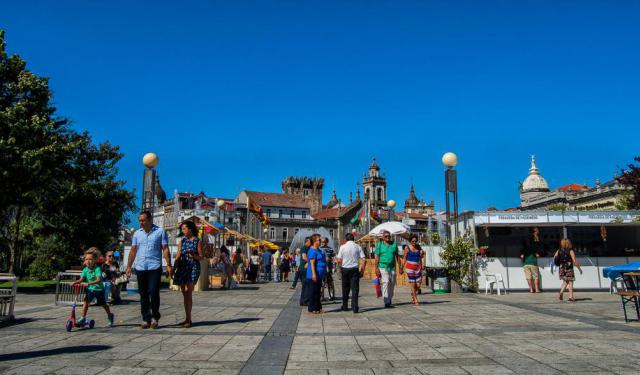
The history of Braga, Portugal's religious capital, spans millennia. Located in the northern Minho region, this city is also one of the country's oldest, reportedly founded by Bracari Celts.
Braga's origin is closely associated with the Roman conquest in 136 BC, culminating in the establishment of Bracara Augusta in 16 BC, a pivotal location within the newly-formed Gallaecia... view more
Tour Duration: 2 Hours
Travel Distance: 2 Km or 1.2 Miles
Braga's origin is closely associated with the Roman conquest in 136 BC, culminating in the establishment of Bracara Augusta in 16 BC, a pivotal location within the newly-formed Gallaecia... view more
Tour Duration: 2 Hours
Travel Distance: 2 Km or 1.2 Miles
Historical Religious Sites Walking Tour
Braga is a prominent destination in Portugal's Religious Tourism segment, primarily due to its vibrant Holy Week celebrations and rich ecclesiastical architecture. Indeed, being one of the world's oldest Christian cities, Braga boasts an extensive religious legacy. Much like Rome, it seamlessly interweaves art and spirituality throughout its historic center.
Here, you will find a... view more
Tour Duration: 1 Hour
Travel Distance: 1.4 Km or 0.9 Miles
Here, you will find a... view more
Tour Duration: 1 Hour
Travel Distance: 1.4 Km or 0.9 Miles