

Kindlifresserbrunnen (Child Eater Fountain), Bern
The Child Eater Fountain is one of Bern’s most unusual and mysterious Renaissance landmarks. Standing in Granary Square, it was created between 1545 and 1546 to replace an earlier wooden fountain dating from the 15th century. It was originally known as the Plaza Fountain, while the name Child Eater Fountain was first recorded in 1666.
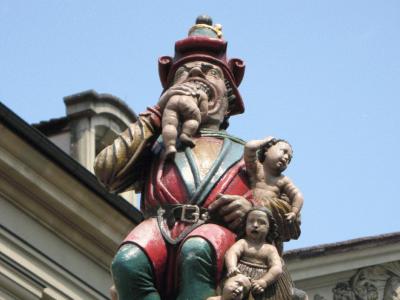
The sculpture depicts a seated ogre biting into a naked child, with a sack containing other children beside him. Pay attention to the left side of the giant's torso to find a sculpted leather pouch overflowing with the helpless children awaiting their fate.
Its exact meaning has never been conclusively established, giving rise to several interpretations.The ogre’s pointed hat has led some scholars to connect the figure with medieval antisemitic imagery and blood-libel traditions. Other theories identify it as Krampus, the frightening creature of Alpine folklore who punishes disobedient children, or as the Greek Titan Cronus, who devoured his own offspring. The figure may also have originated as a carnival character intended to frighten unruly children during the traditional pre-Lenten festivities.
Stepping away from the sinister symbolism, another artistic highlight is the decorative ring beneath the pedestal. It features a painted relief of bears in military armor parading around the column.
Whatever its original purpose, the fountain has fascinated and unsettled generations of visitors for almost five centuries. It also appears prominently in Jacques Chessex’s novel The Ogre.
The sculpture depicts a seated ogre biting into a naked child, with a sack containing other children beside him. Pay attention to the left side of the giant's torso to find a sculpted leather pouch overflowing with the helpless children awaiting their fate.
Its exact meaning has never been conclusively established, giving rise to several interpretations.The ogre’s pointed hat has led some scholars to connect the figure with medieval antisemitic imagery and blood-libel traditions. Other theories identify it as Krampus, the frightening creature of Alpine folklore who punishes disobedient children, or as the Greek Titan Cronus, who devoured his own offspring. The figure may also have originated as a carnival character intended to frighten unruly children during the traditional pre-Lenten festivities.
Stepping away from the sinister symbolism, another artistic highlight is the decorative ring beneath the pedestal. It features a painted relief of bears in military armor parading around the column.
Whatever its original purpose, the fountain has fascinated and unsettled generations of visitors for almost five centuries. It also appears prominently in Jacques Chessex’s novel The Ogre.
Want to visit this sight? Check out these Self-Guided Walking Tours in Bern. Alternatively, you can download the mobile app "GPSmyCity: Walks in 1K+ Cities" from Apple App Store or Google Play Store. The app turns your mobile device to a personal tour guide and it works offline, so no data plan is needed when traveling abroad.
Download The GPSmyCity App



Kindlifresserbrunnen (Child Eater Fountain) on Map
Sight Name: Kindlifresserbrunnen (Child Eater Fountain)
Sight Location: Bern, Switzerland (See walking tours in Bern)
Sight Type: Attraction/Landmark
Guide(s) Containing This Sight:
Sight Location: Bern, Switzerland (See walking tours in Bern)
Sight Type: Attraction/Landmark
Guide(s) Containing This Sight:
Nearby Sights

Walking Tours in Bern, Switzerland

Create Your Own Walk in Bern
Creating your own self-guided walk in Bern is easy and fun. Choose the city attractions that you want to see and a walk route map will be created just for you. You can even set your hotel as the start point of the walk.
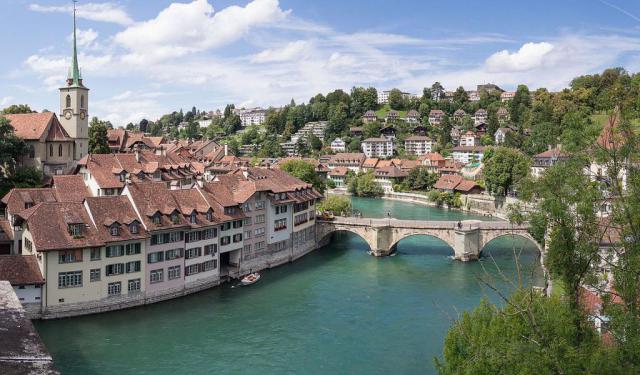
Walking Through Old Town of Bern
During his visit in 1779, German writer Johann Wolfgang von Goethe did not hesitate to call Bern the most beautiful city he had ever seen.
Bern, the capital of Switzerland, was founded in 1191 by Duke Berchtold V of Zähringen, who established the city on a narrow peninsula formed by a bend in the Aare River. According to local legend, the duke vowed to name his new settlement after the first... view more
Tour Duration: 2 Hours
Travel Distance: 2.6 Km or 1.6 Miles
Bern, the capital of Switzerland, was founded in 1191 by Duke Berchtold V of Zähringen, who established the city on a narrow peninsula formed by a bend in the Aare River. According to local legend, the duke vowed to name his new settlement after the first... view more
Tour Duration: 2 Hours
Travel Distance: 2.6 Km or 1.6 Miles
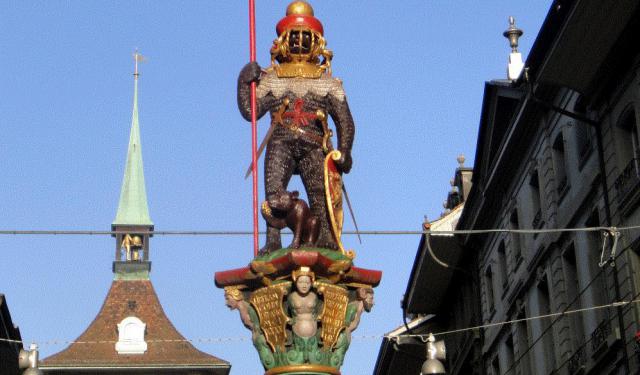
Fountains and Statues Walking Tour
With over 100 public fountains in the Old Town alone, Bern has a well-deserved reputation as the "City of Fountains". During medieval times, local life revolved around fountains as they provided water for residents and served as locations for news exchange and social gatherings.
Throughout history, Bernese residents have cherished their fountains and decorated them with elaborate... view more
Tour Duration: 1 Hour
Travel Distance: 1.6 Km or 1 Miles
Throughout history, Bernese residents have cherished their fountains and decorated them with elaborate... view more
Tour Duration: 1 Hour
Travel Distance: 1.6 Km or 1 Miles
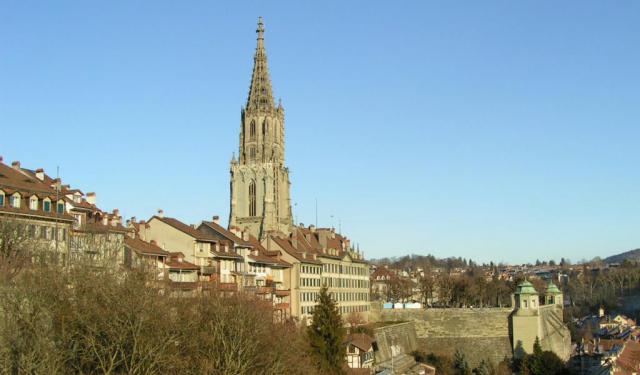
Bern's Historical Churches
They say architecture should speak of its time and place, but yearn for timelessness. While the outside appearances of historical churches in Bern beckon seekers of beauty and tranquility, the ethereal atmosphere within embraces the visitor with a sense of timeless serenity.
Enveloped within Bern's historic old town, the Church of the Holy Ghost (Heiliggeistkirche) is one of the largest... view more
Tour Duration: 1 Hour
Travel Distance: 1.9 Km or 1.2 Miles
Enveloped within Bern's historic old town, the Church of the Holy Ghost (Heiliggeistkirche) is one of the largest... view more
Tour Duration: 1 Hour
Travel Distance: 1.9 Km or 1.2 Miles
Useful Travel Guides for Planning Your Trip

Swiss Sweets and Pastries
Among other things that make Switzerland popular around the world, chocolate is definitely the one. Still, chocolate isn't the only Swiss-made sweet deserving attention, as there are plenty of baked products, such as Magenbrot, Vermicelles, and Biberli, to mention but a few, that are well worth...