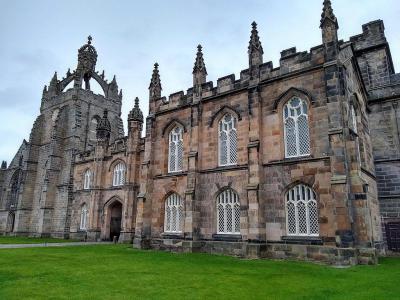


King's College Chapel, Aberdeen
Among the most recognizable landmarks of the University of Aberdeen is King’s College Chapel. Founded in 1495 under the patronage of King James IV of Scotland, King’s College was originally an independent institution. Construction of its chapel began in 1498, and the building was consecrated in 1509. Dedicated to the Holy Trinity and the Blessed Virgin Mary, this is one of Scotland’s finest examples of late medieval architecture.
As you come near it, take a moment to admire the chapel’s exterior, particularly the Crown Tower rising above its western end. Look up at the distinctive open stone crown, supported by four arches and topped with a cross. Resembling a royal crown suspended above the tower, this unusual feature has become the university’s most famous architectural symbol. Also notice the chapel’s tall Gothic windows, pointed arches, and carefully carved stonework.
Now, step inside and begin in the ante-chapel, the western section of the building, which has served as the university’s war memorial since 1928. Here, you will find memorials commemorating 524 members of the university community who lost their lives during the First and Second World Wars. Take a moment to examine the inscriptions before continuing toward the main chapel.
As you move farther inside, look for the magnificent wooden rood screen, dating from around 1509. This intricately carved partition separates the ante-chapel from the choir, traditionally reserved for clergy and college members. Look closely at its delicate Gothic tracery and decorative details, remarkable survivors of the Scottish Reformation.
Beyond the screen, turn your gaze to the 16th-century wooden choir stalls lining both sides of the chapel. Notice their high backs, elaborate canopies, and individually carved details. These are among the finest surviving examples of medieval church woodwork in Scotland.
The chapel also has close connections to two important figures in the university’s history. Its founder, Bishop William Elphinstone, was buried here in 1514, although the precise whereabouts of his remains are uncertain. The chapel is also associated with the burial of Hector Boece, the college’s first principal and an influential Scottish historian.
Finally, look along the length of the chapel toward its eastern end. Its carefully ordered proportions and arrangement reflect a design traditionally associated with the biblical Temple of Solomon, adding another layer of significance to this remarkable medieval building.
Want to visit this sight? Check out these Self-Guided Walking Tours in Aberdeen. Alternatively, you can download the mobile app "GPSmyCity: Walks in 1K+ Cities" from Apple App Store or Google Play Store. The app turns your mobile device to a personal tour guide and it works offline, so no data plan is needed when traveling abroad.
Download The GPSmyCity App



King's College Chapel on Map
Sight Name: King's College Chapel
Sight Location: Aberdeen, Scotland (See walking tours in Aberdeen)
Sight Type: Religious
Guide(s) Containing This Sight:
Sight Location: Aberdeen, Scotland (See walking tours in Aberdeen)
Sight Type: Religious
Guide(s) Containing This Sight:
Nearby Sights





Walking Tours in Aberdeen, Scotland

Create Your Own Walk in Aberdeen
Creating your own self-guided walk in Aberdeen is easy and fun. Choose the city attractions that you want to see and a walk route map will be created just for you. You can even set your hotel as the start point of the walk.

Aberdeen Old Town Walking Tour
Established as a separate burgh in 1489, Old Aberdeen has been an important religious, political, and cultural center since the late Middle Ages. For centuries, it was a town in its own right, only becoming part of the city of Aberdeen in 1891. Today, much of its historic center is a protected conservation area, where medieval buildings stand alongside houses and other structures dating from the... view more
Tour Duration: 2 Hours
Travel Distance: 3.1 Km or 1.9 Miles
Tour Duration: 2 Hours
Travel Distance: 3.1 Km or 1.9 Miles

Aberdeen City Center Walking Tour
Aberdeen, a historic port city on Scotland's northeast coast, has a history stretching back almost a millennium. People have lived in this area for at least 8,000 years, although the city itself began taking shape much later. Its name comes from the Pictish word “aber,” meaning "river mouth," and the River Don, which flows into the North Sea here. So, Aberdeen essentially means... view more
Tour Duration: 2 Hours
Travel Distance: 2.4 Km or 1.5 Miles
Tour Duration: 2 Hours
Travel Distance: 2.4 Km or 1.5 Miles
City Walks Overview
