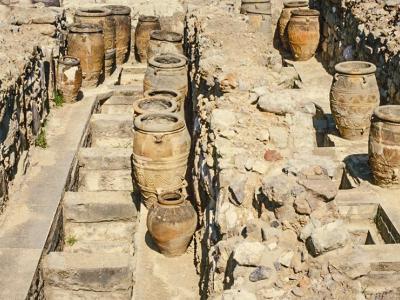


Knossos Palace Storage, Heraklion
Minoan pottery, a pivotal tool in dating the silent Minoan civilization, showcases a distinctive sequence of artistic styles, reflecting the Minoans' penchant for novelty while aiding archaeologists in establishing relative chronologies at various sites.
Dating back to the 18th century BC, Minoan pottery has been discovered at sites across the Aegean islands, mainland Greece, Cyprus, coastal Syria, and Egypt, underscoring the extensive trading networks of the Minoans. The pottery encompasses a diverse range of vessels, collectively known as "vases," and includes "terracottas," small ceramic figurines, and models of buildings. The Late Minoan period saw the pinnacle of artistic achievement in Minoan pottery, with notable examples such as the palace pottery called Kamares ware, and the "Marine Style" and "Floral Style" characterized by intricate patterns.
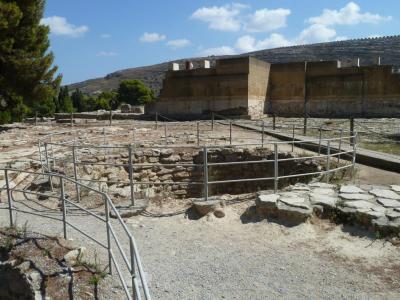
Knossos Palace boasted extensive storage magazines that served dual purposes, housing agricultural commodities and high-quality tableware. The palace stored enormous sets of elaborately decorated tableware, often produced elsewhere in Crete. The prolific, heavily-decorated pottery found at Knossos is uniquely styled, allowing archaeologists to establish a standard relative chronology based on pottery styles. This chronology, in turn, is crucial for assigning dates to different layers of the palace, offering a valuable tool for understanding the timeline of Minoan civilization.
Dating back to the 18th century BC, Minoan pottery has been discovered at sites across the Aegean islands, mainland Greece, Cyprus, coastal Syria, and Egypt, underscoring the extensive trading networks of the Minoans. The pottery encompasses a diverse range of vessels, collectively known as "vases," and includes "terracottas," small ceramic figurines, and models of buildings. The Late Minoan period saw the pinnacle of artistic achievement in Minoan pottery, with notable examples such as the palace pottery called Kamares ware, and the "Marine Style" and "Floral Style" characterized by intricate patterns.
Knossos Palace boasted extensive storage magazines that served dual purposes, housing agricultural commodities and high-quality tableware. The palace stored enormous sets of elaborately decorated tableware, often produced elsewhere in Crete. The prolific, heavily-decorated pottery found at Knossos is uniquely styled, allowing archaeologists to establish a standard relative chronology based on pottery styles. This chronology, in turn, is crucial for assigning dates to different layers of the palace, offering a valuable tool for understanding the timeline of Minoan civilization.
Want to visit this sight? Check out these Self-Guided Walking Tours in Heraklion. Alternatively, you can download the mobile app "GPSmyCity: Walks in 1K+ Cities" from Apple App Store or Google Play Store. The app turns your mobile device to a personal tour guide and it works offline, so no data plan is needed when traveling abroad.
Download The GPSmyCity App



Knossos Palace Storage on Map
Sight Name: Knossos Palace Storage
Sight Location: Heraklion, Greece (See walking tours in Heraklion)
Sight Type: Attraction/Landmark
Sight Location: Heraklion, Greece (See walking tours in Heraklion)
Sight Type: Attraction/Landmark
Nearby Sights

Walking Tours in Heraklion, Greece

Create Your Own Walk in Heraklion
Creating your own self-guided walk in Heraklion is easy and fun. Choose the city attractions that you want to see and a walk route map will be created just for you. You can even set your hotel as the start point of the walk.
Heraklion Introduction Walking Tour
Legend tells that Heracles once set foot on Crete to capture the mighty Cretan Bull - a labor that tested both his strength and endurance. From that tale comes the name “Heraklion,” meaning “city of Heracles,” a fitting tribute to a place that has itself endured through centuries of change and conquest.
The area has been inhabited since the Neolithic era, but it first rose to... view more
Tour Duration: 2 Hours
Travel Distance: 2.3 Km or 1.4 Miles
The area has been inhabited since the Neolithic era, but it first rose to... view more
Tour Duration: 2 Hours
Travel Distance: 2.3 Km or 1.4 Miles
City Walks Overview
