

Heraklion Introduction Walking Tour, Heraklion

Heraklion Introduction Walking Tour (Self Guided), Heraklion

Legend tells that Heracles once set foot on Crete to capture the mighty Cretan Bull — a labor that tested both his strength and endurance. From that tale comes the name “Heraklion,” meaning “city of Heracles,” a fitting tribute to a place that has itself endured through centuries of change and conquest.

The area has been inhabited since the Neolithic era, but it first rose to prominence in the Bronze Age as the chief port of the Minoan civilization between 1750 and 1430 BC. Closely connected to the nearby Palace of Knossos, Heraklion became a major maritime hub trading saffron, textiles, and ceramics across the Mediterranean. It was among the first cities in the world to engage in international trade.

After the fall of the Minoans, Crete passed through Roman and Byzantine hands. In 824 AD, Arab forces captured the city, renaming it Khandak (meaning “the moat”) for the deep trench encircling their fortress. The Byzantines later reconquered it in 960 AD, calling it Chandax, a name that evolved under Venetian rule into Candia.

In 1204, the Venetians transformed Candia into a fortified stronghold and the capital of their island empire. This era, known as the Cretan Renaissance, transformed the city into a thriving center of art, literature and scholarship. During the same period, the famous artist El Greco was born on the island and started his career here, before gaining fame abroad.

Venetian rule did not last forever though. The 21-year Siege of Candia in the 17th century, one of the longest in European history, marked the start of Ottoman control. Under the Ottomans, the city was expanded with mosques, fountains, and markets that blended Eastern influences into its urban landscape.

After centuries of unrest, Crete achieved autonomy in 1898 and united with Greece in 1913. The city reclaimed its ancient name, Heraklion, in honor of its mythic origins.

Strolling through Heraklion’s old town, you’ll pass the 16th-century Venetian Loggia and sturdy bastion walls overlooking the sea, then step into the bustling Lions’ Square with its iconic Morosini Fountain. Nearby, the magnificent Koules Fortress guards the harbor entrance. Shopping-wise, window displays showcase Cretan olive oil, honey and raki. Every turn brings layers of history, vibrant cafés and the Mediterranean breeze — a compact walk through past and present.

As you finish your walk through Heraklion’s lively streets and wind-worn ramparts, think again of Heracles and his labor. Like the hero’s struggle, this city’s story is one of persistence — a legacy and a way of life that stands unapologetically firm against the tides of time.
How it works: Download the app "GPSmyCity: Walks in 1K+ Cities" from Apple App Store or Google Play Store to your mobile phone or tablet. The app turns your mobile device into a personal tour guide and its built-in GPS navigation functions guide you from one tour stop to next. The app works offline, so no data plan is needed when traveling abroad.

Download The GPSmyCity App

Heraklion Introduction Walking Tour Map

Guide Name: Heraklion Introduction Walking Tour
Guide Location: Greece » Heraklion (See other walking tours in Heraklion)
Guide Type: Self-guided Walking Tour (Sightseeing)
# of Attractions: 11
Tour Duration: 2 Hour(s)
Travel Distance: 2.3 Km or 1.4 Miles
Author: DanaOffice
Sight(s) Featured in This Guide:
  • 25th of August Street
  • Saint Titus Cathedral
  • Venetian Loggia
  • Saint Mark's Basilica
  • Morosini Fountain (Lion's Fountain)
  • Central Market
  • Agios Minas Cathedral
  • Historical Museum of Crete
  • Saint Peter Monastery
  • Old Venetian Harbor
  • Castello del Molo (Koules Fortress)
1
25th of August Street

1) 25th of August Street

Once known as "Odos Planis" or "Illusion Street," 25th of August Street earned its nickname due to the impressive Neoclassical buildings that line the approach from the harbor. Today, it is a paved pedestrian thoroughfare, bustling with activity, and home to banks, travel bureaus, and tourist shops housed within these historic structures. The street offers visitors a chance to combine sightseeing with shopping and local culture.

Walking along 25th of August Street, several notable landmarks catch the eye, including the Church of Saint Titus, the Loggia, and the Basilica of St. Mark. Each of these buildings reflects the architectural styles of different periods and tells a story of Heraklion’s resilience and transformation following the major earthquakes and fires of 1898. The street itself serves as a visual record of the city’s history, preserving layers of its past.

The origins of 25th of August Street go back to the Arab period in the 9th or 10th century, when it first served as the main artery connecting the town center to the harbor. During Venetian rule, it was called Main Street, and under Ottoman control, it was known as Vizier's Market, named after the Vezir Mosque.

The current name commemorates a tragic event on 25 August 1898, when a violent outbreak during the feast of St. Titus led to the deaths of many people, including 17 British soldiers and the British Consul Lysimachos Kalokairinos. This incident triggered international intervention, eventually contributing to Crete’s union with Greece in 1913.
2
Saint Titus Cathedral

2) Saint Titus Cathedral

The Cathedral of Saint Titus is a key Orthodox church located in the center of Heraklion, dedicated to Saint Titus, the first bishop of Crete. The cathedral has a complex history, evolving from its beginnings as the Yeni Cami, or "New Mosque," to its current role as an important place of Christian worship within the archdiocese of Crete.

Built in 1869 using the design of architect Athanasios Moussis, the cathedral features a square layout topped with a large dome. Its exterior is marked by vertical elements and a stone-carved apse, reflecting the architectural influences of the period and the blend of styles that characterize its structure.

Originally serving the Muslim community as the Yeni Mosque, the building underwent significant changes after Crete became part of Greece. During the population exchanges between the Balkans and Anatolia, the mosque was converted into an Orthodox cathedral and officially consecrated for Christian worship on May 3, 1925. The removal of the minaret during this transformation symbolized its shift from Islamic to Christian use.

The cathedral’s historical importance deepened on May 15, 1966, when the head of Saint Titus was returned to Heraklion by the city of Venice. This event reinforced the cathedral’s spiritual and cultural significance, making it a central site for the Orthodox community and a place where the city’s layered history is preserved and honored.
3
Venetian Loggia

3) Venetian Loggia

The Venetian Loggia is one of the key buildings from Heraklion’s Venetian period, reflecting the city’s historical and cultural heritage. Its name, “Loggia,” comes from the Italian word for “lodge” and points to its original role as a gathering place for the city’s elite and influential residents.

The Loggia was constructed after 1541, likely based on designs by Michel Sammicheli in the Palladian style. Following 1628, it was modified by Francisco Morosini, a notable Venetian official who contributed to several Heraklion landmarks, including the Lions Fountain and the city’s aqueduct. As the fourth Loggia built in the city, it became a central point for economic and social activity. Meetings on politics, commerce, and social events all took place within its walls, making it an important hub of civic life during Venetian rule.

Under Ottoman rule, the Loggia’s function changed, serving as an armory and suffering damage over time. Restoration efforts began in 1915 with the creation of the Cretan State, but progress was interrupted by World War II. A full-scale restoration started in 1961 and continued through the late 1970s, preserving the building’s historical features while adapting it for modern use.

Today, the Venetian Loggia houses Heraklion’s City Hall, maintaining its role as a center of civic life. The careful restoration has earned recognition and awards, ensuring that the building continues to reflect the city’s layered history and the influence of Venetian architecture in Crete.
4
Saint Mark's Basilica

4) Saint Mark's Basilica

The Basilica of Saint Mark stands proudly in Eleftheriou Venizelou Square, directly opposite the Lions Fountain. Dating back to the 13th century, precisely in 1239, the Venetians, seeking to fortify their dominion over Candia (modern-day Heraklion), and driven by a profound devotion to their homeland, erected the Basilica of Saint Mark. Dedicated to their patron saint, Saint Mark, the basilica served as a locus for official Venetian ceremonies and the final resting place for Venetian nobility.

The basilica's original design featured a straightforward layout with a covered portico, resembling the structure visitors encounter today. In 1956, the Society for Cretan Historical Studies undertook the significant task of restoring the building to its authentic form, preserving its historical essence.

At the southwest corner of the basilica, a towering structure housed a large clock facing Lions Square-a homage to Saint Mark's Basilica in Venice. This bell tower, modeled after its Venetian counterpart, became an integral part of the basilica's identity.

Over the centuries, the Basilica of Saint Mark weathered various earthquakes, withstanding the test of time with minimal repairs. However, during the Ottoman era, the basilica underwent a transformation into the Defterdar Mosque, named after Defterdar Ahmet Pasha, the Supreme Treasurer under Turkish rule. The Ottomans, in their alterations, dismantled the bell tower and erected a minaret in its place.

Today, the basilica serves a new purpose as the Municipal Art Gallery, welcoming visitors from near and far. Its doors are open almost daily, inviting exploration into the layers of history and cultural significance that define this venerable Venetian monument in the heart of Heraklion.
5
Morosini Fountain (Lion's Fountain)

5) Morosini Fountain (Lion's Fountain)

The Lions Fountain, also known as the Morosini Fountain, was built to address Heraklion’s water needs while reflecting the city’s Venetian heritage. Completed in 1628 under the supervision of Francesco Morosini and a team of engineers, the fountain provided the city with up to 1,000 barrels of water per day, offering a practical solution to Heraklion’s limited water supply. Its design successfully combined functionality with artistic detail, making it both a utility and a work of craftsmanship.

The fountain is circular with eight lobes, allowing several people to draw water at the same time. At its center, an octagonal pedestal supports four lions, symbols of Venetian authority and strength. Surrounding the pedestal are carved reliefs depicting Greek mythology, including Tritons, dolphins, and nymphs, showing the influence of Renaissance art in Venetian Crete. This careful balance of engineering and decorative detail illustrates the ingenuity and aesthetic priorities of the time.

Throughout its history, the fountain has seen modifications, including additions during the Turkish period, when marble columns were incorporated for ritual washing. A major restoration by the Municipal Council in 1900 returned the fountain to its original form. More recent conservation efforts have uncovered the Venetian underground ducts that channeled water from Archanes to Heraklion, highlighting the advanced engineering behind the fountain’s construction.

Today, the Lions Fountain remains a central feature of Heraklion’s urban landscape. While it no longer serves as the main water source, it continues to attract both locals and visitors who can appreciate its historical, cultural, and technical significance.
6
Central Market

6) Central Market

The Central Market runs from Meidani Crossroads to Kornarou Square, forming a lively corridor filled with shops, stalls, and small eateries that showcase Heraklion’s daily life. Named to honor the Cretan uprising of 1866, the market offers a wide selection of goods for locals and visitors alike. Shoppers can find souvenirs, affordable clothing and footwear, fresh fruits and vegetables, herbs and spices, as well as dairy and meat products. Small cafes and traditional tavernas along the way add to the busy, everyday atmosphere.

Several side streets branch off from the main market, expanding the area with additional shops, supermarkets, a bank, and an indoor parking lot. Karterou Street, near the top of the market, is particularly known for its fishmongers, who display the day’s fresh catch. While much of Heraklion’s shopping has moved to suburban areas or modern commercial streets, the Central Market keeps its old-fashioned charm. Narrow aisles, closely packed shops, and the steady movement of people give it an energy that contrasts with the polished storefronts of the city’s newer commercial areas.

The market also offers glimpses into Heraklion’s history. Scattered among the shops are remnants of the old city, including a Venetian arch inside the Koudoumas coffee shop and a small 16th-century church accessible through Touli’s bakery. These hidden features highlight the market’s long-standing role in the city’s life and provide context to its historical significance.
7
Agios Minas Cathedral

7) Agios Minas Cathedral (must see)

The Cathedral of Saint Minas stands as a testament to the city's deep connection with its patron saint. Adjacent to the cathedral, the smaller and older "Little Saint Minas" church offers visitors another glimpse into the city's religious history. On the opposite side of the square, the Church of Saint Catherine and the vibrant square named after it provide a lively backdrop with numerous cafes, restaurants, and shops.

Dedicated to Saint Minas, whose feast day is celebrated on November 11th as a public holiday, the cathedral holds religious and historical significance. The chapel boasts an exquisite iconostasis adorned with art and icons crafted by the skilled painter Georgios Castrophylacas. The decision to construct this magnificent church arose during a period of successive Cretan revolts against the Ottoman Turks.

Legend has it that Saint Minas intervened on Easter Sunday in 1826, protecting the city from an attempted storm by the Muslim population during an evening service. The intervention, in reality, involved the Turkish Ayan Agha persuading the Turks to stand down. Designed by the self-taught architect Athanassios Moussis, who arrived from Constantinople for the project, construction began in 1862 but was interrupted during the 1866-1869 revolution. The cathedral was finally completed in 1895, showcasing an impressive combination of interior splendor and exterior grandeur.

Despite Saint Minas being the city's patron saint, the name Minas is relatively uncommon due to historical practices. During the Turkish Occupation, children born out of wedlock and unable to be raised by their parents were left on the cathedral's steps. The church, adopting and caring for these children, would name them Minas. This historical practice has contributed to the infrequent use of the name Minas in the region.
8
Historical Museum of Crete

8) Historical Museum of Crete (must see)

The Historical Museum of Crete is located in a neoclassical building with deep historical roots. The oldest section of the museum was originally the mansion of Andreas Lysimachos Kalokerinos, built in 1903 following the designs of architect Konstantinos Tsantirakis. The building itself is a notable example of early 20th-century neoclassical architecture, with interior murals depicting scenes from the Iliad and Odyssey, painted by Antonios Stefanopoulos, known for his work on the Quellenec House in Athens.

Before this structure, the site was home to an earlier Kalokerinos family residence, constructed in 1870 by architect Lysandros Kaftantzoglou. That building was destroyed during the tragic events of August 25, 1898, when Lysimachos A. Kalokerinos and other family members lost their lives. The loss of the original mansion added historical significance to the site, linking the museum closely to the city’s past.

In the 1970s, the museum was expanded with a new wing funded by the A. & M. Kalokerinos Foundation, blending modern and neoclassical architectural styles. Further development took place in the early 1990s with the addition of another floor. By May 2004, the museum introduced Temporary Exhibition Rooms and the Yannis Pertselakis Amphitheatre, creating spaces for rotating displays and educational programs.

The museum now offers 1,500 square meters of indoor exhibition space divided into 25 sections that span seventeen centuries of Cretan history. Its displays cover the island’s social, cultural, and political development, providing visitors with a clear sense of Crete’s historical evolution. In addition to its exhibitions, the museum features a shop and a café, allowing guests to relax and reflect after exploring its extensive collections.

Visiting the Historical Museum of Crete gives a comprehensive understanding of the island’s past, connecting architectural heritage with cultural history. It offers a combination of permanent and temporary exhibits that appeal to a wide range of interests, making it a valuable destination for anyone looking to learn about Crete’s rich history.
9
Saint Peter Monastery

9) Saint Peter Monastery

Constructed in the early years of Venetian domination, Saint Peter Monastery belonged to the monastic order of Dominicans, specifically the Domenicani Predicatori. During this period, it emerged as one of the most significant and expansive Catholic monasteries in the city.

The monastery suffered damage in the earthquake of 1508, yet it endured as a place of religious significance. The architectural layout of the monastery includes a long aisle, covered by a two-slope roof, leading to a sanctuary roofed by two vaults. Noteworthy features of the structure include windows of various types along the north and south walls, some of which were added during the Turkish period. Adjacent to the sanctuary and towards the south side of the temple, chapels contribute to the overall architectural complexity.

Excavations in the wider area of the temple, known as the area of Kastella, unearthed graves from the second Byzantine period. Beneath these graves, remnants of an extended habitation from the Arabic period were discovered, providing valuable insights into the architecture and lifestyle of that era. Artifacts from these excavations are on display at the Historical Museum, contributing to the broader understanding of the region's history.

Throughout its existence, the monastery experienced transformation, including partial destruction during the Turkish occupation, when it was repurposed into a mosque named after Sultan Ibrahim. In recent times, efforts have been made to reconstruct and preserve the monastery. The reconstructed monastery is envisioned as a festive temple and a meeting place for international, orthodox, Christian, and religious congresses.
10
Old Venetian Harbor

10) Old Venetian Harbor

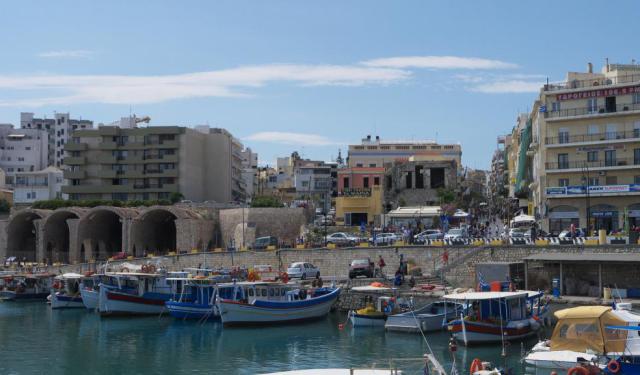
The Old Venetian Harbor of Heraklion reflects the city’s long and layered history, combining Venetian and Ottoman influences in a waterfront setting. Originally built by the Venetians in the 14th century, the harbor served as a key center for maritime trade and defense. Over the centuries, it was expanded and modified, with significant additions in the 19th century under Ottoman administration, which improved the port’s infrastructure while retaining much of the original layout.

Today, the harbor remains a lively part of the city, drawing both locals and visitors. Streets along the waterfront are lined with cafes, restaurants, and shops, creating a welcoming atmosphere for strolling, dining, or simply enjoying the view. Fishing boats share the waters with modern yachts, offering a glimpse of the harbor’s ongoing role in maritime life. At the entrance, the 16th-century lighthouse still stands, a reminder of the port’s long history and its importance for navigation.

The marina within the harbor provides wide views of the sea and the city, making it a pleasant area for walking or relaxing. Visitors can enjoy local cuisine at waterfront eateries, explore shops offering crafts and souvenirs, or observe the mix of historical and contemporary elements in the harbor’s layout. The Old Venetian Harbor continues to serve as a center of activity in Heraklion, combining historical interest with everyday urban life and coastal charm.
11
Castello del Molo (Koules Fortress)

11) Castello del Molo (Koules Fortress) (must see)

The Koules Fortress sits at the entrance of Heraklion’s old harbor, offering visitors a fascinating glimpse into the city’s history. Built by the Venetians in the early 1600s, it was designed to protect the harbor and the city from attacks, ensuring the safety of ships, trade, and residents. Its strategic position allowed defenders to monitor the sea and control access to the port, making it a vital part of Heraklion’s maritime defense.

The fortress replaced an earlier structure damaged by an earthquake and was rebuilt between 1523 and 1540. Made of solid stone, Koules was designed to endure both attacks and time. Walking along its thick walls and exploring its towers and battlements gives a real sense of how the Venetians defended the city and the harbor. Visitors can see where cannons were placed, imagine the soldiers who once lived here, and understand the fortress’s role in Heraklion’s history.

From the upper terraces, the views are impressive. You can see the Mediterranean Sea stretching out, the busy harbor below, and the city’s waterfront. These views make it easy to appreciate why the fortress was so important and provide great photo opportunities.

Today, Koules Fortress is one of Heraklion’s most visited landmarks. It’s an accessible site for history lovers, families, and anyone curious about the island’s Venetian past. With its combination of historical significance, architecture, and panoramic views, a visit to Koules is a chance to step back in time while enjoying one of the best vantage points in the city.

