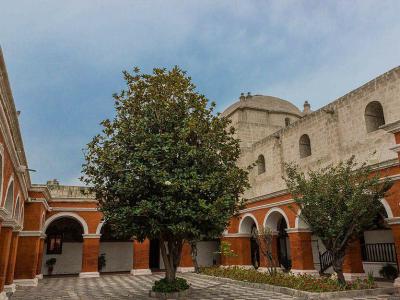


Monasterio de Santa Catalina (Santa Catalina Monastery), Arequipa
The Monastery of Santa Catalina is a captivating enclave, distinguished not only by its vibrant colonial architecture but also by the enigmatic tales concealed within its walls for centuries.
Established in the 16th century during the Spanish settlement of Peru, the Monastery of Santa Catalina emerged from the aspirations of Arequipa's residents. Francisco de Toledo heeded their pleas for a sanctuary where nuns could devote themselves to their faith and duties. Thus, the viceroy commissioned the construction of a grand monastery, unwittingly birthing one of the nation's most significant landmarks.
On September 10, 1579, amidst Arequipa's nascent years, the Monastery of Santa Catalina was unveiled, a testament to colonial opulence that endures today despite enduring numerous earthquakes. Its labyrinthine streets invite exploration on foot. The inaugural residents hailed from diverse backgrounds, spanning Creole, mestizo, and even descendants of curacas, the Inca Empire's political elite, united by unwavering religious fervor.
Spanning over 20,000 square meters, the monastery boasts 22 chambers, including the evocative Patio del Silencio and Cloister of the Orange Trees, now accessible as an outdoor museum.
Constructed with Arequipa's signature white and pink ashlars sourced from Mount Chachani and Mount Misti, the monastery blends Spanish techniques with local materials, epitomizing Peruvian colonial architecture.
Strolling its cobblestone pathways, visitors are transported through time, enveloped in the silence and intrigue that permeate its walls, occasionally encountering cloistered nuns who still reside within its confines.
Established in the 16th century during the Spanish settlement of Peru, the Monastery of Santa Catalina emerged from the aspirations of Arequipa's residents. Francisco de Toledo heeded their pleas for a sanctuary where nuns could devote themselves to their faith and duties. Thus, the viceroy commissioned the construction of a grand monastery, unwittingly birthing one of the nation's most significant landmarks.
On September 10, 1579, amidst Arequipa's nascent years, the Monastery of Santa Catalina was unveiled, a testament to colonial opulence that endures today despite enduring numerous earthquakes. Its labyrinthine streets invite exploration on foot. The inaugural residents hailed from diverse backgrounds, spanning Creole, mestizo, and even descendants of curacas, the Inca Empire's political elite, united by unwavering religious fervor.
Spanning over 20,000 square meters, the monastery boasts 22 chambers, including the evocative Patio del Silencio and Cloister of the Orange Trees, now accessible as an outdoor museum.
Constructed with Arequipa's signature white and pink ashlars sourced from Mount Chachani and Mount Misti, the monastery blends Spanish techniques with local materials, epitomizing Peruvian colonial architecture.
Strolling its cobblestone pathways, visitors are transported through time, enveloped in the silence and intrigue that permeate its walls, occasionally encountering cloistered nuns who still reside within its confines.
Want to visit this sight? Check out these Self-Guided Walking Tours in Arequipa. Alternatively, you can download the mobile app "GPSmyCity: Walks in 1K+ Cities" from Apple App Store or Google Play Store. The app turns your mobile device to a personal tour guide and it works offline, so no data plan is needed when traveling abroad.
Download The GPSmyCity App



Monasterio de Santa Catalina (Santa Catalina Monastery) on Map
Sight Name: Monasterio de Santa Catalina (Santa Catalina Monastery)
Sight Location: Arequipa, Peru (See walking tours in Arequipa)
Sight Type: Religious
Sight Location: Arequipa, Peru (See walking tours in Arequipa)
Sight Type: Religious
Nearby Sights



Walking Tours in Arequipa, Peru

Create Your Own Walk in Arequipa
Creating your own self-guided walk in Arequipa is easy and fun. Choose the city attractions that you want to see and a walk route map will be created just for you. You can even set your hotel as the start point of the walk.

Discover Arequipa's Historical Churches on Foot
Colonists from Spain brought to Peru and Arequipa the power of Catholicism, which is beautifully reflected today in the splendid architectural designs of Arequipa's numerous places of worship. Arequipa’s churches are among the most striking in Peru. Take this self-guided walking tour to explore the city's religious heritage.
Tour Duration: 1 Hour
Travel Distance: 2.1 Km or 1.3 Miles
Tour Duration: 1 Hour
Travel Distance: 2.1 Km or 1.3 Miles
Arequipa's Historic City Center Walking Tour
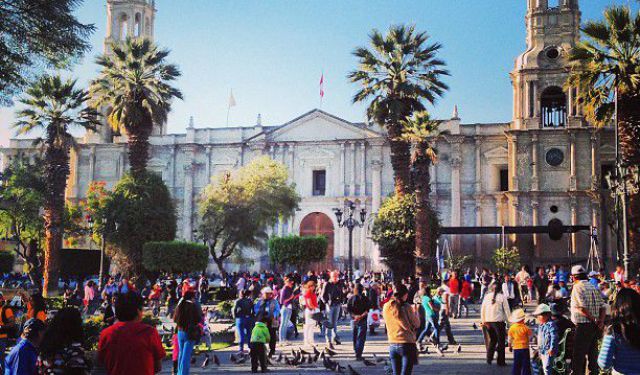
Capital of the eponymous region of Peru, Arequipa is a colonial-era city rich in architecture built of the volcanic stone provided by three neighboring volcanoes. The historic downtown area of Arequipa is dominated by Plaza de Armas complete with a plethora of ancient churches located nearby, of which the most notable is the 17th-century Basilica Cathedral. This orientation tour will walk you... view more
Tour Duration: 2 Hours
Travel Distance: 2 Km or 1.2 Miles
Tour Duration: 2 Hours
Travel Distance: 2 Km or 1.2 Miles
City Walks Overview
