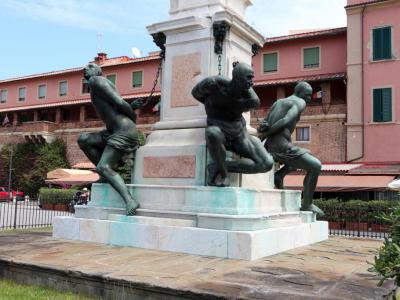


Monumento Dei Quattro Mori (Monument of the Four Moors), Livorno
The Monument of the Four Moors is Livorno’s most recognizable public sculpture. Erected in the early 17th century, it reflects both the artistic taste of the period and the political ambitions of the Medici. The monument was commissioned in 1617 by Cosimo II de’ Medici, the Grand Duke of Tuscany from 1609 to 1621, in honor of his father, Grand Duke Ferdinando I, and completed in 1626.
At the center of the monument is a marble statue of Ferdinando I, dressed as a Knight of the Order of Saint Stephen, the naval order founded by the Medici to combat piracy and assert control over the Tyrrhenian Sea. The figure stands atop a high pedestal, gazing toward the harbor. Surrounding the base are four bronze figures, sculpted by Pietro Tacca, a leading Mannerist and early Baroque sculptor. These figures represent defeated corsairs, bound in chains at each corner of the pedestal.
The four bronze statues belong to a wider 17th-century sculptural trend in Italy that favored expressive depictions of prisoners, captives, and enslaved figures. Each Moor is physically distinct, suggesting different geographic origins within the Mediterranean world and beyond; one figure is clearly African, while others reflect North African or Middle Eastern features. Tradition holds that Tacca used real prisoners as models.
The monument projects Medici maritime power and authority, while also unintentionally revealing darker realities of the period, including slavery and forced captivity, in which Tuscan interests were not innocent observers.
At the center of the monument is a marble statue of Ferdinando I, dressed as a Knight of the Order of Saint Stephen, the naval order founded by the Medici to combat piracy and assert control over the Tyrrhenian Sea. The figure stands atop a high pedestal, gazing toward the harbor. Surrounding the base are four bronze figures, sculpted by Pietro Tacca, a leading Mannerist and early Baroque sculptor. These figures represent defeated corsairs, bound in chains at each corner of the pedestal.
The four bronze statues belong to a wider 17th-century sculptural trend in Italy that favored expressive depictions of prisoners, captives, and enslaved figures. Each Moor is physically distinct, suggesting different geographic origins within the Mediterranean world and beyond; one figure is clearly African, while others reflect North African or Middle Eastern features. Tradition holds that Tacca used real prisoners as models.
The monument projects Medici maritime power and authority, while also unintentionally revealing darker realities of the period, including slavery and forced captivity, in which Tuscan interests were not innocent observers.
Want to visit this sight? Check out these Self-Guided Walking Tours in Livorno. Alternatively, you can download the mobile app "GPSmyCity: Walks in 1K+ Cities" from Apple App Store or Google Play Store. The app turns your mobile device to a personal tour guide and it works offline, so no data plan is needed when traveling abroad.
Download The GPSmyCity App



Monumento Dei Quattro Mori (Monument of the Four Moors) on Map
Sight Name: Monumento Dei Quattro Mori (Monument of the Four Moors)
Sight Location: Livorno, Italy (See walking tours in Livorno)
Sight Type: Attraction/Landmark
Guide(s) Containing This Sight:
Sight Location: Livorno, Italy (See walking tours in Livorno)
Sight Type: Attraction/Landmark
Guide(s) Containing This Sight:
Nearby Sights
Walking Tours in Livorno, Italy

Create Your Own Walk in Livorno
Creating your own self-guided walk in Livorno is easy and fun. Choose the city attractions that you want to see and a walk route map will be created just for you. You can even set your hotel as the start point of the walk.
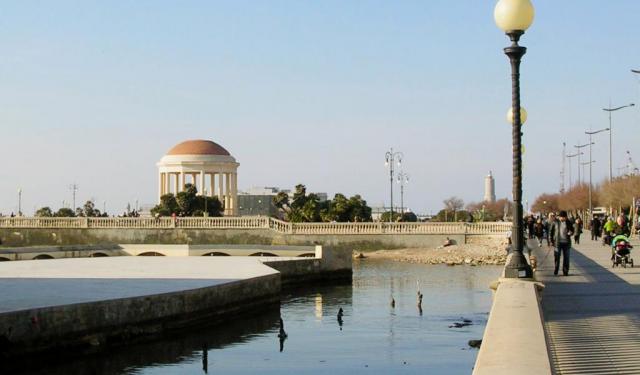
Livorno Seafront Walk
When the weather permits and you fancy a walk, whilst in Livorno, taking a stroll along the local seafront is a good idea. The curvy walkway, running along the coast, south of the city, is dotted with numerous points of interest. The first of them, marking the outset of the long stretch of intriguing sights further ahead, is the former Orlando shipyard.
Practically next door to it is the... view more
Tour Duration: 2 Hour(s)
Travel Distance: 2.3 Km or 1.4 Miles
Practically next door to it is the... view more
Tour Duration: 2 Hour(s)
Travel Distance: 2.3 Km or 1.4 Miles
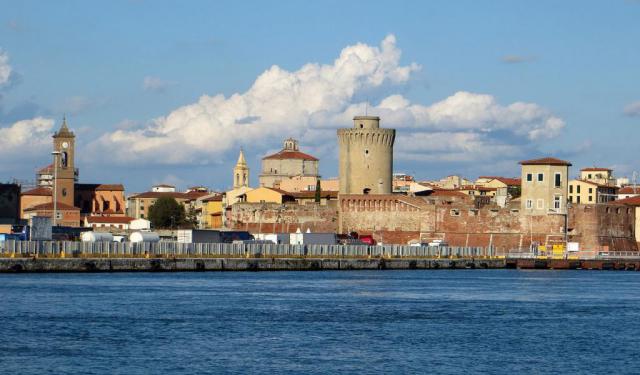
Livorno Introduction Walking Tour
Livorno was never meant to impress, it was meant to work. Travelers liked to note that “every language of the Mediterranean seemed to be spoken at once”. It was built on purpose, as a refuge for merchants, minorities, and outsiders
Livorno is a relatively young Italian city by historical standards, yet its story is unusually layered. Located on the Tyrrhenian coast of Tuscany, Livorno... view more
Tour Duration: 2 Hour(s)
Travel Distance: 3.0 Km or 1.9 Miles
Livorno is a relatively young Italian city by historical standards, yet its story is unusually layered. Located on the Tyrrhenian coast of Tuscany, Livorno... view more
Tour Duration: 2 Hour(s)
Travel Distance: 3.0 Km or 1.9 Miles