

National Center for Civil and Human Rights, Atlanta (must see)
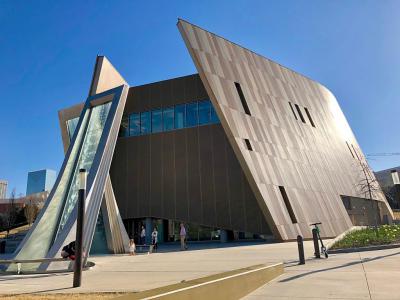
Opened to the public in 2014, the National Center for Civil and Human Rights presents the history of the U.S. Civil Rights Movement alongside contemporary human rights struggles around the world. Designed by architect Philip Freelon, the building’s flowing, curvilinear form-often described as “hands joined in unity”-reflects Atlanta’s central role in the Civil Rights Movement while framing those struggles within a broader global context. Following an expansion, the Center reopened in 2025 with two new wings, increasing gallery and event space.
Inside, the Center combines permanent galleries, rotating exhibitions, and immersive installations that link past movements to present-day human rights issues. Core exhibits trace the Civil Rights Movement through original artifacts, multimedia storytelling, and participatory environments, while newer galleries broaden the lens. “Broken Promises: The Legacy of Reconstruction” examines the post–Civil War era and its lasting consequences, while “Everyone. Everywhere.” explores global human rights through an immersive “A Mile in My Shoes” experience. A new Action Lab invites visitors to design personalized civic engagement plans, turning reflection into potential action.
One of the Center’s most powerful experiences remains the interactive lunch counter simulation, expanded during the renovation to accommodate more visitors. Sitting at a recreated 1960s counter, guests listen through headphones as voices and sounds recreate the experience of nonviolent protest. The Martin Luther King Jr. Collection, drawn from Morehouse College, has been relocated to a prominent main-floor space and reimagined with rotating guest curators, beginning with Bernice A. King. A dedicated Special Exhibitions Gallery now hosts major temporary shows.
Since reopening, the Center has reaffirmed its place as a cornerstone of Atlanta’s cultural landscape, hosting public programs, lectures, and exhibitions that respond directly to current events. Thought-provoking and immersive, the National Center for Civil and Human Rights offers visitors a deeper understanding of Atlanta’s identity-one shaped not only by entertainment and spectacle, but by ongoing struggles for justice and human dignity.
Inside, the Center combines permanent galleries, rotating exhibitions, and immersive installations that link past movements to present-day human rights issues. Core exhibits trace the Civil Rights Movement through original artifacts, multimedia storytelling, and participatory environments, while newer galleries broaden the lens. “Broken Promises: The Legacy of Reconstruction” examines the post–Civil War era and its lasting consequences, while “Everyone. Everywhere.” explores global human rights through an immersive “A Mile in My Shoes” experience. A new Action Lab invites visitors to design personalized civic engagement plans, turning reflection into potential action.
One of the Center’s most powerful experiences remains the interactive lunch counter simulation, expanded during the renovation to accommodate more visitors. Sitting at a recreated 1960s counter, guests listen through headphones as voices and sounds recreate the experience of nonviolent protest. The Martin Luther King Jr. Collection, drawn from Morehouse College, has been relocated to a prominent main-floor space and reimagined with rotating guest curators, beginning with Bernice A. King. A dedicated Special Exhibitions Gallery now hosts major temporary shows.
Since reopening, the Center has reaffirmed its place as a cornerstone of Atlanta’s cultural landscape, hosting public programs, lectures, and exhibitions that respond directly to current events. Thought-provoking and immersive, the National Center for Civil and Human Rights offers visitors a deeper understanding of Atlanta’s identity-one shaped not only by entertainment and spectacle, but by ongoing struggles for justice and human dignity.
Want to visit this sight? Check out these Self-Guided Walking Tours in Atlanta. Alternatively, you can download the mobile app "GPSmyCity: Walks in 1K+ Cities" from Apple App Store or Google Play Store. The app turns your mobile device to a personal tour guide and it works offline, so no data plan is needed when traveling abroad.
Download The GPSmyCity App



National Center for Civil and Human Rights on Map
Sight Name: National Center for Civil and Human Rights
Sight Location: Atlanta, USA (See walking tours in Atlanta)
Sight Type: Attraction/Landmark
Guide(s) Containing This Sight:
Sight Location: Atlanta, USA (See walking tours in Atlanta)
Sight Type: Attraction/Landmark
Guide(s) Containing This Sight:
Nearby Sights


Walking Tours in Atlanta, Georgia

Create Your Own Walk in Atlanta
Creating your own self-guided walk in Atlanta is easy and fun. Choose the city attractions that you want to see and a walk route map will be created just for you. You can even set your hotel as the start point of the walk.

"Gone with the Wind" Walking Tour
Atlanta does “give a damn” about Gone With The Wind. There is a number of museums and sites in the city that commemorate one of America's all-time classic stories. Although released as far back as the 1930s, both Margaret Mitchell's award-winning novel and the film that followed shortly still inspire curiosity about and are equally celebrated in Atlanta.
The first port of call for... view more
Tour Duration: 2 Hour(s)
Travel Distance: 5.0 Km or 3.1 Miles
The first port of call for... view more
Tour Duration: 2 Hour(s)
Travel Distance: 5.0 Km or 3.1 Miles
Atlanta Downtown Walk
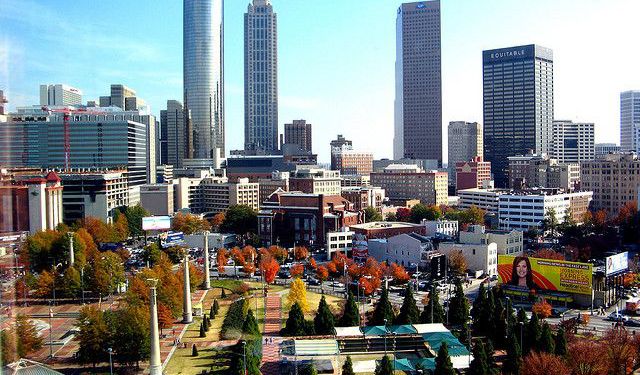
Atlanta began as a practical idea rather than a grand vision. In the 1830s, Georgia planners selected a forested ridge as the southern endpoint of a new railroad linking the state to the Midwest. The settlement that emerged was first called Terminus. The name Atlanta appeared in the 1840s, likely derived from Atlantica-Pacifica, a poetic nod to the railroad’s ambition to connect the Atlantic... view more
Tour Duration: 2 Hour(s)
Travel Distance: 3.3 Km or 2.1 Miles
Tour Duration: 2 Hour(s)
Travel Distance: 3.3 Km or 2.1 Miles

Atlanta Midtown Walking Tour
Atlanta began not as a grand colonial settlement but as a practical railroad town. Its origins lie in the 1830s, when Georgia planned a rail line to connect the interior of the state with the Midwest. The settlement that formed at the rail terminus was first known simply as Terminus, then Marthasville, before being renamed Atlanta in 1847. The name is generally understood to derive from the... view more
Tour Duration: 2 Hour(s)
Travel Distance: 3.4 Km or 2.1 Miles
Tour Duration: 2 Hour(s)
Travel Distance: 3.4 Km or 2.1 Miles
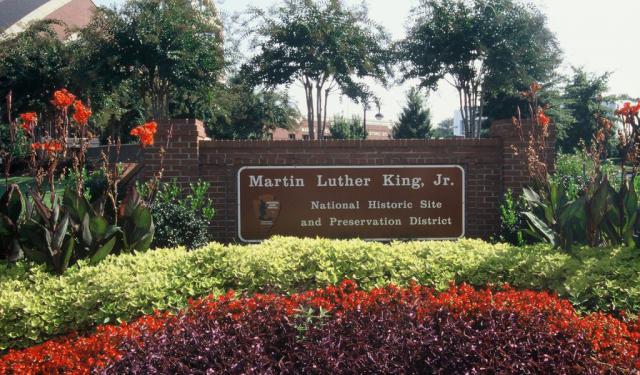
Martin Luther King Walking Tour
Martin Luther King Jr. once said “I was born here. I grew up here. And this city helped shape the man I became.”
Martin Luther King Jr. was born in Atlanta in 1929 into a family deeply rooted in the city’s Black Baptist tradition. Raised on Auburn Avenue, then one of African American corridors in the United States, King grew up surrounded by faith, education, and civic responsibility.... view more
Tour Duration: 1 Hour(s)
Travel Distance: 1.0 Km or 0.6 Miles
Martin Luther King Jr. was born in Atlanta in 1929 into a family deeply rooted in the city’s Black Baptist tradition. Raised on Auburn Avenue, then one of African American corridors in the United States, King grew up surrounded by faith, education, and civic responsibility.... view more
Tour Duration: 1 Hour(s)
Travel Distance: 1.0 Km or 0.6 Miles

Centennial Olympic Park
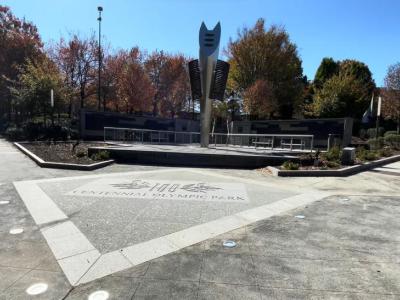
The Centennial Olympic Park in Atlanta is a sprawling urban oasis, covering approximately 21 acres. It was created as a central gathering place for the Centennial Summer Olympic Games held in Georgia in 1996. In the years following the Games, the area witnessed commercial development resulting in a variety of attractions and amenities suitable for visitors of all ages.
One of the notable sites... view more
Tour Duration: 2 Hour(s)
Travel Distance: 1.6 Km or 1 Miles
One of the notable sites... view more
Tour Duration: 2 Hour(s)
Travel Distance: 1.6 Km or 1 Miles