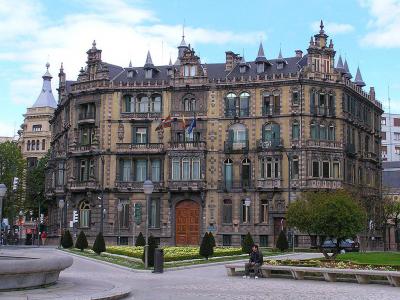


Palacio Chavarri (Chavarri Palace), Bilbao
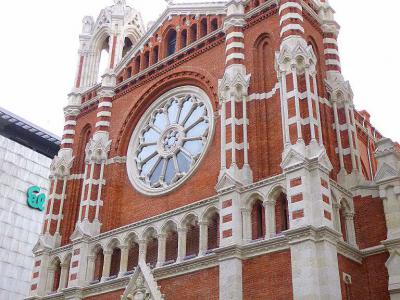
Built between 1888 and 1894, Chavarri Palace was commissioned by industrialist Víctor Chávarri and designed by Belgian architect Paul Hankar, with local architect Atanasio de Anduiza overseeing its execution. Drawing inspiration from Flemish Renaissance palaces in Antwerp and Bruges cities, its richly ornamental facade and flamboyant rooftop silhouette mark it as one of Bilbao’s most iconic 19th-century landmarks.
One of Chavarri Palace’s most charming quirks is that no two windows are the same-each opening in the facade varies in shape, size, and design, lending the building an organically eclectic and captivating rhythm. Its façade, clad in multicolored stone, is richly decorated with stucco and wrought-iron elements, and features a mix of balconies, oriel windows, and dormers against an asymmetrical yet harmonious composition.
Since 1943, the palace has served as the seat of the Spanish Government's representation in Bizkaia province-now the Subdelegation of the Government-after being adapted from a private residence during renovations led by architect Eugenio María Aguinaga. Although its interior has undergone functional modifications, many original details remain-including coffered ceilings, marble fireplaces, wood-paneled rooms, stained-glass elements, and opulently decorated salons.
As a visitor, while access to the interior is limited, guided tours are occasionally available, typically on the last Saturday mornings of the month. These offer a rare chance to explore highlights like the splendid mirrored salon, the family’s former private quarters, the music room, and the gardens-spaces that vividly illustrate the building’s historical and artistic significance.
One of Chavarri Palace’s most charming quirks is that no two windows are the same-each opening in the facade varies in shape, size, and design, lending the building an organically eclectic and captivating rhythm. Its façade, clad in multicolored stone, is richly decorated with stucco and wrought-iron elements, and features a mix of balconies, oriel windows, and dormers against an asymmetrical yet harmonious composition.
Since 1943, the palace has served as the seat of the Spanish Government's representation in Bizkaia province-now the Subdelegation of the Government-after being adapted from a private residence during renovations led by architect Eugenio María Aguinaga. Although its interior has undergone functional modifications, many original details remain-including coffered ceilings, marble fireplaces, wood-paneled rooms, stained-glass elements, and opulently decorated salons.
As a visitor, while access to the interior is limited, guided tours are occasionally available, typically on the last Saturday mornings of the month. These offer a rare chance to explore highlights like the splendid mirrored salon, the family’s former private quarters, the music room, and the gardens-spaces that vividly illustrate the building’s historical and artistic significance.
Want to visit this sight? Check out these Self-Guided Walking Tours in Bilbao. Alternatively, you can download the mobile app "GPSmyCity: Walks in 1K+ Cities" from Apple App Store or Google Play Store. The app turns your mobile device to a personal tour guide and it works offline, so no data plan is needed when traveling abroad.
Download The GPSmyCity App



Palacio Chavarri (Chavarri Palace) on Map
Sight Name: Palacio Chavarri (Chavarri Palace)
Sight Location: Bilbao, Spain (See walking tours in Bilbao)
Sight Type: Attraction/Landmark
Sight Location: Bilbao, Spain (See walking tours in Bilbao)
Sight Type: Attraction/Landmark
Nearby Sights
Walking Tours in Bilbao, Spain

Create Your Own Walk in Bilbao
Creating your own self-guided walk in Bilbao is easy and fun. Choose the city attractions that you want to see and a walk route map will be created just for you. You can even set your hotel as the start point of the walk.
Bilbao Introduction Walking Tour
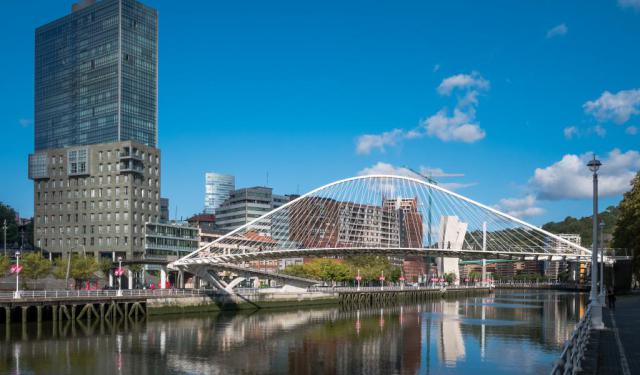
Officially founded in 1300 AD by the Lord of Biscay, Bilbao began as a small port settlement. Its sheltered estuary allowed ships to load wool, iron, and other goods bound for northern Europe, while merchants imported salt, wine, and luxury items. The name "Bilbao" likely comes from the Basque words bil, meaning "settlement," and bao, meaning "estuary"-a fitting... view more
Tour Duration: 2 Hour(s)
Travel Distance: 4.1 Km or 2.5 Miles
Tour Duration: 2 Hour(s)
Travel Distance: 4.1 Km or 2.5 Miles
Bilbao's Old Town Walking Tour
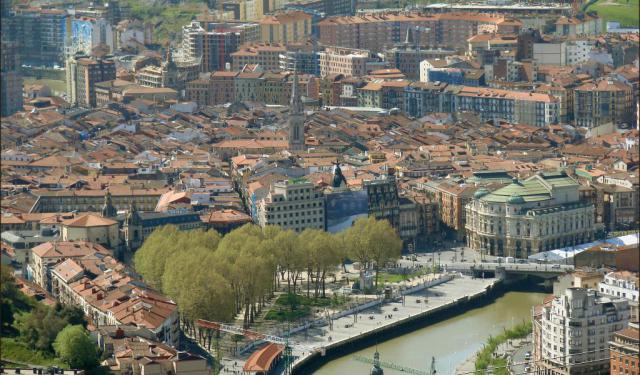
Bilbao's old town, also known as The Seven Streets, is the medieval heart of the city. Indeed, this ancient neighborhood, a place where the city began and which had been fortified by walls until the late 19th century, today consists of seven main streets and many narrow alleys – called cantons (kantoi, cantón) – that connect them.
Often regarded as a jewel of Basque architecture and... view more
Tour Duration: 1 Hour(s)
Travel Distance: 1.6 Km or 1 Miles
Often regarded as a jewel of Basque architecture and... view more
Tour Duration: 1 Hour(s)
Travel Distance: 1.6 Km or 1 Miles