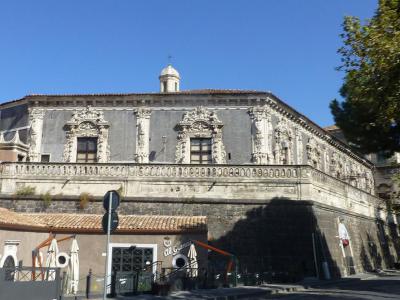


Palazzo Biscari (Biscari Palace), Catania (must see)
Biscari Palace is an aristocratic residences of Baroque and Rococo design. Conceived after the devastating earthquake of 1693, the palace was commissioned by Ignazio Paternò Castello, 3rd Prince of Biscari, with construction beginning in 1702 and continuing through much of the 18th century. Completed in 1763 by the fifth Prince of Biscari, its inauguration was marked by lavish celebrations that reflected the family’s status and Catania’s renewed confidence during the reconstruction era.
The palace’s most amazing exterior façade faces Cardinale Dusmet Street, where richly carved balconies curve outward on stone brackets. When this façade was built, it rose directly above the 16th-century city walls, overlooking the sea at their base. The visitor entrance is marked by a stone portal adorned with cartouches and the Biscari coat of arms, opening into a spacious courtyard with an outdoor staircase that prepares visitors for the decorative richness inside.
The interior reveals a fully developed Rococo style. Frescoes, mirrors, and elaborate stucco work animate the grand rooms, culminating in the octagonal ballroom, the palace’s most celebrated space. Decorated by Matteo Desiderato and Sebastiano Lo Monaco, the ballroom is notable for its illusionistic effects and fluid lines. A distinctive spiral staircase shaped like a sea shell leads to a balcony beneath the dome, originally intended to hold an orchestra and now regarded as one of the palace’s most elegant architectural details.
Beyond the ballroom, the palace unfolds through a sequence of named rooms, each reflecting a specific function or theme. The Fief Room displays large paintings of the Biscari family’s feudal lands, while the Princess Apartment, created for the wife of Ignazio V, is paved with salvaged Roman marble. This reuse of ancient material reflects the interests of Ignazio V, a renowned archaeologist whose collections form the basis of the palace museum. Today, although parts of Biscari Palace remain privately inhabited, sections are open for visits and cultural events.
The palace’s most amazing exterior façade faces Cardinale Dusmet Street, where richly carved balconies curve outward on stone brackets. When this façade was built, it rose directly above the 16th-century city walls, overlooking the sea at their base. The visitor entrance is marked by a stone portal adorned with cartouches and the Biscari coat of arms, opening into a spacious courtyard with an outdoor staircase that prepares visitors for the decorative richness inside.
The interior reveals a fully developed Rococo style. Frescoes, mirrors, and elaborate stucco work animate the grand rooms, culminating in the octagonal ballroom, the palace’s most celebrated space. Decorated by Matteo Desiderato and Sebastiano Lo Monaco, the ballroom is notable for its illusionistic effects and fluid lines. A distinctive spiral staircase shaped like a sea shell leads to a balcony beneath the dome, originally intended to hold an orchestra and now regarded as one of the palace’s most elegant architectural details.
Beyond the ballroom, the palace unfolds through a sequence of named rooms, each reflecting a specific function or theme. The Fief Room displays large paintings of the Biscari family’s feudal lands, while the Princess Apartment, created for the wife of Ignazio V, is paved with salvaged Roman marble. This reuse of ancient material reflects the interests of Ignazio V, a renowned archaeologist whose collections form the basis of the palace museum. Today, although parts of Biscari Palace remain privately inhabited, sections are open for visits and cultural events.
Want to visit this sight? Check out these Self-Guided Walking Tours in Catania. Alternatively, you can download the mobile app "GPSmyCity: Walks in 1K+ Cities" from Apple App Store or Google Play Store. The app turns your mobile device to a personal tour guide and it works offline, so no data plan is needed when traveling abroad.
Download The GPSmyCity App



Palazzo Biscari (Biscari Palace) on Map
Sight Name: Palazzo Biscari (Biscari Palace)
Sight Location: Catania, Italy (See walking tours in Catania)
Sight Type: Attraction/Landmark
Guide(s) Containing This Sight:
Sight Location: Catania, Italy (See walking tours in Catania)
Sight Type: Attraction/Landmark
Guide(s) Containing This Sight:
Nearby Sights

Walking Tours in Catania, Italy

Create Your Own Walk in Catania
Creating your own self-guided walk in Catania is easy and fun. Choose the city attractions that you want to see and a walk route map will be created just for you. You can even set your hotel as the start point of the walk.

Discover Catania's Historical Churches on Foot
Just as many other Italian destinations, the Sicilian city of Catania is full of churches, especially in the historic center, where the presence of religious sites is particularly high! A good number of local churches date back centuries, and as such represent marvelous pieces of architecture, adding much character to the area. It is also commonplace to find inside most of them, be it a duomo,... view more
Tour Duration: 1 Hour(s)
Travel Distance: 1.6 Km or 1 Miles
Tour Duration: 1 Hour(s)
Travel Distance: 1.6 Km or 1 Miles
A Walk Through Catania’s Baroque Old Town
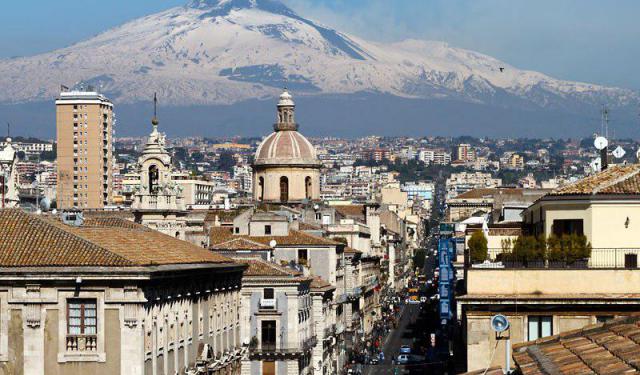
Most cities avoid danger. But here, the danger is part of the experience. Catania settled beside a volcano and stayed. Lava flows, earthquakes, and ash are a living memory here, shaping everything from building materials to local legends.
Catania is one of Sicily’s oldest cities, with a history shaped by colonization, conquest, natural disaster, and repeated renewal. It was founded in 729 BC... view more
Tour Duration: 2 Hour(s)
Travel Distance: 3.8 Km or 2.4 Miles
Catania is one of Sicily’s oldest cities, with a history shaped by colonization, conquest, natural disaster, and repeated renewal. It was founded in 729 BC... view more
Tour Duration: 2 Hour(s)
Travel Distance: 3.8 Km or 2.4 Miles