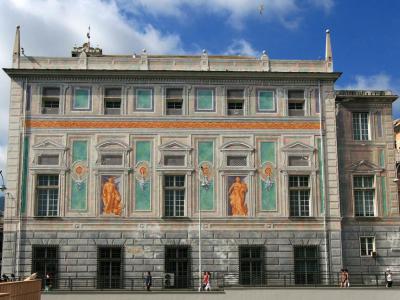


Palazzo San Giorgio (Palace of St. George), Genoa
Once upon a time in the 13th century, Byzantine Emperor Michael VIII Palaiologos felt seriously indebted to Genoa. The city backed him in his fight against the Latin Empire, and his gratitude came in a very specific form-recycled enemy property. In 1260, marble and building materials stripped from the Venetian embassy in Constantinople were shipped west and handed to Genoese noble Guglielmo Boccanegra, who promptly turned them into his waterfront dream palace. Indeed, nothing says “thank you” quite like the repurposed Venetian stone...
To underline the point, stone lions-symbols of Venice’s patron saint, Mark-were set into the façade. A bold move (possibly, too bold). Just two years later, Boccanegra was overthrown as Captain of the People and sent into exile, and his shiny palace took a sharp turn in function. It became a prison. History, as usual, has a sense of humor...
The most famous inmate was Marco Polo, who passed the time by dictating his travel stories to Rustichello of Pisa, a writer of chivalric romances. Somewhere behind these walls, tales of faraway Asia were shaped for European ears-a neat illustration that even a Genoese prison could produce a bestseller.
Still, the building had bigger ambitions than incarceration. Designed by Frate Oliverio, a Cistercian monk with architectural skills, it was also meant to serve the port authorities. By 1400, it entered a new phase as the headquarters of the Bank of San Giorgio, one of the earliest banking institutions in Italy and a financial powerhouse of its day. Commerce, it turns out, was always the long game.
Expansion followed. In 1570, an east wing appeared to house customs offices, archives, and vaults. In 1608, the façade received a full makeover with heroic frescoes, dominated by Saint George slaying the dragon. A clock tower was added above, keeping both time and watch over the harbor.
Look closely at the façade today, and you’ll spot statues of Genoese heavyweights: Christopher Columbus, Andrea Doria, Simone Boccanegra, and others who once steered the city’s fortunes. Now known as the Palace of St. George, the building still runs port business-having moved, over the centuries, from imperial favor to prison cells to financial nerve center, without ever leaving the waterfront.
To underline the point, stone lions-symbols of Venice’s patron saint, Mark-were set into the façade. A bold move (possibly, too bold). Just two years later, Boccanegra was overthrown as Captain of the People and sent into exile, and his shiny palace took a sharp turn in function. It became a prison. History, as usual, has a sense of humor...
The most famous inmate was Marco Polo, who passed the time by dictating his travel stories to Rustichello of Pisa, a writer of chivalric romances. Somewhere behind these walls, tales of faraway Asia were shaped for European ears-a neat illustration that even a Genoese prison could produce a bestseller.
Still, the building had bigger ambitions than incarceration. Designed by Frate Oliverio, a Cistercian monk with architectural skills, it was also meant to serve the port authorities. By 1400, it entered a new phase as the headquarters of the Bank of San Giorgio, one of the earliest banking institutions in Italy and a financial powerhouse of its day. Commerce, it turns out, was always the long game.
Expansion followed. In 1570, an east wing appeared to house customs offices, archives, and vaults. In 1608, the façade received a full makeover with heroic frescoes, dominated by Saint George slaying the dragon. A clock tower was added above, keeping both time and watch over the harbor.
Look closely at the façade today, and you’ll spot statues of Genoese heavyweights: Christopher Columbus, Andrea Doria, Simone Boccanegra, and others who once steered the city’s fortunes. Now known as the Palace of St. George, the building still runs port business-having moved, over the centuries, from imperial favor to prison cells to financial nerve center, without ever leaving the waterfront.
Want to visit this sight? Check out these Self-Guided Walking Tours in Genoa. Alternatively, you can download the mobile app "GPSmyCity: Walks in 1K+ Cities" from Apple App Store or Google Play Store. The app turns your mobile device to a personal tour guide and it works offline, so no data plan is needed when traveling abroad.
Download The GPSmyCity App



Palazzo San Giorgio (Palace of St. George) on Map
Sight Name: Palazzo San Giorgio (Palace of St. George)
Sight Location: Genoa, Italy (See walking tours in Genoa)
Sight Type: Attraction/Landmark
Guide(s) Containing This Sight:
Sight Location: Genoa, Italy (See walking tours in Genoa)
Sight Type: Attraction/Landmark
Guide(s) Containing This Sight:
Nearby Sights


Walking Tours in Genoa, Italy

Create Your Own Walk in Genoa
Creating your own self-guided walk in Genoa is easy and fun. Choose the city attractions that you want to see and a walk route map will be created just for you. You can even set your hotel as the start point of the walk.
Genoa Introduction Walking Tour
Italian poet Petrarch called Genoa “The Superb One,” and quite fittingly so for a city that built its confidence the hard way-through ships, contracts, and a fierce sense of independence.
Pressed between the Ligurian Sea and the Apennines on a narrow strip of land, Genoa didn’t have much room to spread out, so it looked outward instead. By the Middle Ages, it had become one of the... view more
Tour Duration: 2 Hours
Travel Distance: 3.8 Km or 2.4 Miles
Pressed between the Ligurian Sea and the Apennines on a narrow strip of land, Genoa didn’t have much room to spread out, so it looked outward instead. By the Middle Ages, it had become one of the... view more
Tour Duration: 2 Hours
Travel Distance: 3.8 Km or 2.4 Miles
Rolli Palaces Walking Tour
At one point, back in 1576, when the Republic of Genoa was riding high on money, power, and confidence, the city faced a practical question: where do you put visiting kings, princes, and ambassadors? Genoa’s answer was very on brand. Instead of building one grand royal palace, they turned the entire local aristocracy into a hospitality network. The result was the lists of the public lodgings of... view more
Tour Duration: 1 Hour
Travel Distance: 0.4 Km or 0.2 Miles
Tour Duration: 1 Hour
Travel Distance: 0.4 Km or 0.2 Miles
City Walks Overview
