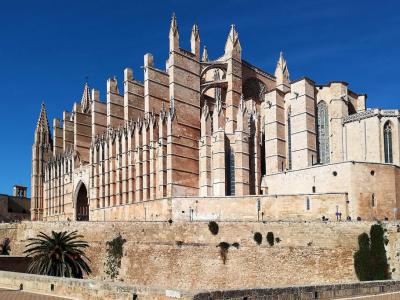


Palma Cathedral, Palma de Mallorca (must see)
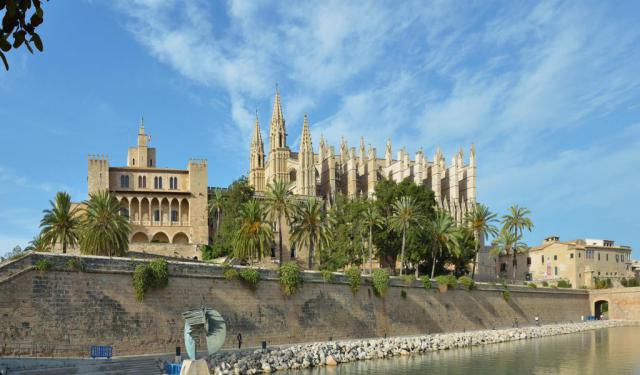
Palma Cathedral, commonly known as La Seu, is the most iconic landmark of Palma de Mallorca and one of the great Gothic cathedrals of the Mediterranean. Rising directly above the Bay of Palma, its vast sandstone structure dominates the city skyline. According to tradition, its construction was born of a vow. In December 1229, King James I of Aragon was caught in a violent storm while sailing to conquer the Balearic Islands. Facing disaster, the young king swore that if he survived and succeeded, he would build a great cathedral in Mallorca. He survived, conquered the island, and in 1230 construction began on La Seu, on the site of the former main mosque.
Building continued intermittently for around 350 years, making the cathedral a record of evolving architectural styles. The seaward-facing portal reflects early Gothic influences from the 13th century, while the opposite portal dates to the late Gothic period of the 16th century. Elsewhere, Gothic gives way to Renaissance elements, Baroque chapels, and touches of Classicism, particularly in the baptistry. The nave, completed last, ranks among the largest in Europe.
Light is central to the cathedral’s identity. The immense Gothic rose window on the eastern façade measures about 41 feet in diameter and is composed of roughly 1,200 pieces of stained glass. Each morning, sunlight floods the interior with shifting colours. Twice a year, on February 2 and November 11, this effect becomes especially dramatic during the “Light Game of the Eight,” when the rising sun projects the rose window’s image directly beneath the western rose, forming a luminous figure eight. For about twenty days on either side of the winter solstice, sunrise can be seen through both rosettes. The rose window on the eastern façade is positioned directly above the High Altar.
Another highlight to admire is famed modernist architect Antoni Gaudí’s early 20th-century intervention: a massive chandelier suspended above the central altar area. To see it best, stand at the front of the pews in the central nave and look up. You will see a large, illuminated, hexagonal baldachin hanging from chains. Made of wrought iron and cardboard, it features 35 brass lamps.
A natural follow-up after viewing Gaudí’s chandelier is another major intervention, completed in 2007. The Chapel of the Blessed Sacrament was renovated by renowned Mallorcan artist Miquel Barceló, who covered its walls with large, cracked ceramic sculptures representing the miracle of the loaves and fishes. Look for the submerged textures of fish and sea plants, as well as the tall, eerie, monochromatic windows that make the space feel underwater. The chapel is located at the front end of the south aisle, near the main altar.
The Trinity Chapel, which is not open to the public, contains the tombs of Kings James II and James III.
Building continued intermittently for around 350 years, making the cathedral a record of evolving architectural styles. The seaward-facing portal reflects early Gothic influences from the 13th century, while the opposite portal dates to the late Gothic period of the 16th century. Elsewhere, Gothic gives way to Renaissance elements, Baroque chapels, and touches of Classicism, particularly in the baptistry. The nave, completed last, ranks among the largest in Europe.
Light is central to the cathedral’s identity. The immense Gothic rose window on the eastern façade measures about 41 feet in diameter and is composed of roughly 1,200 pieces of stained glass. Each morning, sunlight floods the interior with shifting colours. Twice a year, on February 2 and November 11, this effect becomes especially dramatic during the “Light Game of the Eight,” when the rising sun projects the rose window’s image directly beneath the western rose, forming a luminous figure eight. For about twenty days on either side of the winter solstice, sunrise can be seen through both rosettes. The rose window on the eastern façade is positioned directly above the High Altar.
Another highlight to admire is famed modernist architect Antoni Gaudí’s early 20th-century intervention: a massive chandelier suspended above the central altar area. To see it best, stand at the front of the pews in the central nave and look up. You will see a large, illuminated, hexagonal baldachin hanging from chains. Made of wrought iron and cardboard, it features 35 brass lamps.
A natural follow-up after viewing Gaudí’s chandelier is another major intervention, completed in 2007. The Chapel of the Blessed Sacrament was renovated by renowned Mallorcan artist Miquel Barceló, who covered its walls with large, cracked ceramic sculptures representing the miracle of the loaves and fishes. Look for the submerged textures of fish and sea plants, as well as the tall, eerie, monochromatic windows that make the space feel underwater. The chapel is located at the front end of the south aisle, near the main altar.
The Trinity Chapel, which is not open to the public, contains the tombs of Kings James II and James III.
Want to visit this sight? Check out these Self-Guided Walking Tours in Palma de Mallorca. Alternatively, you can download the mobile app "GPSmyCity: Walks in 1K+ Cities" from Apple App Store or Google Play Store. The app turns your mobile device to a personal tour guide and it works offline, so no data plan is needed when traveling abroad.
Download The GPSmyCity App



Palma Cathedral on Map
Sight Name: Palma Cathedral
Sight Location: Palma de Mallorca, Spain (See walking tours in Palma de Mallorca)
Sight Type: Religious
Guide(s) Containing This Sight:
Sight Location: Palma de Mallorca, Spain (See walking tours in Palma de Mallorca)
Sight Type: Religious
Guide(s) Containing This Sight:
Nearby Sights
Walking Tours in Palma de Mallorca, Spain

Create Your Own Walk in Palma de Mallorca
Creating your own self-guided walk in Palma de Mallorca is easy and fun. Choose the city attractions that you want to see and a walk route map will be created just for you. You can even set your hotel as the start point of the walk.
Palma de Mallorca Introduction Walking Tour
French author Aurore Dupin, better known by her pen name George Sand, spent the winter of 1838-1839 in Mallorca together with the famous Polish composer Frédéric Chopin. Despite the cold weather, she wrote that Mallorca was “all that a poet or a painter might dream of.”
The first part of city’s name, Palma, is traditionally linked to the Latin word that means “palm tree,” a symbol... view more
Tour Duration: 2 Hours
Travel Distance: 2.4 Km or 1.5 Miles
The first part of city’s name, Palma, is traditionally linked to the Latin word that means “palm tree,” a symbol... view more
Tour Duration: 2 Hours
Travel Distance: 2.4 Km or 1.5 Miles
Historical Buildings Walking Tour
Fervent devotees of the past will undoubtedly find Palma de Mallorca's old town quite alluring for a chance to get closer to the island's culture and discover firsthand the unspoiled Mallorca as it once was. Indeed, the historic center of the city is ideal for an acquaintance with the local heritage richly presented in the form of multiple historic buildings.
Some of them, like the... view more
Tour Duration: 2 Hours
Travel Distance: 3 Km or 1.9 Miles
Some of them, like the... view more
Tour Duration: 2 Hours
Travel Distance: 3 Km or 1.9 Miles
City Walks Overview
