

Paul Mistral Park, Grenoble (must see)
Paul Mistral Park is the largest green space in Grenoble, covering 33 hectares in total, with 21 hectares dedicated to public use and nearly 14 hectares planted with trees and vegetation. Located near the city center and close to the speedway, the park is a vital recreational and environmental area for residents. It includes a variety of tree species, open lawns, and ponds, offering space for both relaxation and numerous outdoor activities. Originally a military engineering ground, the park's transformation began with the 1925 International Exhibition of Hydropower and Tourism, which marked its shift toward a public urban park.
The site has a layered history. In the 19th century, after the completion of Grenoble’s ramparts by General Haxo in 1836, the area served as a training ground for military engineering. Civilian use and construction were prohibited at the time. It was also home to the Alpes' Gates, one of the city’s five gates, which provided access to neighboring towns like Eybens and Vizille. The International Exhibition of 1925 brought significant changes to the area, most notably the creation of landscaped spaces and the construction of lasting architectural features.
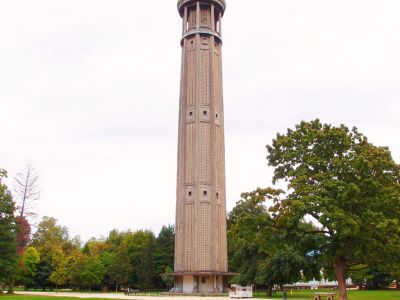
One of the most iconic landmarks in Paul Mistral Park is the Perret Tower. Built for the 1925 exhibition, it was originally named The tower for watching the mountains. Standing 95 meters tall, the tower was the first in Europe to be built with reinforced concrete. Its octagonal shape and innovative engineering reflect early 20th-century design, and although closed to the public since 1960 due to structural concerns, it remains a protected national heritage site since 1998. The tower is still a visible symbol in the city, illuminated in winter and used during public events such as Bastille Day fireworks.
The site has a layered history. In the 19th century, after the completion of Grenoble’s ramparts by General Haxo in 1836, the area served as a training ground for military engineering. Civilian use and construction were prohibited at the time. It was also home to the Alpes' Gates, one of the city’s five gates, which provided access to neighboring towns like Eybens and Vizille. The International Exhibition of 1925 brought significant changes to the area, most notably the creation of landscaped spaces and the construction of lasting architectural features.
One of the most iconic landmarks in Paul Mistral Park is the Perret Tower. Built for the 1925 exhibition, it was originally named The tower for watching the mountains. Standing 95 meters tall, the tower was the first in Europe to be built with reinforced concrete. Its octagonal shape and innovative engineering reflect early 20th-century design, and although closed to the public since 1960 due to structural concerns, it remains a protected national heritage site since 1998. The tower is still a visible symbol in the city, illuminated in winter and used during public events such as Bastille Day fireworks.
Want to visit this sight? Check out these Self-Guided Walking Tours in Grenoble. Alternatively, you can download the mobile app "GPSmyCity: Walks in 1K+ Cities" from Apple App Store or Google Play Store. The app turns your mobile device to a personal tour guide and it works offline, so no data plan is needed when traveling abroad.
Download The GPSmyCity App



Paul Mistral Park on Map
Sight Name: Paul Mistral Park
Sight Location: Grenoble, France (See walking tours in Grenoble)
Sight Type: Park/Outdoor
Sight Location: Grenoble, France (See walking tours in Grenoble)
Sight Type: Park/Outdoor
Nearby Sights
Walking Tours in Grenoble, France

Create Your Own Walk in Grenoble
Creating your own self-guided walk in Grenoble is easy and fun. Choose the city attractions that you want to see and a walk route map will be created just for you. You can even set your hotel as the start point of the walk.
Grenoble Introduction Walking Tour
Grenoble, often called the “capital of the Alps,” sits where the Drac and Isère rivers meet, framed by mountain ridges that have shaped both its history and identity. Its story begins long before France existed, when the Gallic Allobroges tribe founded a fortified settlement named Cularo. By the end of the 4th century CE, the town was renamed Gratianopolis in honor of the Roman Emperor... view more
Tour Duration: 2 Hour(s)
Travel Distance: 2.5 Km or 1.6 Miles
Tour Duration: 2 Hour(s)
Travel Distance: 2.5 Km or 1.6 Miles