

Piazza dei Cavalieri (Knights Square), Pisa (must see)
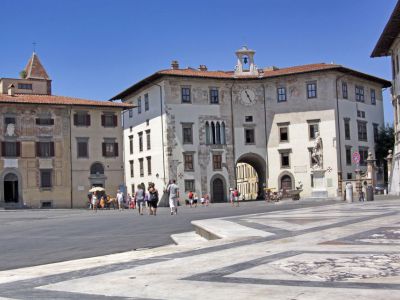
Knights’ Square has long been one of Pisa’s most important civic spaces. In medieval times, it served as the city’s political center, and even earlier it was likely the site of the Roman Forum. The city remained an independent maritime power until 1406, when mercenary commanders Angelo Tartaglia and Muzio Attendolo Sforza occupied the city and ordered its annexation to Florence - a turning point closely linked to Knights’ Square, then the political center of Pisan authority.
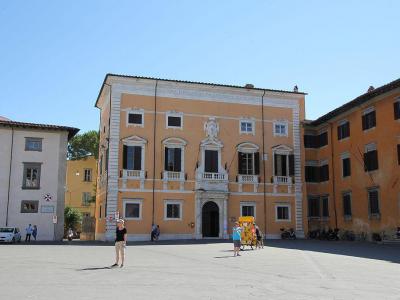
In the 16th century, Cosimo I commissioned the architect Giorgio Vasari to redesign the square in Renaissance style and dedicate it to the Knights of Saint Stephen. This military and religious order had been created to defend the Tuscan coastline from Ottoman and North African pirate raids. At the center of the square stands a statue of Cosimo I, installed in 1596, marking his role in transforming both the space and the institution it represented.
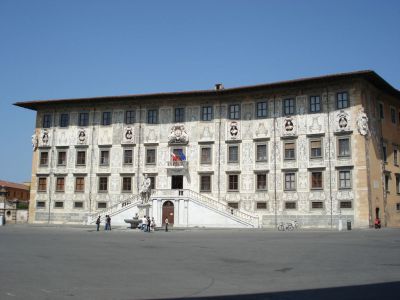
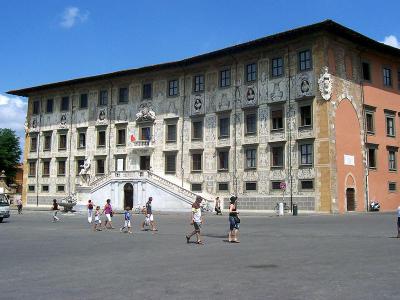
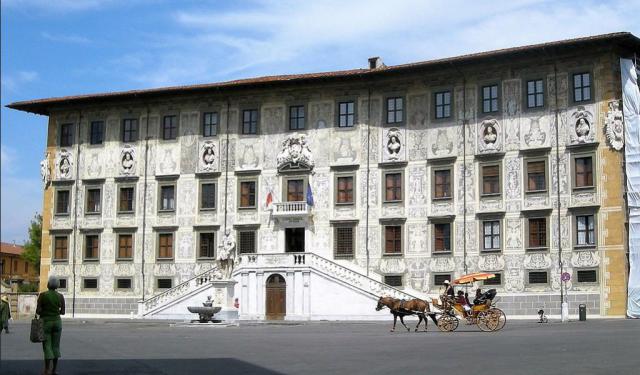
Several important buildings surround the square. The Carovana Palace, once the headquarters of the Knights of Saint Stephen, is known for its richly decorated façade covered with painted allegorical figures, zodiac symbols, and portraits of the Tuscan grand dukes. Nearby, the Clock Palace is associated with the tragic story of Count Ugolino, who was imprisoned and died there-an episode later immortalized by Dante. Today, the building houses part of the university library.
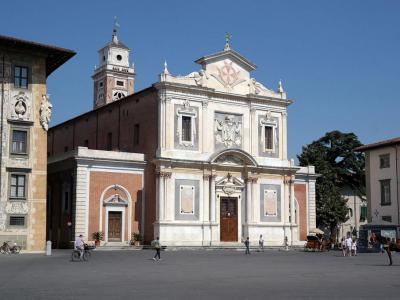
Other historic institutions also line the square, including the Putean College, founded in the early 17th century, and the Church of the Knights of Saint Stephen, designed by painter and architect Giorgio Vasari. Inside the church, captured naval banners recall the order’s maritime campaigns. Together, these buildings reflect the square’s evolution from political center to Renaissance ceremonial space, and now to an important part of Pisa’s academic life.
In the 16th century, Cosimo I commissioned the architect Giorgio Vasari to redesign the square in Renaissance style and dedicate it to the Knights of Saint Stephen. This military and religious order had been created to defend the Tuscan coastline from Ottoman and North African pirate raids. At the center of the square stands a statue of Cosimo I, installed in 1596, marking his role in transforming both the space and the institution it represented.
Several important buildings surround the square. The Carovana Palace, once the headquarters of the Knights of Saint Stephen, is known for its richly decorated façade covered with painted allegorical figures, zodiac symbols, and portraits of the Tuscan grand dukes. Nearby, the Clock Palace is associated with the tragic story of Count Ugolino, who was imprisoned and died there-an episode later immortalized by Dante. Today, the building houses part of the university library.
Other historic institutions also line the square, including the Putean College, founded in the early 17th century, and the Church of the Knights of Saint Stephen, designed by painter and architect Giorgio Vasari. Inside the church, captured naval banners recall the order’s maritime campaigns. Together, these buildings reflect the square’s evolution from political center to Renaissance ceremonial space, and now to an important part of Pisa’s academic life.
Want to visit this sight? Check out these Self-Guided Walking Tours in Pisa. Alternatively, you can download the mobile app "GPSmyCity: Walks in 1K+ Cities" from Apple App Store or Google Play Store. The app turns your mobile device to a personal tour guide and it works offline, so no data plan is needed when traveling abroad.
Download The GPSmyCity App



Piazza dei Cavalieri (Knights Square) on Map
Sight Name: Piazza dei Cavalieri (Knights Square)
Sight Location: Pisa, Italy (See walking tours in Pisa)
Sight Type: Attraction/Landmark
Guide(s) Containing This Sight:
Sight Location: Pisa, Italy (See walking tours in Pisa)
Sight Type: Attraction/Landmark
Guide(s) Containing This Sight:
Nearby Sights
Walking Tours in Pisa, Italy

Create Your Own Walk in Pisa
Creating your own self-guided walk in Pisa is easy and fun. Choose the city attractions that you want to see and a walk route map will be created just for you. You can even set your hotel as the start point of the walk.
Pisa Palaces Walking Tour
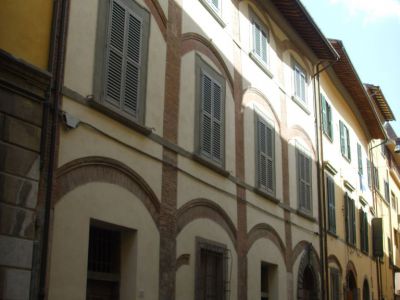
As you continue your acquaintance with Pisa, you will notice that there is a lot more to see here than just a "leaning" landmark. Indeed, just like Italy in general, this particular Tuscan city boasts a glorious heritage of wonderful palaces, fit to transport you back in time.
The most beautiful palaces in Pisa are found on both sides of the Arno River, forming a multi-colored ribbon... view more
Tour Duration: 1 Hour(s)
Travel Distance: 2.1 Km or 1.3 Miles
The most beautiful palaces in Pisa are found on both sides of the Arno River, forming a multi-colored ribbon... view more
Tour Duration: 1 Hour(s)
Travel Distance: 2.1 Km or 1.3 Miles
Pisa Old Town Walking Tour
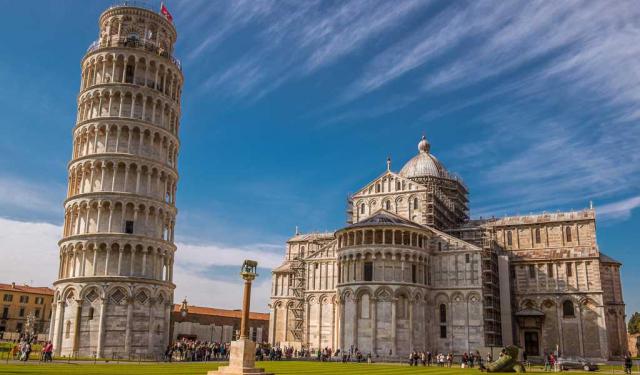
Pisa is known around the world for its Leaning Tower and as the birthplace of Galileo Galilei, often called the father of modern science. Those two associations alone would be enough to secure its place on the map. Yet the city's story stretches far beyond a tilted bell tower and one brilliant mind. It is a city shaped by the sea, by trade, and by centuries of quiet reinvention.
The origin... view more
Tour Duration: 2 Hour(s)
Travel Distance: 3.0 Km or 1.9 Miles
The origin... view more
Tour Duration: 2 Hour(s)
Travel Distance: 3.0 Km or 1.9 Miles

Galileo's Pisa Walking Tour
Among the names most closely connected with Pisa, few are as widely recognized as Galileo Galilei. He became one of the most influential thinkers in history-an astronomer, mathematician, and physicist whose work reshaped how people understood motion, gravity, and the structure of the universe. It's not just the place where his life began; it is also where many of the observations and... view more
Tour Duration: 1 Hour(s)
Travel Distance: 1.8 Km or 1.1 Miles
Tour Duration: 1 Hour(s)
Travel Distance: 1.8 Km or 1.1 Miles