

Pisa Introduction Walking Tour, Pisa

Pisa Introduction Walking Tour (Self Guided), Pisa

Pisa is known around the world for its Leaning Tower and as the birthplace of Galileo Galilei, often called the father of modern science. Those two associations alone would be enough to secure its place on the map. Yet the city's story stretches far beyond a tilted bell tower and one brilliant mind. It is a city shaped by the sea, by trade, and by centuries of quiet reinvention.

The origin of the name “Pisa” remains uncertain. Scholars have proposed pre-Roman roots, possibly linked to ancient Ligurian or Etruscan languages, but there is no single confirmed explanation. What is known is that the city itself was Etruscan in origin, a fact archaeologists firmly established only in 1991. Even its name reflects layers of history that are still being pieced together.

Founded near the seashore—long before the coastline shifted westward—Pisa developed as a maritime center. In 180 BC it became a Roman colony and served as a naval base protecting trade routes from pirates. Its greatest prosperity came in the 11th century, when it stood as a powerful maritime republic. Much of the Romanesque architecture we see today dates from that period.

Decline followed in the 13th century, and by 1405 Pisa had been conquered by Florence. When the Arno changed course, cutting direct access to the sea, its commercial strength faded. Even so, the city continued to matter, especially through the University of Pisa and its botanical garden, founded in 1544 and considered the oldest university botanical garden in Europe.

Today, Pisa feels compact and accessible. The Arno River divides the historic center, with bridges linking neighborhoods filled with students, cafés, and everyday shops. Despite heavy damage during World War II, many churches, medieval palaces, and riverfront buildings survived. Tourism is visible, but so is ordinary life.

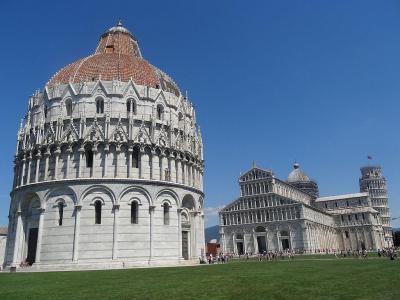
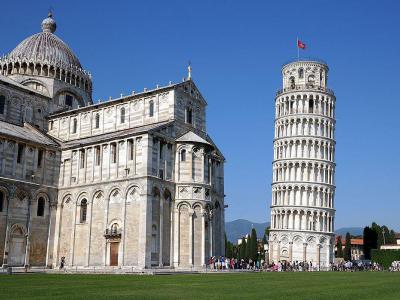
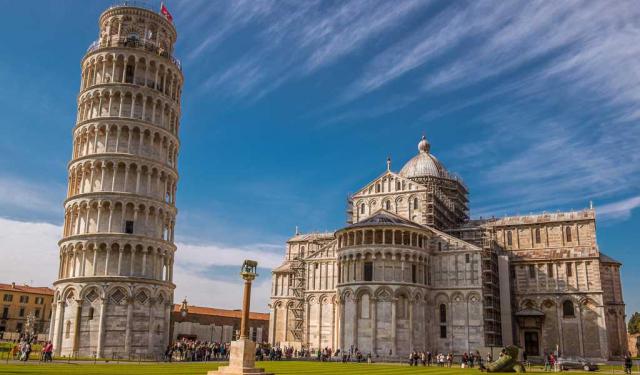
To the north of the old town lies Miracles Square - here stand the Cathedral, the Baptistry known for its acoustics, the Monumental Cemetery, and the unmistakable Leaning Tower of Pisa. Completed in the 14th century, the white marble bell tower was already tilting when finished. Together, these buildings reflect the wealth and confidence of medieval Pisa.

As we walk through the city, you will see how these layers connect—Etruscan roots, Roman expansion, maritime ambition, and academic tradition. Pisa is not large, and its story is not hidden. It is laid out clearly in stone, streets, and squares, ready to be explored step by step.
How it works: Download the app "GPSmyCity: Walks in 1K+ Cities" from Apple App Store or Google Play Store to your mobile phone or tablet. The app turns your mobile device into a personal tour guide and its built-in GPS navigation functions guide you from one tour stop to next. The app works offline, so no data plan is needed when traveling abroad.

Download The GPSmyCity App

Pisa Introduction Walking Tour Map

Guide Name: Pisa Introduction Walking Tour
Guide Location: Italy » Pisa (See other walking tours in Pisa)
Guide Type: Self-guided Walking Tour (Sightseeing)
# of Attractions: 12
Tour Duration: 2 Hour(s)
Travel Distance: 3.0 Km or 1.9 Miles
Author: nicole
Sight(s) Featured in This Guide:
  • Piazza dei Miracoli (Miracles Square)
  • Duomo di Pisa (Pisa Cathedral)
  • Camposanto Monumentale (Monumental Cemetery)
  • Battistero di San Giovanni (Pisa Baptistery)
  • The Leaning Tower
  • Orto Botanico (Botanical Garden)
  • Piazza dei Cavalieri (Knights Square)
  • Borgo Stretto (Narrow Street)
  • Ponte di Mezzo (Middle Bridge)
  • Palazzo Blu (Blue Palace)
  • Santa Maria della Spina Church
  • Tuttomondo Mural
1
Piazza dei Miracoli (Miracles Square)

1) Piazza dei Miracoli (Miracles Square) (must see)

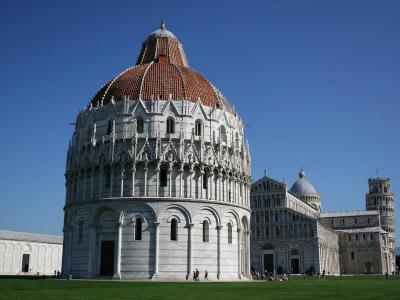
Miracles Square, officially known as Cathedral Square, is the monumental heart of Pisa and one of the most recognizable historic spaces in Europe. Enclosed by medieval walls and arranged as a wide green lawn, the square creates a striking visual setting where white marble buildings rise clearly against the grass. The open layout allows visitors to appreciate each monument individually while also understanding how carefully they were positioned in relation to one another.

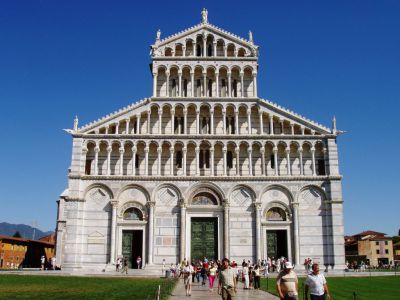
At the center stands Pisa Cathedral, begun in 1063 and considered a masterpiece of Pisan Romanesque architecture. If you look at its façade, you will notice this particular style reflected by the layered arcades and alternating marble bands, indicating Pisa's maritime wealth and cultural connections across the Mediterranean. Just beside it rises the Leaning Tower of Pisa, originally built as the cathedral’s bell tower. Its famous tilt, caused by unstable ground, has made it one of the most photographed structures in the world.

Opposite the cathedral stands the circular Pisa Baptistery, the largest baptistery in Italy. Its combination of Romanesque rounded arches and Gothic upper pointed arches, along with its remarkable acoustics, make it a highlight of any visit. Along the northern edge stretches the Camposanto Monumentale, a Gothic cloister that houses medieval frescoes and Roman sarcophagi, offering a quieter and more reflective atmosphere.

Few visitors realize that the name “Miracles Square” was popularized in the 20th century by writer Gabriele D’Annunzio, who, in his 1910 novel "Maybe Yes, Maybe No", described the square as the "meadow of miracles" because of the remarkable concentration of masterpieces gathered here.

Today, the square represents more than individual landmarks. The careful spacing, the shared marble tones, and the balance between circular and vertical forms create an architectural harmony that makes the entire space feel unified and monumental at the same time.
2
Duomo di Pisa (Pisa Cathedral)

2) Duomo di Pisa (Pisa Cathedral) (must see)

Pisa Cathedral is a magnificent example of Romanesque architecture, located in the heart of the Miracles Square. Built between the 11th and 12th centuries, the cathedral features a stunning white marble façade with intricate carvings and a mix of Byzantine and Islamic architectural influences. Standing in front of the cathedral, if you look at the four rows of open galleries above the entrance, you will find several smaller round arches, which are a typical feature of Moorish architecture.

A must-see highlight in the cathedral is the pulpit by Giovanni Pisano, completed in the early 14th century. A prime example of Gothic sculpture, this pulpit features detailed reliefs depicting scenes from Christ’s life, such as the Nativity, Crucifixion, and Last Judgment. The flowing, expressive figures show Pisano’s mastery in combining religious narrative with an elegant artistic style. You can find the pulpit on a raised platform on the north side of the nave, toward the left side from the main entrance when facing the altar.

In the apse, visitors can admire the mosaic of Christ in Majesty, a medieval masterpiece dating back to the 13th century. The vibrant gold-backed mosaic shows Christ surrounded by angels and saints, radiating a divine presence that draws visitors into the sacred space. The large golden apse mosaic is on a semi-circular wall above the main altar.

Another intriguing feature of the cathedral is its granite Corinthian columns, which were brought from Palermo, Elba Island, and Sardinia, reflecting the city’s historical ties and its cosmopolitan influence during the medieval period.

Few visitors know that the cathedral also leans—though less pronounced than the famous Leaning Tower. The slight tilt is a result of the unstable foundation that also affected the tower. If you look from outside the cathedral, you should be able to see it.

For those with an interest in science, the cathedral is also famous for inspiring Galileo Galilei. The story goes that Galileo observed a swinging lamp in the cathedral and noticed its regular motion. This observation helped him develop his theory of the pendulum. Today, one can still see a lamp hanging in the cathedral’s main nave, though the original lamp observed by Galileo is now stored in the Monumental Cemetery.

With its artistic, architectural, and historical significance, Pisa Cathedral offers a rich and fascinating experience for visitors.
3
Camposanto Monumentale (Monumental Cemetery)

3) Camposanto Monumentale (Monumental Cemetery) (must see)

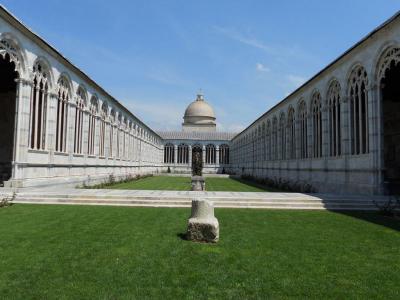
The Monumental Cemetery stands along the northern side of the Miracles Square and immediately feels more enclosed than the surrounding monuments. As you face the long façade, notice the continuous sequence of typical Gothic elements - pointed arches, stretching across the exterior, creating a steady rhythm that defines the building. This elongated structure surrounds a central lawn, forming a cloistered rectangle designed for reflection.

Its Italian name Campo Santo, meaning “holy field,” comes from the tradition that the cemetery was built using sacred soil brought from Golgotha — the site in Jerusalem associated with Christ’s crucifixion — by Archbishop Ubaldo de’ Lanfranchi, giving the ground its special religious significance. A local legend even claims that bodies buried here would decompose within just 24 hours.

If you enter through the right-hand doorway, you can see a sculpted tabernacle showing the Virgin and Child with four saints. It dates to the second half of the 14th century and is attributed to a follower of Giovanni Pisano, an Italian sculptor, painter, and architect. Its placement above the entrance signals the sacred character of the space beyond.

Step inside and walk beneath the covered corridors that frame the open courtyard. Along the walls stand Roman sarcophagi, reminders that this site also became a place for preserving classical antiquities. Among the notable memorials, the western gallery of the cemetery features a 19th-century commemorative statue dedicated to Italian mathematician Leonardo Fibonacci, inaugurated in 1863 and created by Italian sculptor Giovanni Paganucci. The monument reflects Pisa’s pride in the mathematician whose work had a lasting influence on European mathematics.

The frescoed walls are one of the greatest highlights of the cemetery. Between 1336 and 1341, Italian painter Buonamico Buffalmacco decorated them with powerful scenes such as The Triumph of Death, The Last Judgment, and the Stories of the Hermits, created to remind visitors of the fragility of life. About a century later, painter Benozzo Gozzoli added the colorful Stories of the Old Testament along the north wall, preserving biblical history through vivid and detailed imagery.

Although many of these works were damaged during World War II bombing and fire, restoration efforts have preserved significant sections.

Within the Chapel Aulla, you can find the original lamp associated with Galileo Galilei, the renowned Italian astronomer and physicist. Historical accounts link Galileo’s observations of a similar swinging lamp inside Pisa Cathedral to the early development of his studies on pendulum motion.
4
Battistero di San Giovanni (Pisa Baptistery)

4) Battistero di San Giovanni (Pisa Baptistery) (must see)

The Pisa Baptistery stands in the Miracles Square as one of the most striking examples of Romanesque-Gothic architecture in Italy. Founded on August 15, 1152, and designed by Diotisalvi, a medieval architect active in Pisa, its monumental circular form makes it the largest baptistery in the world. As you observe the exterior, you can notice the alternating white and gray marble and the contrast between the solid Romanesque base and the more elaborate "angular" Gothic upper levels that were added later.

On the east side, take your time to study the main doorway facing the Cathedral. The sculpted reliefs above the entrance present religious imagery connected to John the Baptist, reinforcing the theme of spiritual renewal. Above the architrave, you will see a statue of the Madonna and Child, placed prominently to emphasize protection and divine blessing over those entering the building.

Inside, your eyes are immediately drawn to the octagonal baptismal font at the center. Dating from 1246, it was created by Guido Bigarelli da Como, a master stone carver from Lombardy. At the center of the font stands a bronze statue of Saint John the Baptist by Italo Griselli, a 20th-century Italian sculptor. The circular layout, together with the monolithic columns and layered arches, gives the interior a strong architectural presence despite its relatively simple and uncluttered space.

One of the main highlights of the Baptistery that you will easily spot is the pulpit completed in 1260 by Nicola Pisano, a pioneering master of medieval sculpture whose work is widely regarded as a landmark in Italian art. The marble relief panels illustrate key moments from Christ’s life, including the Nativity, Adoration of the Magi, Presentation in the Temple, Crucifixion, and the Last Judgment. The most famous scene is the Nativity, where several scenes are brought together in a single composition centered on the large reclining figure of the Virgin Mary, creating a powerful religious scene.

The Baptistery is famous for its extraordinary acoustics. A single voice or spoken word can linger for up to 10 seconds. You can often demonstrate this by working with a partner. You sing a single note, then have your partner repeat it — you can hear the overlapping echoes almost like a choir.

The Baptistery is also historically significant as the baptism site of Galileo Galilei who was baptised here on February 19, 1564, just four days after his birth. Galileo’s father, Vincenzo Galilei, was a music theorist deeply interested in sound and vibration. The setting invites reflection on how Galileo grew up in a household where mathematics, music, proportion, and harmony were closely intertwined.
5
The Leaning Tower

5) The Leaning Tower (must see)

The Leaning Tower of Pisa is the city’s most famous landmark and one of the most recognizable architectural symbols in the world. Built between 1173 and 1372 as the bell tower of Pisa Cathedral, the structure began to lean during construction when its foundations settled into soft sandy soil.

If you stand near the base, you can already notice that the tower is not perfectly straight. Medieval builders attempted to correct the problem as work continued, slightly adjusting the upper levels and unintentionally creating the gentle curve that makes the tower so distinctive today.

Looking upward, the tower reveals eight levels of elegant open galleries supported by slender marble columns. These repeating arcades give the structure a surprisingly light appearance despite its massive weight. Move a little more to the side, and you'll notice the lean more clearly, especially where the upper floors visibly shift away from the vertical line of the base. Inside the belfry hang seven bells — one for each note of the musical scale — with the largest bell installed in 1655.

You can climb its famous spiral staircase in either 294 or 296 steps, a unique feature of the leaning tower, as the seventh level contains two fewer steps on the north-facing staircase due to the tilt. As you make your way upward, the slope becomes noticeable underfoot, while small openings along the walls offer changing views across Miracles Square. From the top, visitors are rewarded with wide views of the cathedral complex, Pisa’s historic center, and the surrounding Tuscan landscape.

One of the most famous stories associated with the Leaning Tower involves Galileo Galilei and his early experiments on motion. According to tradition, Galileo simultaneously dropped two objects of different weights from the tower to demonstrate that their rate of fall is independent of mass, challenging the long-held Aristotelian belief that heavier objects fall faster.

A curious fact many visitors find surprising is that the Leaning Tower has survived at least four strong earthquakes since the 13th century. Engineers discovered that the same soft ground that caused the tower to lean actually helps protect it during earthquakes, preventing the structure from vibrating in a way that could cause serious damage. Ironically, the soil that once threatened the tower’s stability is also one of the reasons it still stands today.
6
Orto Botanico (Botanical Garden)

6) Orto Botanico (Botanical Garden) (must see)

The Botanical Garden of Pisa offers a quieter side of the city, just a short distance from its famous monuments. Founded in 1544 as part of the University of Pisa, it is considered the oldest university botanical garden in Europe and one of the earliest scientific gardens in the world. Originally created for the study of medicinal plants, the garden continues to reflect centuries of research, education, and curiosity about the natural world.

As you walk through the grounds, the garden unfolds through a series of carefully organized sections connected by shaded paths. Open planting areas alternate with ponds, lawns, and botanical collections arranged according to plant families. The water gardens are among the most relaxing areas to explore, where pools and fountains are surrounded by aquatic plants, including rare species that have disappeared from their natural habitats. The calm atmosphere offers a noticeable contrast to Pisa’s busy monumental areas nearby.

One of the most distinctive buildings within the garden is the former Botanical Institute, completed in the late 16th century and later enhanced with its characteristic seashell decoration added in the mid-18th century. Nearby greenhouses display tropical and exotic plants that would not normally grow in the Tuscan climate.

Inside the Botanical Museum, visitors can discover portraits of early botanists, scientific instruments, and historical collections connected to the development of botanical science. The extensive herbarium, containing hundreds of thousands of preserved plant specimens, remains an important scientific archive, while visitors can explore its collections through multimedia exhibits within the museum.

Today, the Botanical Garden remains both an active research center and a peaceful place to wander, offering visitors a different perspective on Pisa — one shaped not only by art and architecture, but also by science, discovery, and the long tradition of studying nature.
7
Piazza dei Cavalieri (Knights Square)

7) Piazza dei Cavalieri (Knights Square) (must see)

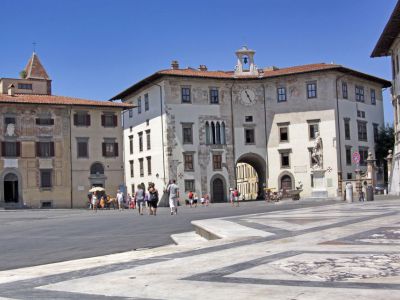
Knights’ Square has long been one of Pisa’s most important civic spaces. In medieval times, it served as the city’s political center, and even earlier it was likely the site of the Roman Forum. The city remained an independent maritime power until 1406, when mercenary commanders Angelo Tartaglia and Muzio Attendolo Sforza occupied the city and ordered its annexation to Florence — a turning point closely linked to Knights’ Square, then the political center of Pisan authority.

In the 16th century, Cosimo I commissioned the architect Giorgio Vasari to redesign the square in Renaissance style and dedicate it to the Knights of Saint Stephen. This military and religious order had been created to defend the Tuscan coastline from Ottoman and North African pirate raids. At the center of the square stands a statue of Cosimo I, installed in 1596, marking his role in transforming both the space and the institution it represented.

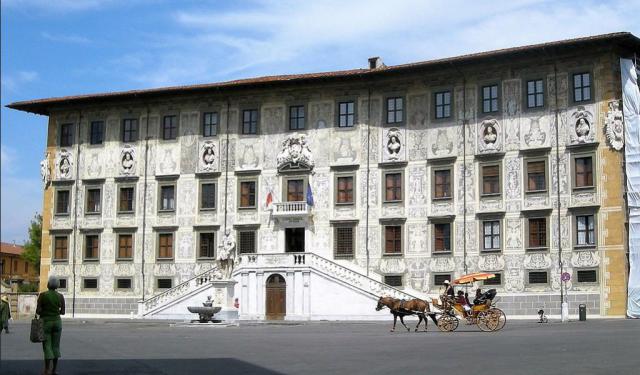
Several important buildings surround the square. The Carovana Palace, once the headquarters of the Knights of Saint Stephen, is known for its richly decorated façade covered with painted allegorical figures, zodiac symbols, and portraits of the Tuscan grand dukes. Nearby, the Clock Palace is associated with the tragic story of Count Ugolino, who was imprisoned and died there—an episode later immortalized by Dante. Today, the building houses part of the university library.

Other historic institutions also line the square, including the Putean College, founded in the early 17th century, and the Church of the Knights of Saint Stephen, designed by painter and architect Giorgio Vasari. Inside the church, captured naval banners recall the order’s maritime campaigns. Together, these buildings reflect the square’s evolution from political center to Renaissance ceremonial space, and now to an important part of Pisa’s academic life.
8
Borgo Stretto (Narrow Street)

8) Borgo Stretto (Narrow Street) (must see)

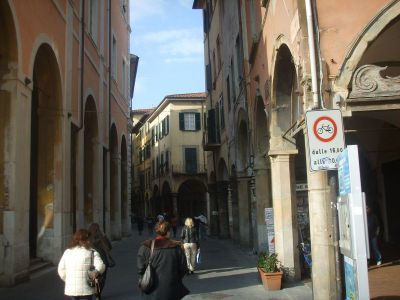
Narrow Street is one of the liveliest and most characteristic streets in Pisa. Running through the historic center, it is largely pedestrian and known for its mix of everyday shops, small boutiques, and more upscale stores. It is a place where locals run errands, meet for coffee, and stroll under covered walkways, giving visitors a sense of daily life beyond the city’s major monuments.

A defining feature of Narrow Street is the continuous line of arcades running along both sides of the street. These sheltered walkways, supported by Corinthian columns, provide shade in summer and protection from rain in winter. Beneath them, visitors will find cafés, bookshops, restaurants, and clothing stores alongside souvenir shops. Just a short walk toward the river stands Caffè dell’Ussero, founded in 1775 and long known as a meeting place for writers, scientists, and political figures.

For many years, a tradition associated Borgo Stretto with the birthplace of Galileo Galilei, but modern historical research has clarified this story. While the Galilei family owned property and operated a shop in this area — which explains the long-standing connection — official records confirm that Galileo was actually born in the Ammannati family house on Via Giusti, near the Church of Sant’Andrea, only a short walk from here.

The buildings lining the street reflect Pisa’s commercial past. Many of the two- and three-story houses once belonged to wealthy merchant families who lived above their businesses. At the corner with Via San Francesco stands the 15th-century Palazzo Poschi, a reminder of the area’s long-standing importance as a center of trade and urban life.
9
Ponte di Mezzo (Middle Bridge)

9) Ponte di Mezzo (Middle Bridge)

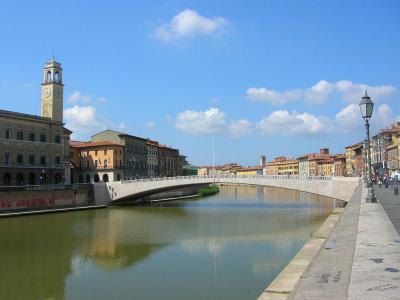
The Middle Bridge spans the River Arno at roughly the center of Pisa, linking the northern and southern parts of the historic city. Bridges have crossed this point for centuries. A wooden Roman bridge once stood nearby, later replaced by stone in the 11th century. Over time, floods, collapse, and rebuilding reshaped the structure, and the elegant arched bridge that stood here in earlier centuries was destroyed during World War II bombing in 1944.

The bridge seen today was completed in 1950. Built of reinforced concrete and covered with pale Verona stone, it stretches about 89 meters and is defined by a single wide arch. At its four corners stand marble spheres preserved from the earlier bridge, small reminders of what once stood here. In the center of the pavement, the Pisan cross is set in white stone, marking the symbolic heart of the crossing.

The Middle Bridge is also closely tied to one of Pisa’s most energetic traditions. Each June, the bridge becomes the stage for the Gioco del Ponte, or Bridge Game, part of the city’s historic celebrations. Teams from the northern and southern districts compete by pushing a heavy cart along tracks across the bridge, reenacting centuries-old rivalry in a dramatic public spectacle.
10
Palazzo Blu (Blue Palace)

10) Palazzo Blu (Blue Palace)

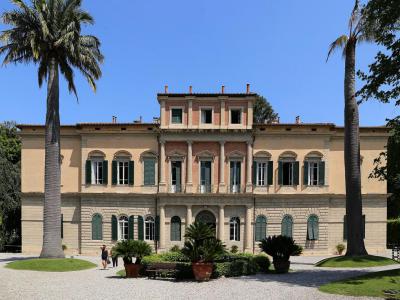
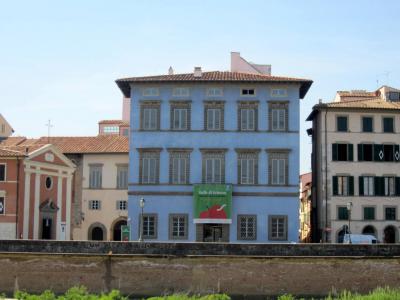
The Blue Palace stands along the banks of the River Arno, its bright façade making it one of the most recognizable historic buildings in central Pisa. The site has been occupied since at least the 11th century, while parts of the present structure date to the 16th century. Over time, the palace passed through the hands of several prominent and influential families, reflecting Pisa’s long tradition of merchant wealth and urban prestige.

In the 19th century, the building underwent major renovation. A new wing was added to create a more balanced, symmetrical layout, and the façade was painted the distinctive shade of blue that gives the palace its name today. Inside, many rooms were designed to reflect the refined tastes of a 19th-century aristocratic residence, with decorative details and furnishings that recreate the atmosphere of an elegant private home from that period.

Today, the Blue Palace houses the city’s Museum of Art and Culture. Its permanent collection includes more than 300 works spanning from the 14th to the 20th centuries, with paintings by artists such as Nino Pisano, Cecco di Pietro, and Benozzo Gozzoli. The museum also presents archaeological material linked to Pisa’s past, including remains from Etruscan, Roman, and Hellenistic periods. On the ground floor, visitors can even see sections of an older roadway dating back to the medieval era.

Alongside its permanent displays, the Blue Palace regularly hosts temporary exhibitions on a wide range of cultural themes, making it one of Pisa’s most active and varied exhibition spaces.
11
Santa Maria della Spina Church

11) Santa Maria della Spina Church

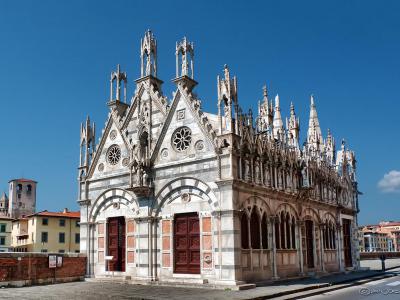
Small in size but striking in detail, Santa Maria della Spina is one of the finest examples of Gothic architecture in Pisa. Set along the banks of the Arno River, the church is built entirely of marble and covered with elaborate decorative elements—pinnacles, carved niches, sculpted figures, and delicate rose windows.

The church was originally built in 1230 and later enlarged in the early 14th century. It was first known as Santa Maria di Pontenovo, named after a nearby bridge that once stood close to the site. When that bridge collapsed in the 15th century and was never rebuilt, the church gradually became known by a different name. It once housed a revered relic believed to be a thorn from Christ’s Crown of Thorns, which gave rise to the name “della Spina,” meaning “of the thorn.”

In the 19th century, the building was dismantled and carefully reconstructed at a slightly higher level to protect it from flooding by the Arno. The extensive restoration altered parts of the structure, drawing criticism from some observers of the time. Inside, the decoration is much more restrained than the exterior, partly due to later renovations. At the center stands an important Gothic sculpture, the Madonna of the Rose, created by Andrea and Nino Pisano.

Despite its modest size, Santa Maria della Spina remains one of Pisa’s most visually intricate and historically distinctive landmarks.
12
Tuttomondo Mural

12) Tuttomondo Mural

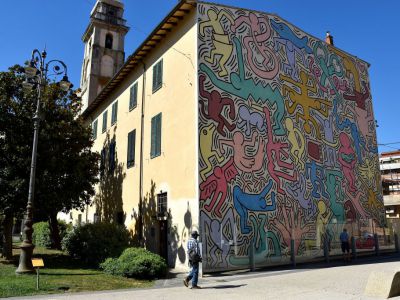
Covering the side wall of the Church of Sant’Antonio Abate, the Tuttomondo mural brings a bold splash of modern color to Pisa’s historic streets. Painted in 1989 by American artist Keith Haring, it was one of his final large-scale works before his death. The title Tuttomondo, meaning “all the world,” reflects the mural’s central theme—unity, peace, and the interconnectedness of humanity.

The composition features a lively group of stylized human figures arranged in Haring’s unmistakable graphic style. Each figure plays a symbolic role. One scene shows a person overcoming a serpent, representing the triumph of good over evil. Elsewhere, a woman holding a child evokes maternity and care, while other figures support dolphins, suggesting harmony between humans and the natural world. The overall effect is energetic yet purposeful, with movement and meaning built into every shape.

Unlike Pisa’s medieval monuments, Tuttomondo belongs fully to the contemporary era, yet it has become an essential stop for visitors. Its bright colors and accessible imagery make it easy to appreciate, even without knowing the deeper symbolism. The mural’s scale and placement transform an ordinary church wall into a public artwork meant to be encountered in everyday life.

Today, Tuttomondo remains one of the largest and most significant modern murals in Italy. It offers a striking contrast to the city’s historic architecture and stands as a reminder that Pisa’s cultural story continues well beyond the medieval period.

Walking Tours in Pisa, Italy

Create Your Own Walk in Pisa

Create Your Own Walk in Pisa

Creating your own self-guided walk in Pisa is easy and fun. Choose the city attractions that you want to see and a walk route map will be created just for you. You can even set your hotel as the start point of the walk.

Galileo's Pisa Walking Tour

Galileo's Pisa Walking Tour

Among the names most closely connected with Pisa, few are as widely recognized as Galileo Galilei. He became one of the most influential thinkers in history—an astronomer, mathematician, and physicist whose work reshaped how people understood motion, gravity, and the structure of the universe. It's not just the place where his life began; it is also where many of the observations and...  view more

Tour Duration: 1 Hour(s)
Travel Distance: 1.8 Km or 1.1 Miles
Pisa Palaces Walking Tour

Pisa Palaces Walking Tour

As you continue your acquaintance with Pisa, you will notice that there is a lot more to see here than just a "leaning" landmark. Indeed, just like Italy in general, this particular Tuscan city boasts a glorious heritage of wonderful palaces, fit to transport you back in time.

The most beautiful palaces in Pisa are found on both sides of the Arno River, forming a multi-colored ribbon...  view more

Tour Duration: 1 Hour(s)
Travel Distance: 2.1 Km or 1.3 Miles