

Plaza de America, Seville
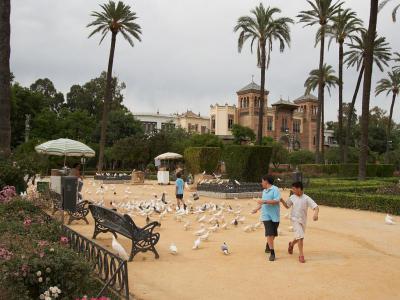
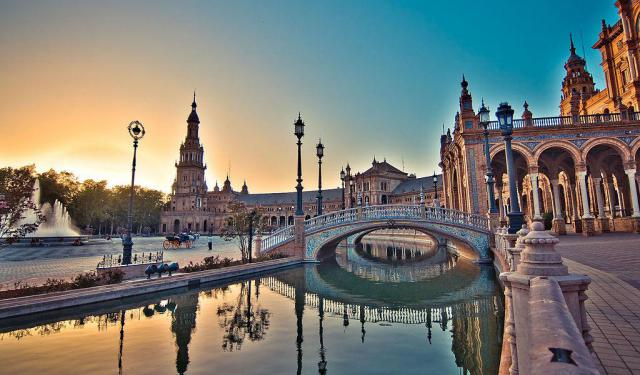
The Plaza de America in Seville is located within the Maria Luisa Park and is a significant part of the artistic urban complex created for the Ibero-American Exhibition in 1929. This square is surrounded by three palaces, each built in a distinct architectural style.
Aníbal González constructed these three buildings between 1913 and 1916 in preparation for the future Ibero-American Exposition of 1929, with each palace showcasing a unique architectural style. The first one, designed in the Neo-Gothic style, is known as the Royal Pavilion. The second, following the Neomudejar architectural style, houses the Museum of Popular Arts and Customs. Lastly, the third palace, designed in Neo-Renaissance style, serves as the Provincial Archaeological Museum, home to the remarkable Carambolo Treasure, which is the largest discovery of prehistoric precious metalwork.
In addition to these palaces, the square features the Glorieta de Miguel de Cervantes, adorned with ceramics depicting scenes from his famous works, and the Glorieta de Rodríguez Marín. The entire ensemble is surrounded by a series of columns connected by chains with illuminated globes, adorned with winged victories sculpted by Manuel Delgado Brackembury and Lorenzo Coullaut Valera. On April 7, 1926, following a dinner at the Royal Pavilion, a celebration took place in the Plaza, during which King Alfonso XIII delivered a poignant speech emphasizing the significance of Seville as the economic hub of southern Spain and the importance of the upcoming Seville Exposition.
Aníbal González constructed these three buildings between 1913 and 1916 in preparation for the future Ibero-American Exposition of 1929, with each palace showcasing a unique architectural style. The first one, designed in the Neo-Gothic style, is known as the Royal Pavilion. The second, following the Neomudejar architectural style, houses the Museum of Popular Arts and Customs. Lastly, the third palace, designed in Neo-Renaissance style, serves as the Provincial Archaeological Museum, home to the remarkable Carambolo Treasure, which is the largest discovery of prehistoric precious metalwork.
In addition to these palaces, the square features the Glorieta de Miguel de Cervantes, adorned with ceramics depicting scenes from his famous works, and the Glorieta de Rodríguez Marín. The entire ensemble is surrounded by a series of columns connected by chains with illuminated globes, adorned with winged victories sculpted by Manuel Delgado Brackembury and Lorenzo Coullaut Valera. On April 7, 1926, following a dinner at the Royal Pavilion, a celebration took place in the Plaza, during which King Alfonso XIII delivered a poignant speech emphasizing the significance of Seville as the economic hub of southern Spain and the importance of the upcoming Seville Exposition.
Want to visit this sight? Check out these Self-Guided Walking Tours in Seville. Alternatively, you can download the mobile app "GPSmyCity: Walks in 1K+ Cities" from Apple App Store or Google Play Store. The app turns your mobile device to a personal tour guide and it works offline, so no data plan is needed when traveling abroad.
Download The GPSmyCity App



Plaza de America on Map
Sight Name: Plaza de America
Sight Location: Seville, Spain (See walking tours in Seville)
Sight Type: Attraction/Landmark
Sight Location: Seville, Spain (See walking tours in Seville)
Sight Type: Attraction/Landmark
Nearby Sights
Walking Tours in Seville, Spain

Create Your Own Walk in Seville
Creating your own self-guided walk in Seville is easy and fun. Choose the city attractions that you want to see and a walk route map will be created just for you. You can even set your hotel as the start point of the walk.
Seville Introduction Walking Tour
19th-century American writer Washington Irving noted that in Seville “the past lingers like perfume.”
Seville is the largest city and provincial capital of Andalusia, located on the banks of the Guadalquivir River. Ancient tradition credits the city’s foundation to Hercules. Historically, early Phoenician settlers called the site Hisbaal, invoking the god Baal, a name later Latinised by... view more
Tour Duration: 2 Hour(s)
Travel Distance: 4.9 Km or 3 Miles
Seville is the largest city and provincial capital of Andalusia, located on the banks of the Guadalquivir River. Ancient tradition credits the city’s foundation to Hercules. Historically, early Phoenician settlers called the site Hisbaal, invoking the god Baal, a name later Latinised by... view more
Tour Duration: 2 Hour(s)
Travel Distance: 4.9 Km or 3 Miles
Old Seville Walking Tour
In his famous book Don Quixote, Spanish writer Miguel de Cervantes referred to Seville as a city where the bustle of life never seemed to stop.
Old Seville, the historic heart of the Andalusian capital, reflects more than two thousand years of cultural layers. The area developed along the banks of the Guadalquivir River, which for centuries connected the city to the wider Mediterranean world.... view more
Tour Duration: 1 Hour(s)
Travel Distance: 2.4 Km or 1.5 Miles
Old Seville, the historic heart of the Andalusian capital, reflects more than two thousand years of cultural layers. The area developed along the banks of the Guadalquivir River, which for centuries connected the city to the wider Mediterranean world.... view more
Tour Duration: 1 Hour(s)
Travel Distance: 2.4 Km or 1.5 Miles
Flamenco Walking Tour
They say if it's Flamenco – it's Andalusia, and if it's Andalusia – it's all about Seville. Indeed, with its roots deeply embedded in the Andalusian culture, Seville is a prime destination for experiencing the essence of Flamenco and is largely considered to be the home of this fiery dance.
Flamenco sites are found all over the city – in bars, theaters, or specialized... view more
Tour Duration: 1 Hour(s)
Travel Distance: 2.7 Km or 1.7 Miles
Flamenco sites are found all over the city – in bars, theaters, or specialized... view more
Tour Duration: 1 Hour(s)
Travel Distance: 2.7 Km or 1.7 Miles
Useful Travel Guides for Planning Your Trip

16 Uniquely Spanish Things to Buy in Seville
Immortalized by Gioachino Rossini in his famous The Barber of Seville opera, the city of Seville is a major historic and cultural sight adorning the face of modern Spain. Much of the city's character is reflected in the locally-made products that can make for a great gift or trip memento...