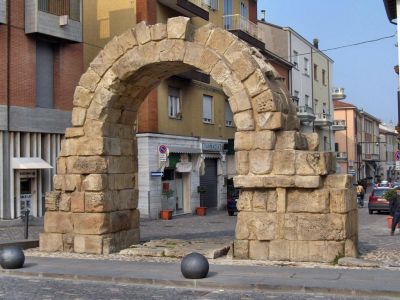


Porta Montanara (Montanara Gate), Rimini
Montanara Gate (Porta Montanara), historically known as Porta Sant'Andrea, is an ancient Roman city gate located in Rimini. Built in the 1st century BC following Sulla's civil war, it originally consisted of two arches, serving as a southern gateway to the Roman colonia of Ariminum. Positioned at the southern end of Rimini’s cardo maximus (now Via Giuseppe Garibaldi), it connected the city to the Marecchia Valley and onward to Arretium (modern Arezzo).
The sandstone Montanara Gate, 12.5 meters wide with two 5.9-meter-high arches, fortified Ariminum after Sulla's forces sacked the city in 82 BC. Over time, the northern arch was sealed, and the southern arch was raised due to street-level changes. By the medieval period, it was part of Borgo Sant'Andrea, integrated into structures like Palazzo Turchi, and witnessed the 1528 Papal takeover ending Malatesta rule.
The gate survived heavy Allied bombing during World War II, which uncovered the long-hidden northern arch in 1944. However, the southern arch was destroyed by Allied forces to facilitate tank movement. Following the war, efforts were made to preserve the remaining northern arch. Despite these efforts, the arch was dismantled in 1949 and relocated to the courtyard of the Tempio Malatestiano, where it was reconstructed using modern cement and non-original stones.
In 2004, the arch was restored near its original location on Via Garibaldi, thanks to efforts funded by local organizations. The inauguration was marked by a commemorative medal featuring the original two-arch design and Rimini’s Roman grid plan. The arch now serves as a testament to the city’s rich Roman history and its resilience through centuries of change.
The surviving arch of Montanara Gate, built with double-row voussoirs, reflects Roman engineering, using sandstone from Covignano Hill or Pietracuta. Flint cubes on Via Garibaldi mark the site of the demolished southern arch. Today, it symbolizes Rimini's rich history, from Roman times to modern restoration.
The sandstone Montanara Gate, 12.5 meters wide with two 5.9-meter-high arches, fortified Ariminum after Sulla's forces sacked the city in 82 BC. Over time, the northern arch was sealed, and the southern arch was raised due to street-level changes. By the medieval period, it was part of Borgo Sant'Andrea, integrated into structures like Palazzo Turchi, and witnessed the 1528 Papal takeover ending Malatesta rule.
The gate survived heavy Allied bombing during World War II, which uncovered the long-hidden northern arch in 1944. However, the southern arch was destroyed by Allied forces to facilitate tank movement. Following the war, efforts were made to preserve the remaining northern arch. Despite these efforts, the arch was dismantled in 1949 and relocated to the courtyard of the Tempio Malatestiano, where it was reconstructed using modern cement and non-original stones.
In 2004, the arch was restored near its original location on Via Garibaldi, thanks to efforts funded by local organizations. The inauguration was marked by a commemorative medal featuring the original two-arch design and Rimini’s Roman grid plan. The arch now serves as a testament to the city’s rich Roman history and its resilience through centuries of change.
The surviving arch of Montanara Gate, built with double-row voussoirs, reflects Roman engineering, using sandstone from Covignano Hill or Pietracuta. Flint cubes on Via Garibaldi mark the site of the demolished southern arch. Today, it symbolizes Rimini's rich history, from Roman times to modern restoration.
Want to visit this sight? Check out these Self-Guided Walking Tours in Rimini. Alternatively, you can download the mobile app "GPSmyCity: Walks in 1K+ Cities" from Apple App Store or Google Play Store. The app turns your mobile device to a personal tour guide and it works offline, so no data plan is needed when traveling abroad.
Download The GPSmyCity App



Porta Montanara (Montanara Gate) on Map
Sight Name: Porta Montanara (Montanara Gate)
Sight Location: Rimini, Italy (See walking tours in Rimini)
Sight Type: Attraction/Landmark
Sight Location: Rimini, Italy (See walking tours in Rimini)
Sight Type: Attraction/Landmark
Nearby Sights
Walking Tours in Rimini, Italy

Create Your Own Walk in Rimini
Creating your own self-guided walk in Rimini is easy and fun. Choose the city attractions that you want to see and a walk route map will be created just for you. You can even set your hotel as the start point of the walk.

Discover Rimini's Federico Fellini Sites on Foot
Even those vaguely familiar with cinema perhaps have heard of Federico Fellini. In recent history, the picturesque resort town of Rimini, on the Adriatic coast of Italy, "marked" itself primarily as the birthplace and the final resting place of this great film director.
Fellini lived in Rimini from January 1920, when he was born, until January 1939, when he moved out to Rome. While... view more
Tour Duration: 2 Hours
Travel Distance: 3.4 Km or 2.1 Miles
Fellini lived in Rimini from January 1920, when he was born, until January 1939, when he moved out to Rome. While... view more
Tour Duration: 2 Hours
Travel Distance: 3.4 Km or 2.1 Miles
Rimini's Historic Old Town Walking Tour
The Roman Republic founded an outpost called Ariminus at the mouth of the river Marecchia in 268 BC. Rimini was a center of civil wars and invasions. Julius Caesar made his famous "Rubicon" speech to his troops in the city forum.
The city was an all-important junction. The ancient Roman road, via Flaminia, ended in Rimini at the Arch of Augustus, erected in 27 BC. Another old Roman... view more
Tour Duration: 2 Hours
Travel Distance: 2.4 Km or 1.5 Miles
The city was an all-important junction. The ancient Roman road, via Flaminia, ended in Rimini at the Arch of Augustus, erected in 27 BC. Another old Roman... view more
Tour Duration: 2 Hours
Travel Distance: 2.4 Km or 1.5 Miles
City Walks Overview
