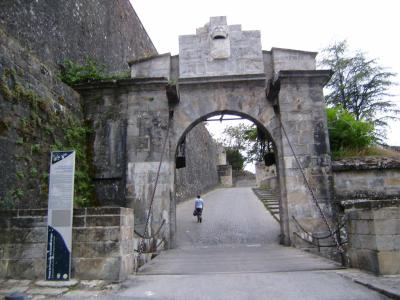


Portal de Francia (France Gate), Pamplona
Constructed in 1553 under the direction of the Viceroy of Alburquerque, the France Gate serves as the best-preserved among the six entrances that once punctuated the formidable fortifications surrounding Pamplona. Its enduring name, the France Gate, reflects its historical function as the primary ingress and egress point for travelers arriving from and departing to the neighboring country of France.
The portal features two imposing doors, with the inner door adorned with a striking carved Renaissance coat of arms. This intricately crafted emblem portrays the double-headed eagle and the imperial arms, evoking the grandeur and power associated with the era. Additionally, a plaque installed on the gateway commemorates a pivotal moment in Pamplona's history-the departure of General Tomas Zumalacárregui in 1833 to assume command of the Carlist troops. This significant event underscores the gateway's role as a witness to the tumultuous events that have shaped the city over the centuries.
Over time, the France Gate has acquired additional names that reflect its multifaceted significance. Since 1939, it has also been known as the Zumalacárregui Gateway, paying homage to the influential military leader whose departure from Pamplona marked a turning point in the Carlist Wars. Furthermore, the gateway holds deep spiritual significance as it has served as the traditional entrance for pilgrims embarking on the Way of St. James, a historic pilgrimage route leading to the revered shrine of Santiago de Compostela.
The portal features two imposing doors, with the inner door adorned with a striking carved Renaissance coat of arms. This intricately crafted emblem portrays the double-headed eagle and the imperial arms, evoking the grandeur and power associated with the era. Additionally, a plaque installed on the gateway commemorates a pivotal moment in Pamplona's history-the departure of General Tomas Zumalacárregui in 1833 to assume command of the Carlist troops. This significant event underscores the gateway's role as a witness to the tumultuous events that have shaped the city over the centuries.
Over time, the France Gate has acquired additional names that reflect its multifaceted significance. Since 1939, it has also been known as the Zumalacárregui Gateway, paying homage to the influential military leader whose departure from Pamplona marked a turning point in the Carlist Wars. Furthermore, the gateway holds deep spiritual significance as it has served as the traditional entrance for pilgrims embarking on the Way of St. James, a historic pilgrimage route leading to the revered shrine of Santiago de Compostela.
Want to visit this sight? Check out these Self-Guided Walking Tours in Pamplona. Alternatively, you can download the mobile app "GPSmyCity: Walks in 1K+ Cities" from Apple App Store or Google Play Store. The app turns your mobile device to a personal tour guide and it works offline, so no data plan is needed when traveling abroad.
Download The GPSmyCity App



Portal de Francia (France Gate) on Map
Sight Name: Portal de Francia (France Gate)
Sight Location: Pamplona, Spain (See walking tours in Pamplona)
Sight Type: Attraction/Landmark
Sight Location: Pamplona, Spain (See walking tours in Pamplona)
Sight Type: Attraction/Landmark
Nearby Sights
Walking Tours in Pamplona, Spain

Create Your Own Walk in Pamplona
Creating your own self-guided walk in Pamplona is easy and fun. Choose the city attractions that you want to see and a walk route map will be created just for you. You can even set your hotel as the start point of the walk.
Pamplona Introduction Walking Tour
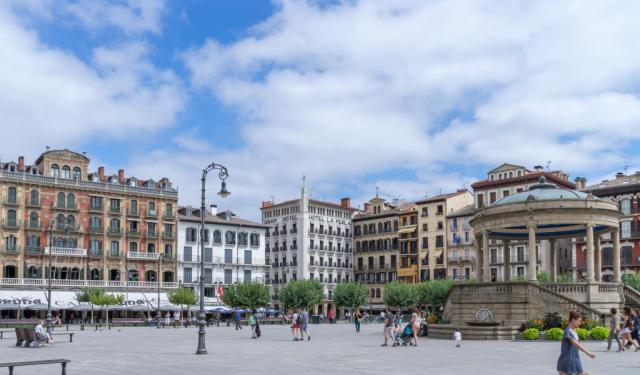
Pamplona, the capital of the autonomous region of Navarre in northern Spain, is one of the oldest cities in the country. Its history spans millennia. Originally a small Vascones settlement known as Iruña, it was transformed into a Roman city named Pompelo by the Roman commander Gnaeus Pompey in 74 BC. Over the centuries, Pamplona witnessed the rise and fall of various powers, from the Visigoths... view more
Tour Duration: 2 Hours
Travel Distance: 2.8 Km or 1.7 Miles
Tour Duration: 2 Hours
Travel Distance: 2.8 Km or 1.7 Miles