

Public Gardens, Halifax (must see)
The Halifax Public Gardens were established in 1874 and cover 16 acres. Designed as formal Victorian gardens, they feature carefully arranged flower beds, three fountains, three ponds, two stone bridges, and a variety of statues and memorials. Much of the original 19th-century layout survives, including curving gravel paths, geometric flower beds, exotic plants, and specimen trees typical of the Victorian Gardenesque style.
The gardens were created by combining two earlier green spaces: the Nova Scotia Horticultural Society Garden, founded in 1837, and a neighboring public park that opened in 1866. Their layout, ornamental planting, winding paths, and decorative features have helped preserve the character of a traditional Victorian garden. Superintendent Richard Power played an important role in shaping the present design during the 1870s, introducing a more unified plan and developing features such as Griffin’s Pond.
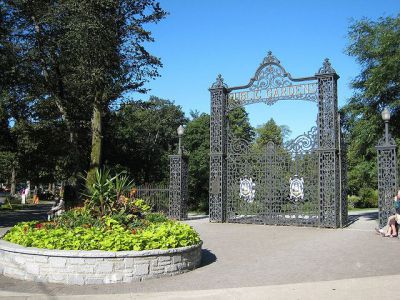
Among the monuments and plaques found throughout the grounds are memorials to military figures such as Charles Carroll Wood, the first Canadian casualty of the Boer War. Other plaques recognize members of the temperance movement and their role in campaigns that helped advance women’s voting rights. The main wrought-iron gates are also worth noticing. Originally purchased from a Scottish foundry, they bear the historic coat of arms of Halifax and were moved to their present position in 1907.
Today, the Public Gardens are considered one of the finest surviving Victorian gardens in North America. They were designated a National Historic Site of Canada in 1984. During the summer, free concerts are held at the bandstand on Sundays, and the gardens also serve as a setting for major civic celebrations, including Canada Day and Natal Day.
The gardens were created by combining two earlier green spaces: the Nova Scotia Horticultural Society Garden, founded in 1837, and a neighboring public park that opened in 1866. Their layout, ornamental planting, winding paths, and decorative features have helped preserve the character of a traditional Victorian garden. Superintendent Richard Power played an important role in shaping the present design during the 1870s, introducing a more unified plan and developing features such as Griffin’s Pond.
Among the monuments and plaques found throughout the grounds are memorials to military figures such as Charles Carroll Wood, the first Canadian casualty of the Boer War. Other plaques recognize members of the temperance movement and their role in campaigns that helped advance women’s voting rights. The main wrought-iron gates are also worth noticing. Originally purchased from a Scottish foundry, they bear the historic coat of arms of Halifax and were moved to their present position in 1907.
Today, the Public Gardens are considered one of the finest surviving Victorian gardens in North America. They were designated a National Historic Site of Canada in 1984. During the summer, free concerts are held at the bandstand on Sundays, and the gardens also serve as a setting for major civic celebrations, including Canada Day and Natal Day.
Want to visit this sight? Check out these Self-Guided Walking Tours in Halifax. Alternatively, you can download the mobile app "GPSmyCity: Walks in 1K+ Cities" from Apple App Store or Google Play Store. The app turns your mobile device to a personal tour guide and it works offline, so no data plan is needed when traveling abroad.
Download The GPSmyCity App



Public Gardens on Map
Sight Name: Public Gardens
Sight Location: Halifax, Canada (See walking tours in Halifax)
Sight Type: Attraction/Landmark
Guide(s) Containing This Sight:
Sight Location: Halifax, Canada (See walking tours in Halifax)
Sight Type: Attraction/Landmark
Guide(s) Containing This Sight:
Nearby Sights








Walking Tours in Halifax, Canada

Create Your Own Walk in Halifax
Creating your own self-guided walk in Halifax is easy and fun. Choose the city attractions that you want to see and a walk route map will be created just for you. You can even set your hotel as the start point of the walk.

Halifax's Historical Buildings Walking Tour
Between the impressive waterfront and colorful, bustling streets, Halifax is a picturesque city. Much of its fascinating history is duly reflected in the local architecture. There are a number of historical landmarks in Halifax, including the time-honored buildings, palaces, and churches, where you can learn much about its glorious past.
The presence of these historical locations is bound to... view more
Tour Duration: 1 Hour(s)
Travel Distance: 1.6 Km or 1 Miles
The presence of these historical locations is bound to... view more
Tour Duration: 1 Hour(s)
Travel Distance: 1.6 Km or 1 Miles

Halifax Downtown Walking Tour
When writer Charles Dickens sailed into Halifax in 1842, the first thing he noticed was a city climbing from the waterfront toward a fortress on the hill. Nearly two centuries later, that same landscape still defines downtown Halifax.
Halifax, the capital of Nova Scotia, developed around one of the finest natural harbors on the Atlantic coast. The British founded Halifax in 1749, largely for... view more
Tour Duration: 2 Hour(s)
Travel Distance: 2.9 Km or 1.8 Miles
Halifax, the capital of Nova Scotia, developed around one of the finest natural harbors on the Atlantic coast. The British founded Halifax in 1749, largely for... view more
Tour Duration: 2 Hour(s)
Travel Distance: 2.9 Km or 1.8 Miles