

Quan Su Pagoda, Hanoi
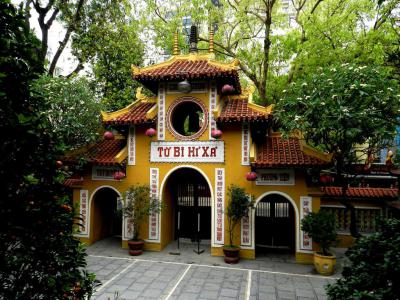
Quan Su Pagoda, located on Quan Su Street in Hanoi, stands as both the largest and most frequented pagoda in the city. This historic site serves as the headquarters of the Buddhist Sangha of Vietnam, playing a central role in the country's Buddhist activities.
The origins of Quan Su Pagoda trace back to a modest structure under a thatched roof in An Tap village, where local villagers gathered for worship. During the 15th century, under the Le Dynasty, the pagoda was expanded into a more significant temple, earning the nickname "Ambassador’s Pagoda." This name derived from its proximity to a guest house established by the Le emperors for foreign envoys, who were predominantly Buddhists and used the temple as their place of worship.
A key figure in the pagoda's history is the monk Thanh Phuong, who undertook extensive renovations, enhancing the temple's structure with additional corridors and revitalizing its religious statues through painting. He also commissioned a new bell for the temple, enriching its spiritual ambiance. The temple layout is divided into two main sections: the front is dedicated to the Buddha, while the rear honors Master Minh Khong of the Ly Dynasty.
In 1934, the Tonkin Buddhist Association selected Quan Su Pagoda as their headquarters, further solidifying its significance in Vietnamese Buddhism. Although the adjacent guest house for ambassadors has since been closed, Quan Su Pagoda continues to thrive as a pivotal center for Buddhist practice and culture in Vietnam.
The origins of Quan Su Pagoda trace back to a modest structure under a thatched roof in An Tap village, where local villagers gathered for worship. During the 15th century, under the Le Dynasty, the pagoda was expanded into a more significant temple, earning the nickname "Ambassador’s Pagoda." This name derived from its proximity to a guest house established by the Le emperors for foreign envoys, who were predominantly Buddhists and used the temple as their place of worship.
A key figure in the pagoda's history is the monk Thanh Phuong, who undertook extensive renovations, enhancing the temple's structure with additional corridors and revitalizing its religious statues through painting. He also commissioned a new bell for the temple, enriching its spiritual ambiance. The temple layout is divided into two main sections: the front is dedicated to the Buddha, while the rear honors Master Minh Khong of the Ly Dynasty.
In 1934, the Tonkin Buddhist Association selected Quan Su Pagoda as their headquarters, further solidifying its significance in Vietnamese Buddhism. Although the adjacent guest house for ambassadors has since been closed, Quan Su Pagoda continues to thrive as a pivotal center for Buddhist practice and culture in Vietnam.
Want to visit this sight? Check out these Self-Guided Walking Tours in Hanoi. Alternatively, you can download the mobile app "GPSmyCity: Walks in 1K+ Cities" from Apple App Store or Google Play Store. The app turns your mobile device to a personal tour guide and it works offline, so no data plan is needed when traveling abroad.
Download The GPSmyCity App



Quan Su Pagoda on Map
Sight Name: Quan Su Pagoda
Sight Location: Hanoi, Vietnam (See walking tours in Hanoi)
Sight Type: Religious
Sight Location: Hanoi, Vietnam (See walking tours in Hanoi)
Sight Type: Religious
Nearby Sights
Walking Tours in Hanoi, Vietnam

Create Your Own Walk in Hanoi
Creating your own self-guided walk in Hanoi is easy and fun. Choose the city attractions that you want to see and a walk route map will be created just for you. You can even set your hotel as the start point of the walk.
Hanoi's Old Quarter Walking Tour
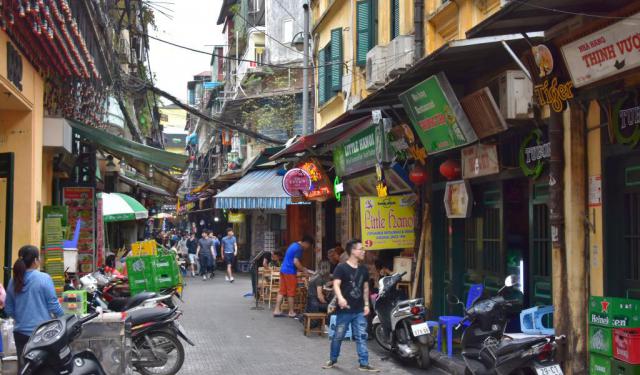
Vietnamese writer Thach Lam’s book Hanoi’s Thirty-Six Streets celebrates the streets, food and everyday character of the old city. In one memorable passage, he wrote: “We too have Hanoi, a city of many beauties.”
Hanoi, the capital of Vietnam, has a history stretching back more than a thousand years, although settlements existed in the area long before the city became an imperial... view more
Tour Duration: 2 Hours
Travel Distance: 4 Km or 2.5 Miles
Hanoi, the capital of Vietnam, has a history stretching back more than a thousand years, although settlements existed in the area long before the city became an imperial... view more
Tour Duration: 2 Hours
Travel Distance: 4 Km or 2.5 Miles
Explore Hanoi's Modern City Center on Foot
Known for its centuries-old architecture and rich culture with Southeast Asian, Chinese and French influences, the capital of Vietnam, Hanoi, traces its origin back to the third century BC. Originally, a portion of modern-day Hanoi served as the capital of the historic Vietnamese nation Âu Lạc. Following the collapse of Âu Lạc, the city was made part of Han China (111 BC-40 AD).
... view more
Tour Duration: 2 Hours
Travel Distance: 4 Km or 2.5 Miles
... view more
Tour Duration: 2 Hours
Travel Distance: 4 Km or 2.5 Miles