

Queen’s Park, Brighton
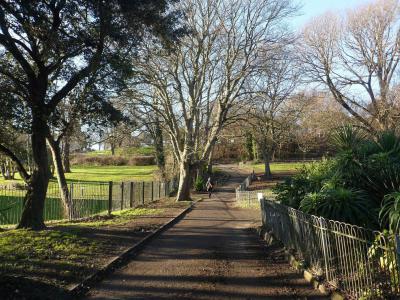
Queen's Park in Brighton is a historic public park with a rich history dating back to 1825. Originally acquired by Thomas Attree, a property developer inspired by Regent's Park in London, the park was intended to be a residential area surrounded by detached villas. Attree hired architect Charles Galloway to design the layout and named the park after Queen Adelaide, the consort of William IV. Queen Adelaide patronized the German Spa at the park's south end, which operated until 1886 and later became a mineral water plant until 1960. Today, the site houses the Royal Spa Nursery School.
Attree's grand residential vision for Queen's Park never fully materialized, and the surrounding housing now consists mostly of late Victorian architecture with some 20th-century additions. Notable features include Pennant Lodge, the former home of Charles Freshfield, and the Pepper Pot, a distinctive structure initially believed to be a wind-powered water pump. The Pepper Pot has served various purposes over the years, including as an artist's studio and public convenience, but it has been sealed and unused in the 21st century.
Today, Queen's Park is a cherished green space featuring a large pond, which has its bit of local lore. A popular myth suggests the pond was created by a First World War plane crash, though this is untrue. The myth likely stems from a real incident in 1923 when a biplane piloted by retired Air Marshall Phillip Austin crash-landed in the pond without causing any damage.
The park is well-equipped with amenities for the community, including a children's play area, a café, tennis courts, a former bowling green, and a scented garden designed for people with disabilities. There is also a large dog-free area and a section left untended to promote wildlife. The park's bowling green, once used by Kemp Town Bowling Club, was also a filming location for the 1987 movie "Wish You Were Here" starring Emily Lloyd.
Attree's grand residential vision for Queen's Park never fully materialized, and the surrounding housing now consists mostly of late Victorian architecture with some 20th-century additions. Notable features include Pennant Lodge, the former home of Charles Freshfield, and the Pepper Pot, a distinctive structure initially believed to be a wind-powered water pump. The Pepper Pot has served various purposes over the years, including as an artist's studio and public convenience, but it has been sealed and unused in the 21st century.
Today, Queen's Park is a cherished green space featuring a large pond, which has its bit of local lore. A popular myth suggests the pond was created by a First World War plane crash, though this is untrue. The myth likely stems from a real incident in 1923 when a biplane piloted by retired Air Marshall Phillip Austin crash-landed in the pond without causing any damage.
The park is well-equipped with amenities for the community, including a children's play area, a café, tennis courts, a former bowling green, and a scented garden designed for people with disabilities. There is also a large dog-free area and a section left untended to promote wildlife. The park's bowling green, once used by Kemp Town Bowling Club, was also a filming location for the 1987 movie "Wish You Were Here" starring Emily Lloyd.
Want to visit this sight? Check out these Self-Guided Walking Tours in Brighton. Alternatively, you can download the mobile app "GPSmyCity: Walks in 1K+ Cities" from Apple App Store or Google Play Store. The app turns your mobile device to a personal tour guide and it works offline, so no data plan is needed when traveling abroad.
Download The GPSmyCity App



Queen’s Park on Map
Sight Name: Queen’s Park
Sight Location: Brighton, England (See walking tours in Brighton)
Sight Type: Attraction/Landmark
Sight Location: Brighton, England (See walking tours in Brighton)
Sight Type: Attraction/Landmark
Nearby Sights

Walking Tours in Brighton, England

Create Your Own Walk in Brighton
Creating your own self-guided walk in Brighton is easy and fun. Choose the city attractions that you want to see and a walk route map will be created just for you. You can even set your hotel as the start point of the walk.
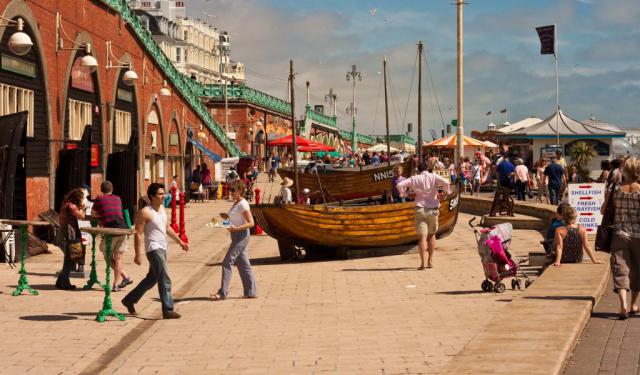
Brighton Seafront Walking Tour
No trip to Brighton is complete without a stroll along the seaside. Here you will know right away that you’re in an English seaside resort, catching the scent of fish and chips and watching deckchairs fluttering in the breeze. Stretching along the pebbly coastline for nearly 5 miles, Brighton's promenade has that Victorian glamour with a dash of youthful energy and style, buzzing with life... view more
Tour Duration: 2 Hour(s)
Travel Distance: 2.0 Km or 1.2 Miles
Tour Duration: 2 Hour(s)
Travel Distance: 2.0 Km or 1.2 Miles
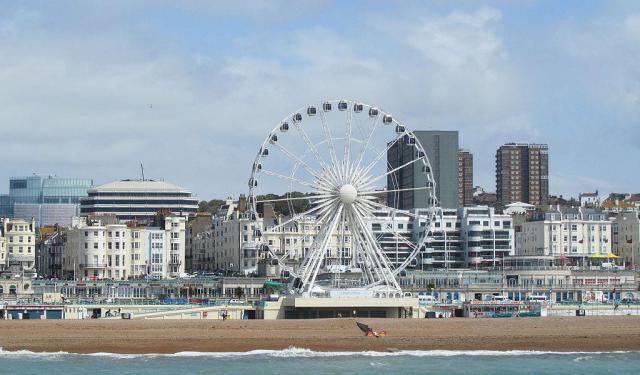
A Stroll Through Brighton's Charming Downtown
The town of Bristelmestune is first mentioned in William the Conqueror's Domesday Book of 1085. In 1810 it officially became Brighton. The area of Brighton has known settlements since the Bronze Age. It experienced Celts, Saxons, Romans. But the train stopped with the arrival of the Normans in 1066.
When Conquering William took the helm, Bristelmestune was a fishing village of 400 souls.... view more
Tour Duration: 1 Hour(s)
Travel Distance: 2.2 Km or 1.4 Miles
When Conquering William took the helm, Bristelmestune was a fishing village of 400 souls.... view more
Tour Duration: 1 Hour(s)
Travel Distance: 2.2 Km or 1.4 Miles