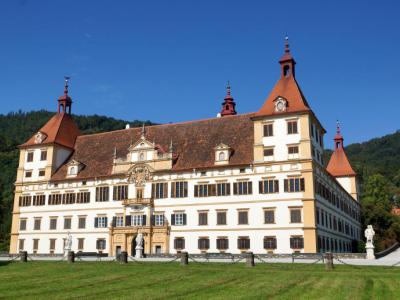


Schloss Eggenberg (Eggenberg Castle), Graz (must see)
In 1625, Prince Hans Ulrich von Eggenberg wanted to build a house that would mean everything to him. In the chaotic age that he lived in he felt the desire to have a home that would be the whole universe. He built Eggenberg Castle. On the edge of Graz is a beautiful park. The Eggenberg Castle sits there, reflecting the cosmos.
The castle has 365 windows, 31 rooms on each floor, 24 state rooms having 52 doors and four corner towers. The building reflects all aspects of time: the seasons, weeks, days, hours, minutes all based on the Gregorian calendar.
The paintings of the Planet Hall (1678) have astronomical symbols. On the ceiling, painter Hans Adam Weisenkircher assigned celestial bodies to days, gods, metals and Eggenbergers themselves. There is a triumphant general and an imperial envoy. The twelve signs of the Zodiac adorn the walls.
Hans Ulrich brought elements of the ancient Eggenberger Castle into his new palace. All diagonals drawn through the building intersect at the old Gothic chapel. In the 18th century the Castle theatre was converted into a baroque church.
Peacocks in full display stalk about the grounds. There is a Planet Garden in the park which continues the cosmos motif.
The Eggenberg Castle is run by the Joanneum, the Provincial Museum of Styria. Important collections include the Lapidarium with the largest collection of Roman stones in Austria. There are also the departments of early history, the coin collection and the art gallery with art from the Romanesque and late Baroque periods.
In 1717 Johann Christian II von Eggenberg died of appendicitis. He was 13. His father and grandfather had died before him. With Johann's death The Eggenberger dynasty came to an end. Only the castle remains to carry on the Eggenberg name.
The castle has 365 windows, 31 rooms on each floor, 24 state rooms having 52 doors and four corner towers. The building reflects all aspects of time: the seasons, weeks, days, hours, minutes all based on the Gregorian calendar.
The paintings of the Planet Hall (1678) have astronomical symbols. On the ceiling, painter Hans Adam Weisenkircher assigned celestial bodies to days, gods, metals and Eggenbergers themselves. There is a triumphant general and an imperial envoy. The twelve signs of the Zodiac adorn the walls.
Hans Ulrich brought elements of the ancient Eggenberger Castle into his new palace. All diagonals drawn through the building intersect at the old Gothic chapel. In the 18th century the Castle theatre was converted into a baroque church.
Peacocks in full display stalk about the grounds. There is a Planet Garden in the park which continues the cosmos motif.
The Eggenberg Castle is run by the Joanneum, the Provincial Museum of Styria. Important collections include the Lapidarium with the largest collection of Roman stones in Austria. There are also the departments of early history, the coin collection and the art gallery with art from the Romanesque and late Baroque periods.
In 1717 Johann Christian II von Eggenberg died of appendicitis. He was 13. His father and grandfather had died before him. With Johann's death The Eggenberger dynasty came to an end. Only the castle remains to carry on the Eggenberg name.
Want to visit this sight? Check out these Self-Guided Walking Tours in Graz. Alternatively, you can download the mobile app "GPSmyCity: Walks in 1K+ Cities" from Apple App Store or Google Play Store. The app turns your mobile device to a personal tour guide and it works offline, so no data plan is needed when traveling abroad.
Download The GPSmyCity App



Schloss Eggenberg (Eggenberg Castle) on Map
Sight Name: Schloss Eggenberg (Eggenberg Castle)
Sight Location: Graz, Austria (See walking tours in Graz)
Sight Type: Attraction/Landmark
Sight Location: Graz, Austria (See walking tours in Graz)
Sight Type: Attraction/Landmark
Nearby Sights

Walking Tours in Graz, Austria

Create Your Own Walk in Graz
Creating your own self-guided walk in Graz is easy and fun. Choose the city attractions that you want to see and a walk route map will be created just for you. You can even set your hotel as the start point of the walk.
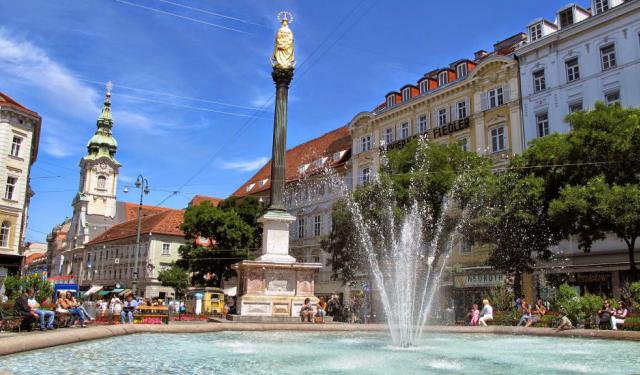
Graz Old Town Walking Tour
Before humanity understood how planets move, the renowned astronomer Johannes Kepler was studying the skies from Graz between 1594 and 1600. During his time here, he developed ideas that would eventually lead to his revolutionary laws of planetary motion.
Graz, the capital of the Austrian state of Styria, has a history stretching back more than a thousand years. Its name derives from the Slavic... view more
Tour Duration: 2 Hours
Travel Distance: 3 Km or 1.9 Miles
Graz, the capital of the Austrian state of Styria, has a history stretching back more than a thousand years. Its name derives from the Slavic... view more
Tour Duration: 2 Hours
Travel Distance: 3 Km or 1.9 Miles
City Walks Overview
