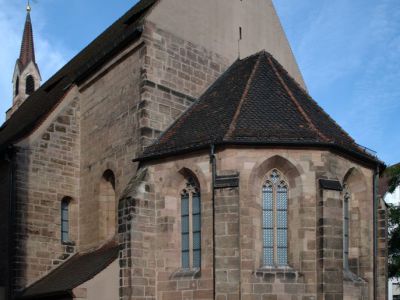


St. Clara's Church, Nuremberg
Saint Clara's Church in Nuremberg is a Roman Catholic church with a rich history spanning several centuries. The church, originally constructed in a Romanesque style, began its construction in 1270 and was consecrated in 1274. It initially served as the church of a monastery for the Order of Poor Clare.
In the 15th century, the church underwent significant expansions, adopting a more Gothic appearance. This transformation was followed by a period of religious and administrative changes, beginning with the dissolution of the monastery in 1525 during the Reformation. Subsequently, the church was used as a Protestant preaching church from 1574.
The church experienced another transformation in 1854 when it was reconsecrated as a Catholic church, after having been desecrated following Nuremberg's integration into Bavaria in 1806. The building suffered extensive damage during World War II but was restored post-war to its former architectural state. Since 1996, Saint Clara's Church has functioned as an open church, offering a wide range of spiritual and cultural events, without a traditional parish structure.
Architecturally, the church predominantly displays Gothic features with remnants of its Romanesque origins, such as the arch of the main portal and certain arched windows. It lacks a traditional tower but features a small roof turret above the main portal. Notable on its exterior is a bronze sculpture of the biblical figure Job, created by Gerhard Marx in 1957.
Inside, Saint Clara's Church is noted for its simplistic and austere one-nave design. Artworks within the church include a large carved crucifixion group from around 1510 by Nuremberg sculptor Faith Wirsberger, various altars dating back to the early 16th century, and an organ from 1986. The church also houses a special chapel, named after the last abbess Caritas Pirkheimer, which was integrated during the 2006-2007 renovations as an entrance chapel.
Additionally, the church contains a Way of the Cross with 14 sculptural compositions created since 1929, displayed during the Easter penance period. Despite its age and the challenges it has faced, Saint Clara's Church continues to be a significant cultural and spiritual landmark in Nuremberg.
Want to visit this sight? Check out these Self-Guided Walking Tours in Nuremberg. Alternatively, you can download the mobile app "GPSmyCity: Walks in 1K+ Cities" from Apple App Store or Google Play Store. The app turns your mobile device to a personal tour guide and it works offline, so no data plan is needed when traveling abroad.
Download The GPSmyCity App



St. Clara's Church on Map
Sight Name: St. Clara's Church
Sight Location: Nuremberg, Germany (See walking tours in Nuremberg)
Sight Type: Religious
Sight Location: Nuremberg, Germany (See walking tours in Nuremberg)
Sight Type: Religious
Nearby Sights
Walking Tours in Nuremberg, Germany
Create Your Own Walk in Nuremberg
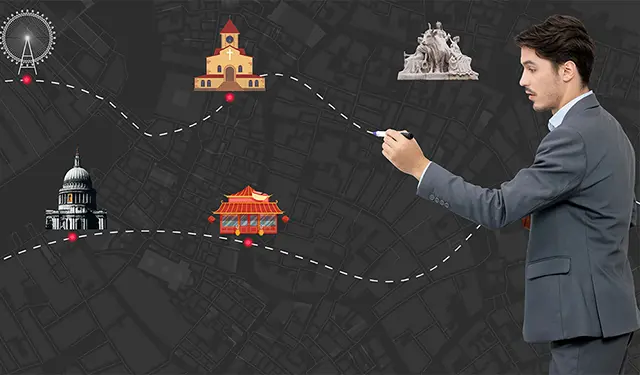
Creating your own self-guided walk in Nuremberg is easy and fun. Choose the city attractions that you want to see and a walk route map will be created just for you. You can even set your hotel as the start point of the walk.
Hitler's Nuremberg Tour
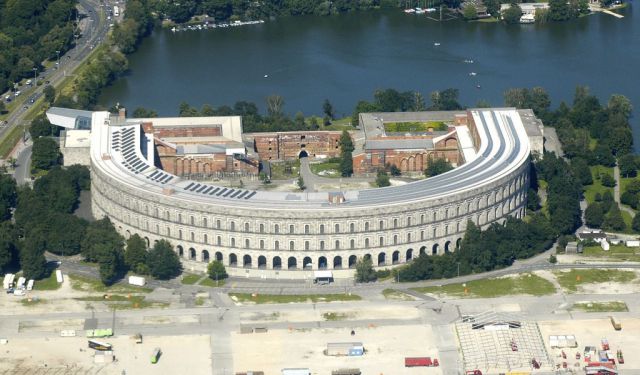
Nuremberg’s association with Adolf Hitler and National Socialism is one of the darkest chapters in the city’s history. Although Nuremberg is known for its medieval architecture and storybook appearance, few German cities are as closely intertwined with the Nazi legacy. Hitler referred to it as the “City of the Party Rallies” and regarded it as a model for the ideal German city.
The... view more
Tour Duration: 2 Hours
Travel Distance: 4.9 Km or 3 Miles
The... view more
Tour Duration: 2 Hours
Travel Distance: 4.9 Km or 3 Miles
A Walk Through Nuremberg's Historical Old Town
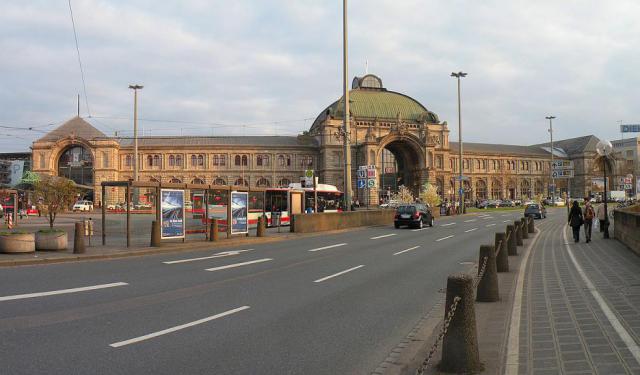
American poet Henry Wadsworth Longfellow described Nuremberg as a “quaint old town of toil and traffic, quaint old town of art and song.”
Nuremberg has witnessed some of the most significant events in German history. For many people, the city is first associated with the rise of the Third Reich, the Nazi Party rallies, and the postwar trials of Nazi leaders. Indeed, Hitler regarded... view more
Tour Duration: 3 Hours
Travel Distance: 3.8 Km or 2.4 Miles
City Walks Overview
